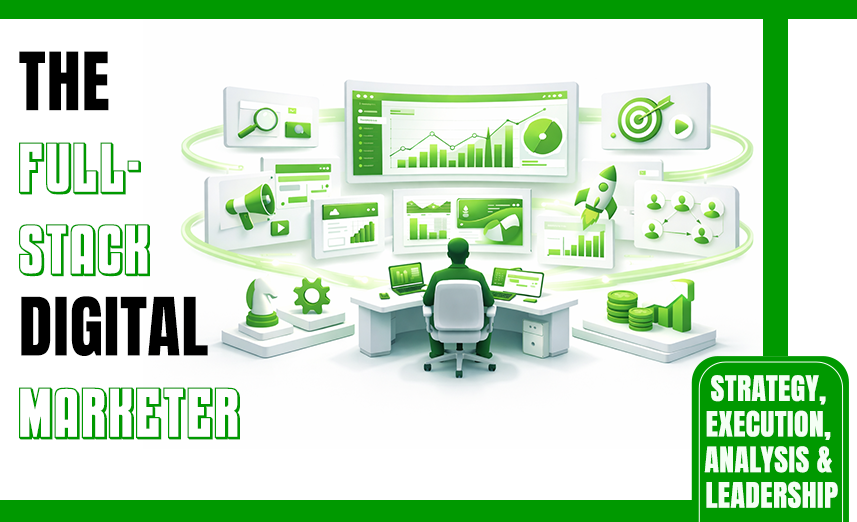
Digital marketing used to be simpler. You could be “the SEO person” or “the ads person,” hit your numbers, and call it a day. I realized the hard way that this is no longer effective. Channels bleed into each other, AI changes how people discover brands, attribution is messy, and nothing lives in isolation. The first time a campaign “won” in reports but failed to move the pipeline, I realized I wasn’t missing one tactic; I was missing the bigger picture. That’s where the Full-stack digital marketer mindset started for me.
It didn’t mean I suddenly had to do everything alone. It meant I forced myself to understand how strategy, creative, funnels, data, and operations connect. I focused on how each choice affected behavior: who we attracted, how they moved, and where they dropped, instead of chasing hacks. When I shifted from “campaigns” to “systems,” each test was no longer an independent experiment but rather an input to the next one.
Leverage is the reward. You begin to view marketing as a growth engine rather than as content creation. That engine has four core pillars: strategy, execution, analysis, and leadership, plus two multipliers: innovation and ongoing optimization. This blog breaks down how I think about each, how they work together, and how you can use this mindset to build marketing that’s actually predictable, rather than permanently “in testing.”
What “Full-Stack” Means in Digital Marketing
“Full-stack” refers to a person or a developer who understands both front-end and back-end. In marketing, I see it as understanding how positioning, channels, funnels, and data form one system. A full-stack marketer can translate business goals into plans, not just campaigns, and see how a landing page tweak might change paid CAC or email engagement three steps later. That perspective is the foundation of any serious Digital marketing strategy.
Here’s how I frame it in practice: a strong “stack” can scope strategy from goals, execute across channels, read the numbers for what they really say, and communicate that back in plain language. When you think this way, you stop asking “What should we post this week?” and start asking “What’s blocking revenue, and where does marketing have leverage?” That shift is the core of a Growth marketing system’s approach.
Comparison snapshot: partial vs. full-stack mindset
| Type of marketer | Focus | Blind spot | Result |
|---|---|---|---|
| Channel specialist | Single channel metrics | Funnel + economics | Good stats, weak business impact |
| Tool operator | Platforms & features | Strategy + story | Busy dashboards, unclear direction |
| Full-stack thinker | System from click to revenue | Needs time to go deep | Slower start, stronger long-term gains |
Callout Box — Quick Win: Map one winning customer journey end-to-end—from first touch to revenue. Notice how many “marketing” wins never show up in reporting, then fix the gaps.
Pillar 1: Strategy — The Ability to Choose the Right Game
Strategy is mostly saying “no” with context. I start with the business model before touching channels: Who are we targeting? What problem is painful enough to pay for? How does this actually make money? If those answers are unclear, no campaign will save it. Here’s where Digital marketing strategy becomes real: aligning the promise, pricing, positioning, and proof with what buyers already believe and want to solve.
Then I map a simple journey: awareness → consideration → conversion → retention. Email nurturing, landing page conversion, paid demand acceleration, and discovery may all be handled by SEO. Rather than attempting to “be everywhere,” I will sketch one or two main routes. Teams with a clear strategy become more creative and stop debating random ideas because they share a common lens through which to view them.
Finally, I set a north star metric and a few supporting KPIs. Maybe that’s qualified demo requests, free trials, or MQLs with a clear definition. Around that, I align on click-through rate, conversion rate, CAC, and LTV. Strategy becomes a scoreboard, not a slide deck. That’s where the Full-stack digital marketer mindset is different: the plan is only “good” if it connects inputs (spend, content, time) to measurable outcomes you’re willing to be judged on.
Pillar 2: Execution — Turning Ideas Into Consistent Output
The majority of successful plans quietly die during execution. I treat it not as inspiration but as production. A system’s outputs include creative, copy, advertisements, landing pages, email flows, and experiments. Results are chaotic when outputs are chaotic. I therefore create straightforward routines, such as content calendars, testing queues, monthly campaigns, and weekly priorities. In this way, marketing execution stops being based on “whoever shouts loudest this week” and instead becomes a machine.
On a practical level, I keep campaigns stupidly clear: one audience, one primary promise, one strong proof point, one obvious next step. Complexity feels smart, but usually kills performance because users can’t follow what’s being offered. I’d rather run a clean, “boring” funnel that converts than a clever one that confuses. This mindset also keeps teams aligned; it’s easier to critique a single clear idea than a bloated pile of features and angles.
I also design assets with conversion in mind from the start—offer-focused pages, proof near CTAs, frictionless forms, and clear “what happens next” explanations. When I combine that with a basic QA checklist (load speed, mobile scan, broken links, tracking), Marketing execution stops being a creative lottery and becomes reliable. That’s when people finally see how much of the Full-stack digital marketer mindset is operational discipline, not just smart ideas.
Warning Callout: If you can’t easily name the one action each asset is supposed to drive, your execution is probably working against you.
Pillar 3: Analysis — Learning Faster Than Everyone Else
Data doesn’t make decisions; questions do. I’ve seen teams starving for insight while drowning in dashboards. “What changed, why, and what are we doing next?” must be answered in every report, according to my rule. This is the point at which marketing analytics truly merits a place at the table. According to McKinsey, companies that use analytics well are 1.5 times more likely to report above-average growth.
I follow a simple chain when something doesn’t perform well: traffic quality, message match, page clarity, offer strength, and follow-up speed. This prevents chaotic adjustments and focuses on the actual problem. This way of thinking changes “our landing page sucks” into “traffic is fine, but the offer feels risky” or “ad targeting is off; the page is fine.” In my experience, once you frame the data around questions rather than charts, the majority of fixes become clear.
That’s one more layer of the Full-stack digital marketer mindset. I also treat tests like experiments, not decorations: a clear hypothesis, a success metric, a timeframe, and documented learnings. Wyzowl reports that 86% of marketers say AI has made them more efficient or saved them time. That speed is only useful if you’re running better experiments, not just more. Done right, Marketing analytics turns every campaign—win or loss—into an asset because the lesson compounds into future decisions.
Pillar 4: Leadership — Making Growth a Team Sport
You don’t need “Head of” in your title to lead. Leadership here is about improving outcomes through people and processes. I’ve seen great strategies die because sales weren’t aligned or founders kept changing priorities mid-flight. Real Digital marketing leadership starts with setting expectations: what we’re doing, why it matters, what success looks like, and what we’re not doing right now. Saying “no” with context is one of the most useful skills in marketing.
In updates, I speak the language of decision-makers: qualified leads, CAC, conversion rates, pipeline, revenue. No one in a boardroom cares that we shipped twelve posts; they care that we improved demo-to-close by three points. That mindset builds trust quickly. When leaders know you’ll bring them the uncomfortable truth with a plan attached, they give you room to execute. That’s also how Digital marketing leadership earns more budget instead of fighting for scraps.
Inside the team, I focus on feedback loops and small, consistent improvements—weekly retros, shared learnings, and a culture where experiments are expected, not punished. Adobe’s 2026 AI and Digital Trends Report notes that 76% of companies see faster content creation with AI. However, many still struggle with data and process alignment. Leadership is what turns those tools and numbers into an engine the whole team knows how to drive within a Full-stack digital marketer mindset.
Callout Box — Quick Win: Replace “activity reports” with a one-page outcomes summary: what changed, why, and what we’ll test next. Watch alignment improve.
Pillar 5: Innovation — Leading AI & Market Shifts
Digital moves fast enough that what worked 18 months ago can already feel stale. Instead of panicking, I treat innovation like portfolio management. I’ll keep most of my budget in proven plays and reserve a slice for bets—new formats, channels, and especially AI in digital marketing use cases. Recent research shows 88% of marketers use AI in their day-to-day roles. That means “ignoring it” isn’t really an option anymore.
For me, innovation is testing search changes, creative formats, automation, and new targeting options with intention. I’ll design small, contained experiments that either earn a place in the core plan or get shut down quickly. This is also where I lean heavily on tools that accelerate research, ideation, and production so that we can ship more thoughtful tests rather than rushed guesses. A healthy portion of innovation time goes into documenting what failed so we don’t repeat expensive lessons. That’s one more way the Full-stack digital marketer mindset compounds.
To keep chaos in check, I like a rough 70–20–10 model: 70% on proven motions, 20% on improving them, and 10% on frontier experiments. TechKV notes that 68% of companies saw improved content marketing ROI after using AI. That’s promising—but only if innovation is anchored to strategy, not shiny-object syndrome. In my experience, AI in digital marketing is most valuable when it’s plugged into a real system instead of used as a shortcut.
Pillar 6: Optimization — Compounding Growth Gains
Most teams chase big, dramatic wins. I’ve had better luck stacking small ones. I treat every step of the funnel as improvable—ad relevance, audience targeting, offer clarity, page structure, form friction, and follow-up timing. That’s how Marketing optimization becomes a habit instead of a quarterly project. Even a few percentage points of lift at multiple stages can transform ROI when they stack across the whole journey.
I prioritize where to look using simple filters: high-traffic pages with weak conversion, campaigns with strong engagement but poor sales, or channels with great LTV but undersized budgets. When I combine that with behavioral tools like heatmaps and session recordings, patterns emerge quickly. Around 44% of B2C marketers rely on big data and analytics to respond more effectively to customers. That’s the mindset behind focused CRO and funnel optimization work.
Finally, I document wins and losses—test logs, key learnings, and before/after benchmarks—so the organization remembers what we’ve already paid to discover. Gitnux reports that 72% of digital marketing agencies had integrated AI tools by late 2023, mostly for segmentation and efficiency). Tools accelerate experiments; systems preserve the compounding benefit. That’s the heart of Marketing optimization in a world where CRO and funnel optimization can’t just be one-off projects.
Callout Box — Fun Fact: If you consistently log experiments, you’ll often find “new” ideas your team wants to try are already proven—saving time and budget.
The Full-Stack Digital Marketer Skill Stack
If you’re building this mindset, the skills need to stack in a way that supports outcomes, not ego. I bucket them into six pillars. For strategy, it’s positioning, differentiation, audience research, funnel planning, and choosing channels based on unit economics. That’s where your ability to design a solid Digital marketing strategy determines whether any later efforts can actually fix revenue problems or just decorate them.
Execution skills include copywriting, creative direction, landing page UX, SEO fundamentals and strategies, paid ad structures, and lifecycle flows. Together, these let you turn ideas into shippable campaigns without reinventing the wheel every time. Analysis and leadership add tracking hygiene, attribution understanding, conversion-rate diagnosis, stakeholder alignment, prioritization, and process building. That’s how Growth marketing systems become sustainable rather than dependent on a single “hero” marketer.
Innovation and optimization skills wrap around everything: AI-assisted workflows, platform evaluation, competitive intelligence, experimentation systems, and offer iteration. You don’t need to master every skill at once. But you do need to understand how they connect so you can see where a system is weak. That’s the practical side of the Full-stack digital marketer mindset—not “know everything,” but “see everything clearly enough to make smart, grounded decisions.”
Callout Box — Quick Win: Audit your skills against the six pillars. Pick one weak area that directly touches revenue and improve that first—depth beats scattered learning.
Wrapping it Up
The Full-stack digital marketer mindset is what separates busy teams from growth teams. When strategy, execution, analysis, leadership, innovation, and optimization run as one system, you stop chasing hacks and start making deliberate moves. Campaigns build on each other instead of resetting every quarter, and even so-called failures become useful because they sharpen the next test, the next offer, the next bet. That’s when marketing stops feeling like guesswork and starts behaving like a repeatable, teachable growth engine, and leadership finally understands why it’s working and is willing to invest more.
Build the Mindset. Install the Growth Engine.
Ready to turn that mindset into an actual growth system, not more scattered campaigns? Partner with Ashwani Kumar Sharma and eSign Web Services to design, execute, and measure marketing that compounds, and finally feels aligned with your brand, numbers, and goals.
Frequently Asked Questions (FAQs)
Question: What is a full-stack digital marketer?
Answer: A full-stack digital marketer understands how the entire growth engine works, from positioning and channels to funnels, tracking, and iteration. They don’t just “run campaigns”; they connect activity to outcomes. That means turning business goals into coherent plans, coordinating with other teams, and using data to decide what to do next. The value isn’t in knowing every tool; it’s in seeing how every moving part affects revenue and acting on that insight.
Question: Is full-stack marketing the same as doing everything alone?
Answer: No. Being “full-stack” doesn’t mean you become a one-person agency. It means you understand the system well enough to make good decisions, guide specialists, and spot weak links. You might not design every ad or build every page, but you know what “good” looks like and how each piece supports the bigger goal. That’s what prevents blind spots, duplicated effort, and campaigns that look busy but don’t move the business.
Question: What’s the biggest benefit of a full-stack mindset?
Answer: The biggest benefit is control. When you see how strategy, execution, and measurement connect, you stop relying on luck or “growth hacks.” You can diagnose why something is working, or failing, and choose a next step with confidence. Over time, this creates compounding growth because each campaign teaches you something that sharpens the next one. Instead of chasing trends, you’re building a repeatable, teachable system.
Question: Do I need to know coding to be a full-stack marketer?
Answer: You don’t need to be a full developer, but some technical awareness helps a lot. Understanding tracking setup, pixels, basic page performance, and how data flows through your stack lets you ask better questions and catch issues early. You should be comfortable reading simple documentation and collaborating with dev or ops. The real requirement is curiosity and problem-solving, not writing production-level code.
Question: How do I become a full-stack digital marketer?
Answer: Build it in layers. Start with fundamentals: clear offers, messaging that resonates, and basic funnel logic. Then add channels like search, paid, and email while learning to measure what actually matters. Apply everything to real projects, not just courses. Keep a simple loop: test, measure, document, improve. Over time, patterns show up, and your confidence grows. The goal isn’t to know everything; it’s to think in connected systems.
Question: Which skills should I learn first?
Answer: Start with understanding customers and offers. If you can’t explain who you’re helping and why they should care, no channel can fix that. Next, learn how to structure landing pages and simple funnels so interest can turn into action. Then add measurement basics; analytics, events, and simple dashboards, so decisions are grounded in reality. After that, channel skills become far more valuable and easier to prioritize.
Question: How does a full-stack marketer approach SEO and paid ads together?
Answer: They treat them as one system, not rivals. Paid can test messaging quickly and reveal what converts; SEO can turn those learnings into long-term visibility and trust. When both share the same positioning, offers, and funnel structure, results compound. Insights from queries, search behavior, and ad performance flow between channels, guiding which topics to prioritize and which angles consistently resonate.
Question: What tools are important for analysis?
Answer: My usual base stack is GA4, Tag Manager, and Search Console. Then I add platform reporting, a CRM for pipeline visibility, and sometimes a dashboard tool to pull everything together. Heatmaps and session recordings help decode on-page behavior. But tools don’t make decisions, you do. The real power lies in asking clear questions and checking whether the data actually answers them, instead of collecting metrics for their own sake.
Question: How do I explain marketing results to leadership?
Answer: Talk in outcomes, not activities. Instead of listing tasks, explain what improved, what underperformed, and what you learned. Tie everything back to metrics leadership cares about: qualified leads, pipeline, customer acquisition cost, and revenue. Then propose clear next steps with reasons. A good update makes decisions easier, approve this test, shift this budget, pause that channel, because the story connects spend, behavior, and business impact.
Question: Is full-stack marketing still relevant with AI and automation growing?
Answer: It’s more relevant than ever. AI can speed up research, drafting, and testing, but it doesn’t automatically make good decisions. Someone still has to set strategy, define quality, choose trade-offs, and protect brand trust. A full-stack mindset helps you use AI as leverage instead of a crutch, deploying it where it amplifies your judgment, not where it replaces it. The tech is powerful, but the operating system is still human.