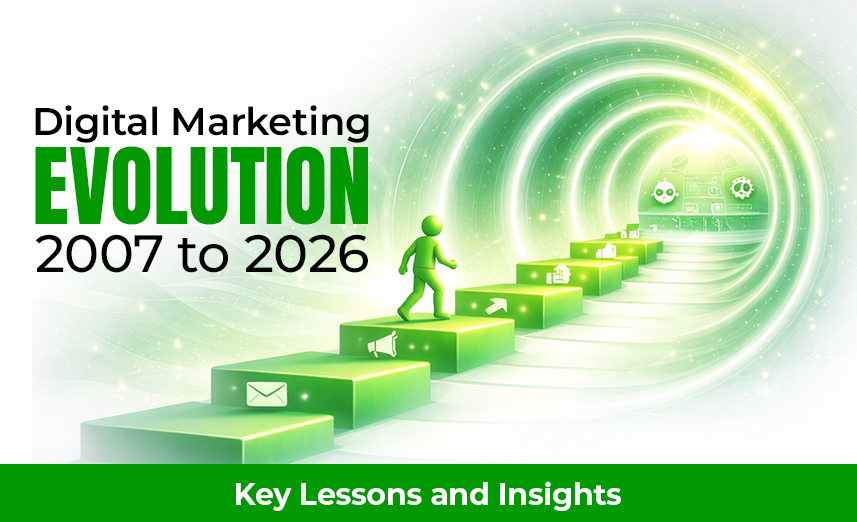
I started my journey in digital marketing in 2007, when the industry felt open, experimental, and, frankly, forgiving. Back then, simply having a website put you ahead of most businesses. Keyword ranking was more about repetition than relevance, and very few people seriously discussed user experience, intent, or trust. Looking back, that early phase of the digital marketing evolution was less about strategy and more about opportunity. It rewarded speed over thought and activity over outcomes. What I didn’t realize then, but understand clearly now, is that those early wins were fragile by design.
Over the years, I’ve watched platforms rise, dominate, and then quietly lose influence. I’ve seen businesses grow fast, panic faster, and rebuild from scratch multiple times because their foundations were weak. The biggest lesson I learned is that Digital marketing history isn’t just a timeline of tools and platforms; it’s a record of how user behavior keeps forcing marketers to mature. Every major shift, from search updates to social media to AI, has pushed the industry closer to accountability.
This blog isn’t written to impress. It’s written to be honest. These lessons didn’t come from theory or trend reports. They came from campaigns that failed, strategies that worked more slowly than expected, and long-term results that only showed up when patience replaced shortcuts.
2007–2011: The Beginner’s Era — Easy Wins, Weak Foundations
In the early days, digital marketing felt almost unfair in how easy it was to generate visibility. Most websites were static, content was thin, and competition was minimal. If you understood even the basics of SEO, you could outrank established businesses without offering anything particularly useful. Traffic became the primary success metric, and very few people asked what that traffic actually did. Looking back, this phase of the digital marketing evolution rewarded presence over purpose, creating a false sense of competence across the industry.
Loopholes dominated SEO during this time. Keyword stuffing, low-quality backlinks, and directory submissions worked because algorithms were primitive. Many sites ranked simply because they knew how to manipulate signals, not because they deserved attention. I saw countless businesses confuse rankings with relevance, which led them to neglect user experience entirely. This was the era where bad habits were formed; habits that would later become liabilities.
What made this phase dangerous wasn’t the simplicity; it was the lack of discipline it encouraged. When growth feels effortless, fundamentals feel optional. And when fundamentals are ignored, collapse becomes inevitable the moment the environment changes. That pattern has repeated itself in every era since.
What “Doing Digital Marketing” Looked Like Back Then
In those early years, most of us, including myself were still figuring out what digital marketing even meant. There were no playbooks, no best-practice frameworks, and very little pressure to think long term. Success was defined by visibility, not sustainability. The work felt experimental, sometimes exciting, and often misleading in hindsight. These were the patterns that dominated how marketing decisions were made during that phase.
- Build a basic website and treat it like an online brochure rather than a conversion tool.
- Focus heavily on keyword repetition because rankings felt like the ultimate goal.
- Chase backlinks wherever they were available, with little concern for relevance or quality.
- Measure success using traffic spikes instead of leads or business outcomes.
- Assume that what worked once would keep working indefinitely.
At the time, none of this felt reckless. It felt efficient. Results came quickly, and very few businesses questioned why they were getting traffic or what that traffic actually did. The real problem with this era wasn’t ignorance; it was false confidence. Those early wins created habits that would later become liabilities once the ecosystem matured and demanded more accountability.
2012–2015: When Quality Replaced Cleverness
This period marked a turning point for the industry. Algorithm updates began exposing weak foundations, and many sites that once dominated search results vanished almost overnight. Suddenly, tactics that had worked for years stopped delivering results. This was the moment when SEO and PPC evolution stopped being about manipulation and started demanding accountability. Search engines began rewarding usefulness, originality, and experience rather than shortcuts.
Content quality and usability became central to performance. Long-form content, clearer structure, and thoughtful design started outperforming shallow pages. This shift aligned directly with a noticeable User behavior shift; people were no longer satisfied with thin answers. They wanted clarity, depth, and relevance. Businesses that invested in genuine content and better UX didn’t just recover; they built resilience.
This was also when strategy replaced improvisation. Marketers started thinking in terms of buyer journeys, intent stages, and long-term value. Content calendars replaced random posting, and planning became non-negotiable. The lesson was clear: sustainable growth doesn’t come from exploiting systems; it comes from aligning with how people actually search, read, and decide.
I believe that if digital marketing only works when algorithms are generous, it isn’t a strategy; it’s a gamble. Long-term growth comes from building for users first.
2016–2019: Mobile, Social, and the Rise of Audience Control
By the time mobile traffic overtook desktop, it became impossible to ignore how dramatically behavior had changed. Websites that weren’t mobile-friendly lost credibility instantly. Page speed, layout, and usability became survival requirements, not optimization choices. This mobile marketing rise forced businesses to rethink design, content delivery, and performance from the ground up.
Social platforms also matured during this phase. What started as engagement channels evolved into discovery engines. Brands were no longer found only through search; they were judged through feeds, comments, and shares. This social media marketing growth reshaped how trust was built. Audiences formed opinions long before clicking a website, which meant consistency and authenticity mattered more than clever messaging.
Paid advertising followed the same trajectory. Targeting became more precise, but competition intensified. Spending money without a strategy stopped working. The brands that succeeded understood their audience deeply and respected attention as a finite resource. This phase reinforced a core truth: when users gain control, marketers must earn relevance.
2020–2023: Data, Automation, and Trust Took Center Stage
Privacy regulations and tracking changes forced a hard reset. Easy attribution disappeared, and marketers had to confront uncomfortable questions about how they measured success. First-party data became essential, and transparency turned into a competitive advantage. This shift accelerated data-driven marketing, but it also exposed how many strategies relied on shallow metrics.
Automation expanded rapidly during this period. Campaigns could scale faster than ever, but so could mistakes. I saw automation amplify weak strategies just as efficiently as strong ones. Tools didn’t replace thinking; they punished the absence of it. The real advantage came from understanding data, not just collecting it.
Most importantly, trust emerged as a measurable performance factor. Audiences became more skeptical and selective. Brands that communicated clearly, avoided exaggeration, and delivered consistent value outperformed louder competitors. This era cemented trust and authenticity as marketing requirements, not branding preferences. Attention could be bought, but belief had to be earned.
2024–2026: AI, Multimedia, and Human-First Marketing
AI has fundamentally changed visibility, but not principles. Search engines now summarize answers instead of sending clicks, forcing brands to focus on authority and clarity; this phase of the digital marketing evolution rewards structured, meaningful content rather than clever SEO tricks. The rise of AI marketing 2025 made one thing obvious: shallow strategies don’t disappear quietly; they get ignored.
Video and multimedia content now dominate engagement. Short-form video, interactive visuals, and concise storytelling outperform traditional formats in many industries. This shift reflects ongoing content marketing changes, where attention is earned through relevance and emotional connection, not volume.
What stands out most in this era is the return to human-first thinking. With so much content everywhere, the brands that win are those that educate, respect attention, and build relationships. Marketing today isn’t about catching eyes; it’s about earning trust repeatedly. That’s the direction everything is moving, regardless of platform.
How Digital Strategy Evolved (2007–2026)
| Era | What Most Businesses Did | What Actually Worked | Lesson I Kept |
|---|---|---|---|
| 2007–2011 | Keyword stuffing + cheap links | Basic presence + early adoption | Easy wins teach bad habits |
| 2012–2015 | Panic after updates | Quality content + cleaner UX | Value beats loopholes |
| 2016–2019 | Desktop-first thinking | Mobile speed + audience-first content | Users changed the rules |
| 2020–2023 | Over-reliance on tracking | First-party data + trust-led messaging | Trust became performance |
| 2024–2026 | Content volume explosion | Clarity + authority + structure | AI rewards credibility |
Lessons I Carry Forward
Seventeen years in this industry taught me lessons that haven’t expired, even as platforms, algorithms, and tools have changed repeatedly. I’ve watched tactics rise fast, deliver short-term results, and then quietly disappear once the environment matures. Every time that happened, the same businesses struggled; not because they lacked effort, but because they relied on methods that couldn’t compound. Sustainable growth always came from understanding people first, not from chasing systems. That realization didn’t come early for me; it came after seeing the same mistakes repeat across different eras.
What became obvious over time is that user behavior is the only stable signal in marketing. Algorithms change because people change. Platforms evolve because habits evolve. When strategies are built around how users actually search, scroll, compare, and decide, they survive disruption. When strategies are built around exploiting temporary gaps, they don’t. I’ve seen tools come and go, but the principles behind good communication, clarity, and usefulness have stayed remarkably consistent.
The lessons guiding me today are hard-earned.
- Short-term tactics never compound.
- User behavior always dictates outcomes.
- Tools evolve faster than principles.
- Trust outperforms tactics in saturated markets.
These truths have held up through every algorithm update, platform shift, and trend cycle I’ve lived through. They’re not exciting, but they’re reliable—and reliability is what builds long-term growth.
Designing for the Future, Not the Next Trend
When I think about the future of marketing, I don’t think in terms of platforms or features. I think in terms of systems. The businesses that continue to grow aren’t reacting to every new update or tool; they’re building foundations that can absorb change without breaking. Over time, I’ve learned that clarity beats novelty. When your message is clear, your positioning is honest, and your value is well-articulated, you don’t need to reinvent yourself every year.
The temptation to chase trends is understandable. New formats promise reach, new tools promise efficiency, and new tactics promise speed. But speed without direction usually leads to rework. I’ve seen companies exhaust themselves jumping from one strategy to another, never allowing anything to mature. The brands that outperform them take a slower, more deliberate approach. They focus on understanding their audience deeply, structuring content thoughtfully, and refining execution patiently.
Designing for the future means asking better questions:
- Will this still make sense when the platform changes?
- Does this help users, or just visibility?
- Can this scale without losing trust?
When those questions guide strategy, growth becomes steadier. The goal isn’t to predict the next trend. It’s to remain relevant when trends fade, and that requires discipline more than creativity.
A Final Reality Check for Businesses
One of the hardest lessons I’ve learned is that digital marketing rarely fails because of technology. It fails because of expectations. Businesses often enter this space hoping for speed, shortcuts, and immediate returns, especially when they see others posting success stories. But most of those stories leave out the context, the testing, and the time it took to get there. When results don’t arrive instantly, frustration sets in, strategies get abandoned, and momentum is lost.
The businesses that succeed approach marketing differently. They understand that momentum is built, not triggered. They invest in learning their audience, refining their message, and improving execution incrementally. Progress may feel slow at first, but it compounds in ways that quick wins never do. Over time, small improvements stack, trust builds, and performance stabilizes.
What consistently separates lasting growth from short-lived success isn’t access to better tools; it’s patience paired with smart execution. Every major phase of my journey reinforced that truth. When expectations are realistic, and strategies are allowed to mature, marketing becomes predictable rather than stressful.
That’s the most consistent lesson from my journey through the digital marketing evolution, and it’s the one that still guides every strategy I build today.
Wrapping It Up: What 18 Years Ultimately Taught Me
Seventeen years in digital marketing have made one thing very clear to me: the industry doesn’t reward speed, noise, or cleverness for long. It rewards clarity, consistency, and respect for the people on the other side of the screen. Every phase I’ve lived through, from the early SEO loopholes to AI-driven search, reinforced the same lesson in different ways. When strategies were built around real user needs, they adapted. When they were built around shortcuts, they collapsed.
Digital marketing evolution will never cease. Platforms will evolve, algorithms will get smarter, and new tools will promise faster results. That’s inevitable. What isn’t inevitable is confusion. Businesses that stay grounded in fundamentals, understand how users actually behave, and allow strategies to mature don’t panic with every update. They adjust, refine, and keep moving forward.
Looking back, the biggest advantage wasn’t knowing the next trend early. It was knowing what not to chase. That perspective only comes with time, mistakes, and the discipline to learn from both. And it’s the perspective I continue to rely on as the industry moves into its next chapter.
After seventeen years, the lesson hasn’t changed: build for people first, and everything else eventually falls into place.
If this people-first approach to digital marketing resonates with you and you’re looking for sustainable growth—not shortcuts—I’m open to a conversation about how this philosophy can be applied to your business. Book a Strategy Call Now!
Frequently Asked Questions
Question: Why does history matter in digital marketing?
Answer: Understanding past phases; such as keyword SEO, mobile shifts, and automation; helps marketers avoid repeating mistakes. History reveals what strategies worked, what failed, and why, offering key insights into long-term trends. By learning from these past lessons, digital marketers can develop effective strategies that are not just based on nostalgia, but on proven success, ensuring that their approach is both relevant and sustainable in an ever-evolving digital landscape.
Question: Can old tactics still work in 2026?
Answer: Old tactics like keyword stuffing and irrelevant link building are largely ineffective in 2026. Today, successful marketing revolves around value-driven content, clear UX, and trust-building strategies. Modern users demand more relevant and engaging experiences. Marketers must adapt to user behaviors and align their tactics with the evolving digital landscape to stay relevant. Emphasizing genuine content that connects with audiences works far better than outdated, manipulative SEO techniques.
Question: Is social media influencing search relevance?
Answer: Yes, social media is increasingly influencing search relevance. Social signals such as engagement, shares, and brand reputation play a significant role in how content ranks on search engines. As search engines evolve, the integration of social media data within user journeys shapes visibility and ranking. Marketers must align social media strategies with search strategies to ensure consistent brand messaging and maximize visibility across both platforms, creating a cohesive user experience that boosts overall digital performance.
Question: Does automation make marketing easier or riskier?
Answer: Automation makes marketing more efficient but also presents risks. It helps scale successful strategies and reduces manual effort, allowing marketers to focus on big-picture tasks. However, without a clear strategy, automation can amplify poor decisions, wasting budget and resources quickly. Marketers must ensure their automated processes are aligned with a strong, well-thought-out plan to avoid missteps. Automation should support a clear strategy, not replace the need for careful, deliberate decision-making at every stage of the campaign.
Question: How important is mobile-friendly design today?
Answer: Mobile-friendly design is absolutely essential in 2026. With most internet users accessing websites via smartphones, having a mobile-optimized site is crucial for both visibility and user experience. Websites that are not mobile-friendly risk losing traffic, credibility, and ultimately conversions. Google also factors mobile optimization into rankings, making it even more important for SEO. Marketers need to ensure their sites load quickly, are easy to navigate on mobile, and provide a seamless, intuitive experience for users.
Question: Is content still king with AI-driven search?
Answer: Content remains king, but it’s no longer just about quantity. With AI-driven search, what matters most is the quality, structure, and depth of the content. AI prioritizes authoritative, useful content over keyword stuffing or high volume. Clear, well-organized content that answers user intent is rewarded, while shallow, poorly structured content gets penalized. Marketers must focus on creating in-depth content that provides value and builds credibility, aligning with AI’s emphasis on meaningful user experiences.
Question: Should brands shift budget from ads to content now?
Answer: It’s important for brands to strike a balance between advertising and content. Content that builds authority and user trust can yield long-term benefits, while ads often provide short-term visibility. Shifting entirely from ads to content may not be ideal for all brands, as ads can be effective for immediate traffic. However, investing in content that establishes thought leadership, nurtures relationships, and resonates with audiences will lead to stronger, sustainable engagement over time.
Question: Does video outperform text content in 2026?
Answer: In 2026, video often outperforms text, especially on mobile devices. Video is highly engaging and can convey information quickly and dynamically, which resonates well with modern audiences who prefer digesting content visually. However, the success of video depends on its relevance, quality, and integration with an overall content strategy. For some brands, well-crafted text content may still be more effective, but for others, video is a crucial tool in maintaining engagement and driving conversions.
Question: How do privacy and data rules affect marketing?
Answer: Privacy and data regulations are pushing marketers to rely more on first-party data and prioritize transparency. With increasing scrutiny on data collection, consumers now expect more control over their personal information. Marketers must adapt by focusing on ethical data practices, clear consent processes, and offering genuine value. The use of dark tactics, like tracking without consent, can harm trust and lead to poor performance. Marketers who are transparent and respect privacy will build stronger relationships with their audience.
Question: What kind of marketing mindset works today?
Answer: Today’s successful marketing mindset is focused on value, adaptability, and honesty. Rather than relying on quick hacks or shortcuts, marketers should prioritize building authentic relationships with their audience. Successful campaigns treat customers as partners, not just targets for conversion. This mindset helps marketers stay resilient through algorithm changes and shifting user behaviors. Trust, relevance, and long-term engagement are at the core of modern marketing strategies, ensuring sustainable success regardless of trends or technological shifts.