Most marketing professionals today chase the latest skill or certification. They master Google Ads one month, dive into TikTok marketing the next, and wonder why their career feels scattered. The problem isn’t their ambition—it’s their approach. They focus on individual skills instead of understanding how marketing systems work together.
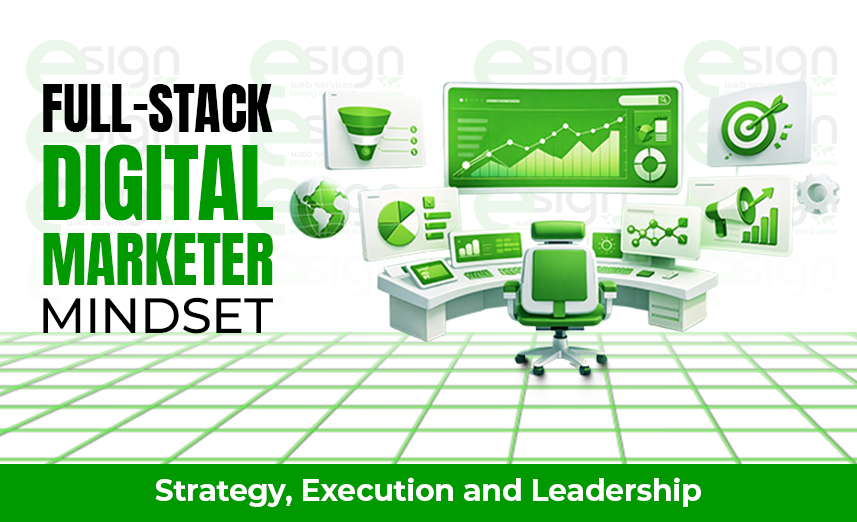
The term “full-stack” originally came from software development, describing developers who could work across different layers of technology. But in 2026, being a full-stack digital marketer means something deeper: strategic integration. It’s about seeing the connections between every marketing channel, understanding how each decision impacts the entire business, and orchestrating campaigns that work as one unified system.
I’ve spent years building and leading marketing teams, and here’s what I’ve learned: A true full-stack marketer doesn’t just know how to run Facebook ads or write blog posts. They understand how every marketing lever impacts business growth. They see the big picture while managing the details.
“Being a full-stack marketer isn’t about doing everything — it’s about understanding how everything works together.”
This mindset shift changes everything. Instead of being a specialist who masters one channel, you become the conductor of an orchestra, making sure every instrument plays in harmony.
The Four Pillars of a Full-Stack Digital Marketer
Strategy — The Foundation
Strategy isn’t about fancy frameworks or complicated charts. It’s about understanding your market, your audience, and their intent before you launch a single campaign. Too many marketers jump straight into tactics—posting on social media, running ads, or optimizing websites—without laying the groundwork first.
When I work with businesses, I always start with three fundamental questions: Who are we trying to reach? What problem are we solving for them? Why should they choose us over everyone else? These questions form the foundation for everything that follows.
Crafting effective strategy involves several key elements:
Understanding Markets and Audiences
Before you write a single piece of content or design an ad, you need to know who you’re talking to. This goes beyond basic demographics. What keeps your audience awake at night? What are their daily challenges? Where do they go for information? What language do they use when describing their problems?
Positioning and Brand Narratives
Your positioning isn’t what you think about your business—it’s what your customers think. Every successful marketing campaign tells a story that resonates with the audience’s existing beliefs and desires. Your job is to craft that narrative in a way that makes choosing you feel obvious.
Funnel Design
A good strategist thinks about the entire customer journey. How do people first discover you? What convinces them to take the next step? What barriers might prevent them from buying? The strategy phase is where you map this journey and identify the key moments that matter most.
I rely on two key frameworks that have served me well:
Top-Down Clarity: Vision → Goals → Tactics
Start with the big picture and work your way down. What’s the long-term vision for this business? What specific goals will move us toward that vision? Which tactics will help us achieve those goals? This prevents you from getting lost in the day-to-day execution.
Customer-First Thinking: “Why should anyone care?”
Every marketing message, every campaign, every piece of content should answer this question. If you can’t clearly explain why someone should care about what you’re offering, neither can they.
Key Lesson: Without strategy, execution is noise.
I’ve seen countless marketing teams work incredibly hard on campaigns that ultimately fail because they skipped the strategy phase. They had perfect execution, beautiful creative, and flawless technical implementation. But they were solving the wrong problem or talking to the wrong audience.
Execution — The Engine
Strategy sets the direction, but execution is what turns ideas into results. This is where most marketing teams either excel or fall apart. Good execution requires discipline, coordination, and attention to detail across multiple channels simultaneously.
The challenge with modern digital marketing is integration. You’re not just running Google Ads or just doing SEO or just posting on social media. You’re orchestrating all of these channels to work together, and that requires a different approach than managing them separately.
Coordinated Marketing Actions
When I plan campaigns, I think about how each channel supports the others. The blog content reinforces the message in our ads. The social media posts drive traffic to our landing pages. The email sequences nurture the leads generated by our SEO efforts. Nothing exists in isolation.
Project Management and Systems
Great execution requires structure. At my agency, eSign Web Services, we’ve developed specific systems for managing complex campaigns:
- Structured execution timelines that account for dependencies between different channels
- Performance sprints where we focus intensively on specific goals for 2-4 week periods
- Quality assurance cycles that ensure nothing goes live without proper review
Standard Operating Procedures
The difference between good marketers and great ones often comes down to consistency. SOPs ensure that your best practices get followed even when you’re busy, stressed, or working with new team members. They turn individual expertise into team knowledge.
Accountability Systems
Everyone needs to know what they’re responsible for and when it needs to be delivered. This isn’t about micromanagement—it’s about clarity. When people understand their role in the bigger picture, they make better decisions and take more ownership of the results.
Key Lesson: Discipline converts ideas into results.
The most creative strategy in the world won’t help you if you can’t execute it consistently. I’ve learned that boring fundamentals—like project management and SOPs—are what separate successful campaigns from failed ones.
Analysis — The Compass
Data is everywhere in digital marketing. Google Analytics, Search Console, social media insights, ad platform reports, email metrics—the amount of information available can be overwhelming. But having data isn’t the same as having insight.
The real skill isn’t in collecting metrics—it’s in interpreting them to make better decisions. Most marketers I meet can tell you their click-through rate or their cost per click, but they struggle to explain what those numbers mean for their business strategy.
Using Analytics as Decision Tools
Every piece of data should inform a decision. If you’re tracking something that doesn’t influence what you do next, you’re wasting time. The key is setting up your analytics to answer specific business questions, not just to collect information.
For example, instead of just tracking website traffic, ask: “Which traffic sources bring visitors who are most likely to become customers?” Instead of just monitoring social media engagement, ask: “Which types of content drive the most qualified leads to our website?”
Data Interpretation vs. Data Observation
This is where most marketers get stuck. They can see that their email open rates dropped last month, but they can’t explain why or what to do about it. Observation tells you what happened. Interpretation tells you why it happened and what you should do next.
Good analysis requires context. A 50% increase in website traffic sounds great, but if none of those visitors convert into customers, it might not be helping your business. A decrease in social media followers might seem bad, but if your remaining followers are more engaged and more likely to buy, it could actually be positive.
Seeing Patterns and Predicting Performance
The most valuable analytical skill is pattern recognition. When you’ve been analyzing marketing data for years, you start to see trends before they become obvious. You notice that certain types of content perform better in specific seasons. You recognize early warning signs that a campaign is about to underperform.
This predictive ability comes from looking at data over longer time periods and considering external factors that might influence performance. It’s not just about what the numbers show—it’s about understanding the story behind the numbers.
Tools and Dashboards
I use a combination of tools depending on what questions I’m trying to answer:
- Google Analytics 4 for understanding user behavior and conversion paths
- Google Search Console for monitoring search performance and identifying opportunities
- Platform-specific analytics for deeper insights into channel performance
- Custom dashboards that combine data from multiple sources to show the complete picture
Key Lesson: Data is not insight — interpretation is.
The goal of analysis isn’t to collect as much data as possible. It’s to develop the ability to see patterns, predict future performance, and make decisions that improve results over time.
Leadership — The Multiplier
Leadership is the most important pillar, but it’s also the most overlooked. Most marketers focus on mastering individual skills—learning new tools, platforms, or techniques. But at some point, your success depends more on your ability to lead others than on your personal expertise.
I learned this the hard way while building my agency. In the early days, I tried to do everything myself. I was the strategist, the executor, and the analyst all rolled into one. But as we grew, I realized that my individual contributions had limits. The real growth came when I learned to multiply my impact through other people.
Managing Cross-Functional Teams
Modern marketing requires specialists: SEO experts, PPC managers, content writers, social media managers, web developers. Each of these roles requires deep, specific knowledge. But someone needs to make sure they’re all working toward the same goals.
This is where leadership becomes critical. Your job isn’t to be better than each specialist at their specific skill. Your job is to help them understand how their work fits into the bigger picture and to coordinate their efforts for maximum impact.
Building Culture and Training Systems
The best marketing teams don’t just have skilled individuals—they have shared ways of thinking and working. This comes from intentional culture-building and structured training programs.
At eSign, we’ve developed training systems that help specialists understand marketing strategy, not just their specific channel. Our PPC managers learn about SEO. Our content writers understand conversion optimization. Our SEO experts know how their work supports our advertising efforts.
Accountability and Mentorship
Good leaders create accountability without micromanagement. They set clear expectations, provide the resources and support people need to succeed, and then hold them responsible for results.
Mentorship is equally important. Your role as a leader is to help skilled individuals become strategic thinkers. Instead of just telling someone how to optimize an ad campaign, you teach them to think about why that optimization supports the overall business objectives.
“A leader’s job is to turn skill-based people into system-based thinkers.”
Creating Systems That Scale
Individual expertise doesn’t scale—systems do. As a leader, you need to identify the processes and frameworks that consistently produce good results, then document and teach them to others.
This includes everything from how you conduct campaign planning meetings to how you analyze and report on performance. When these systems are clear and repeatable, your team can maintain quality and consistency even as they grow.
Key Lesson: Leadership amplifies execution speed and quality.
The most successful marketing organizations aren’t necessarily the ones with the most talented individuals. They’re the ones with the best systems and the strongest leadership to coordinate those systems effectively.
The Full-Stack Marketer vs. the Specialist
Understanding the difference between full-stack marketers and specialists helps clarify when each approach is most valuable:
| Criteria | Full-Stack Marketer | Specialist |
| Vision | End-to-end growth impact | Channel-specific performance |
| Approach | Holistic & integrated | Deep and focused |
| Skill Use | Orchestrates multiple tools | Masters specific tools |
| Thinking | Strategic + Analytical | Tactical + Technical |
| Outcome | Business transformation | Channel optimization |
| Problem Solving | Cross-channel solutions | Platform-specific solutions |
| Team Role | Coordinator and strategist | Expert contributor |
Both approaches are valuable, and most successful marketing organizations need both types of people. Specialists provide the deep expertise required to excel in specific channels. Full-stack marketers ensure those channels work together effectively.
The key insight is this: as you advance in your marketing career, you need to develop full-stack thinking regardless of your role. Even if you specialize in one area, understanding how your work impacts the entire marketing system makes you more valuable and more effective.
If you’re leading a marketing team or running your own business, full-stack thinking becomes essential. You need to see the connections, understand the trade-offs, and make decisions that optimize for overall business growth rather than individual channel performance.
The Mindset Model: 4L Framework by Ashwani Kumar Sharma
After years of building marketing teams and working with businesses across different industries, I’ve developed a framework that captures how full-stack marketers think and operate. I call it the 4L Framework: Learn, Link, Lead, Leverage.
Learn — Stay Current and Curious
The digital marketing landscape changes constantly. New platforms emerge, algorithms update, consumer behaviors shift, and new tools become available. Full-stack marketers maintain a learning mindset that helps them adapt to these changes.
But learning effectively requires focus. Instead of trying to keep up with every new trend, successful marketers identify the changes that will have the biggest impact on their specific business or industry. They go deep on topics that matter and ignore the noise.
Practical Learning Strategies:
- Follow industry leaders who consistently provide valuable insights
- Test new features and tools on a small scale before rolling them out broadly
- Join communities where practitioners share real experiences and results
- Set aside specific time each week for learning and experimentation
Link — Connect Channels, Data, and Outcomes
This is where full-stack thinking really shows its value. Instead of viewing each marketing channel in isolation, you learn to see the connections and dependencies between them.
For example, your SEO strategy should inform your content marketing, which should support your social media efforts, which should reinforce your paid advertising messages. Your email marketing should nurture the leads generated by all of these channels. Your conversion rate optimization should improve the performance of traffic from every source.
Connection Points to Monitor:
- How different channels work together to move prospects through your funnel
- Which combinations of touchpoints are most likely to result in conversions
- How changes in one channel affect performance in others
- Where handoffs between channels create friction or opportunities
Lead — Build Teams, Set Direction, Create Systems
Leadership in marketing goes beyond managing people. It includes setting strategic direction, building systems that scale, and creating a culture of continuous improvement.
Even if you’re not formally managing a team, you can develop leadership skills by taking ownership of cross-channel coordination, mentoring other marketers, and advocating for strategic thinking over tactical execution.
Leadership Development Areas:
- Strategic thinking and business acumen
- Communication skills for presenting ideas and rallying support
- System design for processes that work across different channels and team members
- Conflict resolution for the inevitable disagreements about priorities and approaches
Leverage — Use Automation, AI, and Analytics to Scale
Technology should amplify human intelligence, not replace it. The best marketers identify repetitive tasks that can be automated, decisions that can be supported by data, and processes that can be improved through artificial intelligence.
But leverage isn’t just about technology. It also includes leveraging partnerships, outsourcing non-core activities, and creating content or systems that provide value long after the initial investment.
Areas for Leveraging Technology:
- Marketing automation for lead nurturing and customer onboarding
- AI tools for content creation, audience research, and performance optimization
- Analytics platforms for real-time decision making and performance monitoring
- Integration tools that connect different platforms and eliminate manual data transfer
This framework provides a mental model for continuous development as a full-stack marketer. Each element builds on the others, creating a compound effect that accelerates your growth and effectiveness over time.
How AI Enhances the Full-Stack Approach
Artificial intelligence has become one of the most powerful tools available to modern marketers. But like any tool, its value depends on how you use it. The key is understanding where AI can genuinely improve your results versus where human judgment remains irreplaceable.
AI’s Role in Research and Analysis
AI excels at processing large amounts of data to identify patterns that humans might miss. In marketing, this translates to better audience insights, competitive analysis, and performance optimization.
For example, AI can analyze thousands of customer interactions to identify the language patterns that resonate most with different audience segments. It can process competitor content to identify gaps in your market coverage. It can examine your campaign performance data to suggest optimizations that improve results.
Automation That Actually Helps
The best AI applications in marketing automate tasks that are time-consuming but don’t require creative thinking. This includes things like:
- A/B testing different ad variations to find the best performers
- Adjusting bid strategies based on performance data
- Personalizing email content based on subscriber behavior
- Scheduling social media posts for optimal engagement times
Personalization at Scale
One of AI’s biggest advantages is its ability to deliver personalized experiences to large audiences. Instead of creating one message for everyone, you can use AI to customize content, offers, and messaging based on individual user behavior and preferences.
This doesn’t mean every interaction needs to be completely unique. It means using AI to identify the most relevant segments and messages for different groups of people, then delivering the right message to the right person at the right time.
Predictive Analytics for Better Decisions
AI can analyze historical data to predict future trends and performance. This helps with budget allocation, campaign planning, and strategic decision-making.
For instance, AI might identify that certain types of campaigns perform better during specific seasons, or that particular audience segments are more likely to upgrade to premium services after specific interactions.
The Human Element Remains Critical
Despite all these capabilities, AI doesn’t replace strategic thinking. It provides better information and automates routine tasks, but humans still need to:
- Set overall strategy and objectives
- Interpret AI insights within business context
- Make creative decisions about messaging and positioning
- Build relationships and manage teams
- Adapt to unexpected situations and opportunities
Smart marketers use AI to enhance clarity and speed, not to automate judgment.
The goal is to use AI to handle the tasks it does well, freeing up your time and mental energy for the work that requires human creativity, empathy, and strategic thinking.
Practical Example: From Strategy to Scale
Let me share a real example of how the full-stack approach works in practice. Last year, I worked with a B2B software company that was struggling with inconsistent leads and unpredictable revenue growth. Their marketing efforts were fragmented—they had someone running Google Ads, another person managing their blog, and a third handling social media. Each channel was performing reasonably well in isolation, but they weren’t working together.
The Strategic Foundation
We started by revisiting their core strategy. Through customer interviews and data analysis, we discovered that their best customers typically researched solutions for 3-6 months before making a purchase decision. They valued detailed information and case studies over flashy marketing messages. Most importantly, they needed to see multiple touchpoints and build trust over time before they were willing to engage with sales.
This insight completely changed our approach. Instead of optimizing each channel for immediate conversions, we designed a system that would nurture prospects through a longer decision-making process.
Integrated Execution
We restructured their marketing around a single strategic theme: “Practical Solutions for Complex Problems.” Every piece of content, every ad campaign, and every social media post reinforced this positioning.
SEO Strategy: We created comprehensive guides and case studies that answered the detailed questions prospects had during their research phase. These pages were optimized for the specific terms their ideal customers used when searching for solutions.
Content Marketing: The blog became a tool for demonstrating expertise and building trust over time. Instead of generic industry news, we focused on practical advice and real customer success stories.
Paid Advertising: Our Google Ads and LinkedIn campaigns drove traffic to the most relevant content pieces rather than generic landing pages. We used retargeting to stay in front of prospects who had engaged with our content but weren’t ready to buy yet.
Email Marketing: We created nurture sequences that delivered additional value to people who downloaded our guides or attended our webinars. The emails continued the conversation rather than just pushing for sales meetings.
The Analysis and Optimization Loop
We set up tracking to understand how prospects moved between different channels and touchpoints. This revealed some interesting patterns:
- Prospects who engaged with both our SEO content and our paid ads were 3x more likely to request a demo than those who only saw one channel
- Case studies were far more effective at moving prospects toward a sales conversation than general educational content
- The optimal email nurture sequence was 7 messages over 6 weeks, not the 3 messages over 2 weeks they had been using
Results and Learnings
Over six months, the integrated approach produced dramatic improvements:
- Total qualified leads increased by 180%
- The average sales cycle decreased from 4 months to 2.5 months
- Customer acquisition cost dropped by 40% despite increased marketing investment
- Revenue became much more predictable as the pipeline filled with qualified prospects
The key insight was that no single channel was responsible for these results. The improvement came from alignment and integration. When every marketing activity reinforced the same strategic message and supported the same business objectives, the combined effect was much greater than the sum of the individual parts.
Scaling the System
Once we had proven the approach worked, we focused on scaling it:
- We created templates and processes that allowed them to produce more content consistently
- We expanded successful ad campaigns to new platforms and audiences
- We trained their sales team to have better conversations with the marketing-qualified leads
- We implemented marketing automation to handle routine nurturing tasks
This example illustrates why the full-stack approach is so powerful. It’s not about being an expert in every individual tactic—it’s about understanding how all the tactics work together to achieve business objectives.
Building Future-Ready Marketers and Teams
The marketing industry changes rapidly, but the principles of strategic thinking, systematic execution, data-driven optimization, and effective leadership remain constant. If you want to build a career or a team that thrives regardless of technological changes, focus on developing these fundamental capabilities.
Developing Strategic Depth
Too many marketers focus on collecting certifications instead of developing real strategic thinking skills. While certifications can be useful for learning specific platforms or techniques, they don’t teach you how to solve business problems or create integrated marketing systems.
Instead, focus on understanding business fundamentals:
- How do businesses actually make money, and how does marketing contribute to profitability?
- What are the key drivers of customer acquisition, retention, and growth in different industries?
- How do you identify and prioritize opportunities when you have limited resources?
- What frameworks help you make good decisions when you don’t have perfect information?
Cross-Channel Exposure and Training
If you’re currently a specialist in one area, actively seek opportunities to understand other channels. You don’t need to become an expert in everything, but you should understand how your specialty fits into the larger marketing ecosystem.
If you’re leading a team, create opportunities for specialists to learn from each other. Have your SEO expert explain their strategy to your paid advertising manager. Ask your content creator to sit in on campaign planning meetings. Encourage your social media manager to understand your email marketing approach.
Mentorship and Knowledge Sharing
The best way to develop strategic thinking is to learn from people who are already thinking strategically. Seek out mentors who can help you see the bigger picture and understand how successful marketing systems are designed and managed.
If you’re in a leadership position, make mentorship a priority. Your job isn’t just to get work done—it’s to develop the people on your team so they can eventually think and operate at a higher level.
Building Learning Systems
Create structured ways to capture and share knowledge across your team. This might include:
- Regular case study discussions where you analyze what worked and what didn’t in recent campaigns
- Cross-training sessions where team members teach each other about their areas of expertise
- External training programs that expose your team to new ideas and approaches
- Documentation systems that capture your best practices and make them available to everyone
My Experience at eSign Web Services
Building my agency taught me that the most successful marketing teams aren’t necessarily the ones with the most talented individuals—they’re the ones with the best systems for developing talent and coordinating efforts.
We invest heavily in training our team members to think strategically, not just tactically. Our SEO specialists understand business objectives, not just search rankings. Our content creators know how their work supports lead generation and sales, not just engagement metrics.
This investment takes time and resources, but it pays off in several ways:
- Our team members are more engaged because they understand how their work matters
- Our client results are better because everyone is working toward the same objectives
- Our capacity to take on new challenges grows because we have people who can think through problems, not just execute predetermined solutions
The future belongs to marketers and marketing teams that can adapt to change while maintaining focus on fundamental business objectives. Technical skills will continue to evolve, but the ability to think strategically, execute systematically, analyze effectively, and lead others will always be valuable.
Conclusion — The New Definition of a Marketer
The marketing profession has evolved far beyond what it was even five years ago. The days when you could succeed by mastering a single channel or platform are largely over. Today’s business environment requires marketers who can think across disciplines, integrate different approaches, and adapt quickly to changing conditions.
This doesn’t mean everyone needs to become a generalist. Specialists will always be important—the world needs people who can dive deep into the complexities of SEO, paid advertising, content creation, and conversion optimization. But even specialists need to understand how their work fits into larger business systems.
The future belongs to marketers who combine technical competence with strategic thinking. Who can execute campaigns flawlessly while also understanding why those campaigns matter to the business. Who can analyze data to extract insights, not just report on metrics. Who can lead teams and coordinate complex efforts across multiple channels and touchpoints.
Technology will continue to change at an accelerating pace. New platforms will emerge, algorithms will evolve, and consumer behaviors will shift. But the fundamental challenge will remain the same: understanding what your customers need, creating value for them, and building sustainable relationships that drive business growth.
The full-stack mindset provides a framework for navigating these changes successfully. When you understand how strategy, execution, analysis, and leadership work together, you can adapt to new tools and platforms without losing sight of your core objectives.
“In 2026, being a marketer means being a strategist, executor, analyst, and leader — all in one mindset.”
This integration of skills and perspectives isn’t just a nice-to-have—it’s becoming essential for anyone who wants to create meaningful impact in their organization or build a successful marketing career. The marketers who thrive in the coming years will be those who can see the connections, coordinate the complexity, and lead others toward shared objectives.
Whether you’re just starting your marketing career or leading a team of experienced professionals, the path forward is clear: develop the full-stack mindset, build systems that scale, and never stop learning. The future of marketing belongs to those who can think and operate across the entire spectrum of strategic and tactical capabilities.
Frequently Asked Questions
Q: What is a full-stack digital marketer?
A: A full-stack digital marketer is a strategist who understands how all marketing channels, data systems, customer touchpoints and execution layers work together to drive business growth. They do not handle every task personally. Instead, they integrate strategy, execution, analysis and leadership into one cohesive mindset to guide teams and ensure predictable outcomes.
Q: How is a full-stack marketer different from a specialist?
A: A specialist focuses deeply on one area such as SEO, Google Ads, social media or content writing. A full-stack marketer has the ability to connect all channels and assess how each one influences the overall growth plan. Specialists drive channel-specific performance, while full-stack marketers orchestrate direction, alignment and business-level impact.
Q: Why is strategy the most important component of full-stack marketing?
A: Strategy provides clarity on the audience, intent, positioning and goals. Without strategic direction, execution becomes scattered and expensive. A full-stack marketer uses strategy to ensure every task contributes to measurable outcomes rather than isolated activities.
Q: Do full-stack marketers need to master every tool or platform?
A: No. The value of a full-stack marketer is not based on doing everything alone. The value comes from understanding how each channel works, how the data connects and how to lead specialists effectively. Depth is important, but integration is what creates real advantage.
Q: Why is analysis so crucial in full-stack marketing?
A: Analysis converts raw data into actionable insights. Full-stack marketers look for patterns, identify the reasons behind performance changes, and adjust strategy accordingly. Accurate interpretation guides smarter decisions, better optimization and faster growth.
Q: How does leadership fit into the full-stack marketer role?
A: Leadership ensures that teams move in alignment with a common direction. A full-stack marketer builds structure, accountability, processes and clarity across departments. This leadership approach amplifies output and maintains high performance, even as the team grows.
Q: Can AI replace full-stack marketers?
A: AI can automate tasks, generate content, assist with research and streamline reporting. However, it cannot replace strategic thinking, human judgment or the ability to understand customer psychology. AI is a support system that enhances the work of a full-stack marketer but does not replace the role.
Q: What skills should someone develop to become a full-stack digital marketer?
A: Key skills include strategic thinking, customer understanding, cross-channel knowledge, data interpretation, project management, communication and leadership. Technical skills help, but systems thinking and decision-making define long-term success.
Q: Is the full-stack mindset suitable for beginners?
A: Yes, but it evolves over time. Beginners can start by mastering one or two channels while learning how other channels influence the customer journey. As experience grows, they can gradually build strategic, analytical and leadership capabilities.
Q: How can companies benefit from hiring or developing full-stack marketers?
A: Companies gain stronger strategy alignment, better decision quality, more efficient execution, improved cross-team collaboration and faster scalability. Full-stack marketers reduce wasted effort and ensure marketing investments lead to measurable business growth.