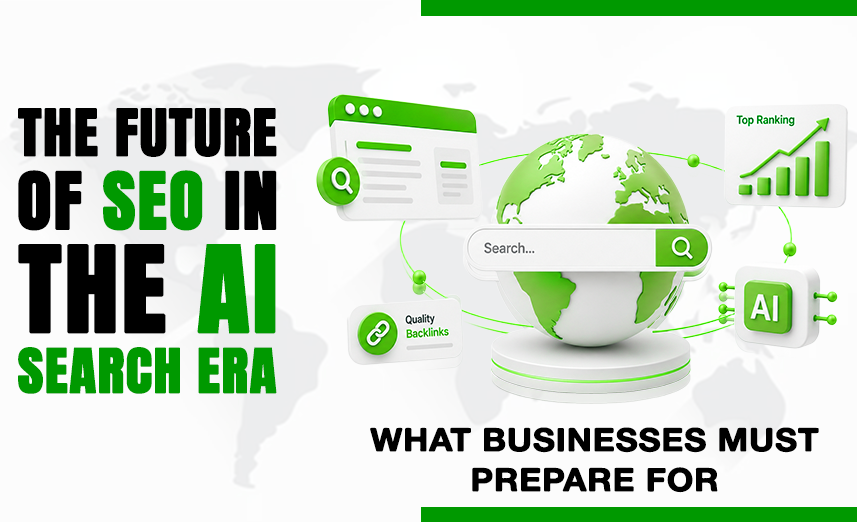
Search has always rewarded businesses that adapted earliest. But what is happening right now with AI-powered search is not just another algorithm update to wait out; it is a structural change in how information gets found, presented, and acted upon. The rules have not just shifted. They have been rewritten.
The future of SEO AI is no longer something to plan for next year. It is actively reshaping how buyers interact with search results, how brands earn visibility, and how content gets selected or bypassed entirely. If your current strategy treats SEO as a rankings-first exercise, it is worth taking a wider view before the gap becomes a problem you cannot close quickly.
The question itself has changed. It is no longer just “Can we rank?” It is now “Can AI understand, trust, and reuse our content?” Businesses that answer yes to the second question will hold a measurable advantage as AI search becomes the default experience for millions of users worldwide. This guide breaks down what is shifting, what still holds, and what practical moves make sense right now.
The Shift from Search Engines to Answer Engines
I have noticed that the traditional search journey was predictable: type a query, scan the blue links, click a result, get your answer. That journey has compressed significantly. AI-powered systems now synthesize, summarize, and often fully satisfy a user query before a single website is visited. For many searches, the click never happens; and the user still leaves satisfied.
For businesses, this means AI search SEO strategy is no longer optional; it has become the new baseline. Google’s AI Overviews are available in more than 200 countries and over 40 languages, which shows how rapidly this shifted from cautious experiment to everyday default. The competition is no longer for the top of the page. It is to become the answer itself.
This shift also means thinking well beyond the traditional click. Earning visibility beyond traditional SERPs, through AI summaries, knowledge panels, and direct answer boxes, is where brand recognition is increasingly being built before a user ever decides to click anywhere.
What businesses should watch closely:
- Rankings still matter; but answer inclusion now creates a layer of visibility that rankings alone cannot deliver.
- AI-generated responses reward directness. Writing buried under lengthy introductions rarely gets cited.
- Buyer questions around pricing, comparison, and risk need confident, clear answers; not carefully worded avoidance.
- Brands must optimize for recognition and consistency, not just position in a results list.
- Weak content may hold rankings today but quietly disappear from AI-led search experiences in the coming months.
The practical starting point is your revenue pages; services, pricing, comparison, and problem-solution content. These pages need to open with a direct, useful answer within the first few sentences. Add real proof, provide honest context, and guide the reader forward. That is not old SEO repackaged. It is simply better content for a genuinely different environment.
How AI Systems Evaluate Content
AI systems do not read content the way a distracted user skims a blog. They look for meaning, relationships, context, and credibility, and planning for SEO in the AI era means thinking carefully about how clearly your content communicates all of those things at once. A page that uses five different terms for the same service, buries its expertise, or jumps between unrelated ideas creates confusion for both AI and real readers. AI search ranking factors now heavily favor content that is clean, consistent, and complete. Ambiguity is one of the fastest ways to lose ground in AI-generated results.
The signals AI prioritizes follow a consistent pattern. It looks for context, not just the surface keyword but the full intent behind what someone is actually searching for. It needs clear entities: your brand, services, people, location, and core topics connected consistently across your entire site. It responds to real examples that show how advice applies to actual buyers, not generic statements dressed up as insight. It weighs trust signals; evidence that content was written by someone with genuine, demonstrable expertise, not assembled to satisfy a word count target. And it depends on consistent terminology across every blog, service page, and FAQ to build an accurate picture of your site’s overall authority.
This is where entity-based SEO becomes truly essential. Build a simple entity map for your business; brand name, key people, services, industries, locations, and core proof points, and use it consistently across every piece of content, every schema block, and every internal link. AI content signals reward websites that make themselves easy to understand. Understanding how Google SGE SEO reads your pages begins with making them impossible to misread.
The Rise of Zero-Click Search Behavior
Here is a number worth sitting with: SparkToro and Datos reported that 58.5% of U.S. Google searches in 2024 ended without a single click. No website visit. No traffic. No session in your analytics. The user found the answer directly on the results page and moved on without ever choosing to click through.
Pew Research Center found that when an AI summary appeared, users clicked traditional results only 8% of the time; compared to 15% when no AI summary was present. Links inside AI summaries were clicked in just 1% of visits. Zero-click search is not a future trend to plan for. It is the environment businesses are operating in right now, whether or not their reporting reflects it.
What this means for how you measure performance:
- Traffic may fall while brand visibility quietly grows inside search results; these two things can move in opposite directions.
- Impressions carry more weight when clicks are harder to earn.
- AI mentions can shape buyer decisions before a user ever reaches your website.
- Branded search volume can reveal demand being generated by answer visibility that your standard reports are not yet capturing.
- Assisted conversions matter more as buyer journeys become less direct and less linear.
Generative search optimization means expanding what “performance” actually looks like to your team. Track impressions, branded searches, AI Overview presence, featured snippets, assisted conversions, and lead quality alongside organic sessions; not instead of them. A single traffic number tells an increasingly incomplete story. Building a wider measurement framework is what separates reactive reporting from genuinely strategic visibility management.
Content Strategy for AI Search
Content in the AI search era needs to do three things simultaneously: serve the reader, satisfy the AI, and build genuine trust with both. That is where answer engine optimization moves from being a concept to being a daily content decision. Every page you publish is either easy to extract meaning from, or it is not, and that distinction matters far more now than it did even two years ago.
The structure that consistently performs best follows a simple logic: answer first, explain second, prove third, guide fourth. If a reader has to scroll through several paragraphs before reaching the actual point, the content is failing, and AI systems that might otherwise cite it will move on to something cleaner. Conversational search optimization matters here too, because people now search in full questions: ‘Which SEO approach actually works for a small service business?’ or ‘How do I get my content to appear in AI-generated answers?’ Content that responds naturally and directly to those questions has a measurably better chance of being selected and cited.
This means opening every section with the direct answer before layering in context, using specific examples tied to real buyer situations rather than generic advice, keeping terminology consistent across all content types because consistency itself signals reliability, adding real proof where claims need credibility, client outcomes, verified data, original research, and closing key sections with a clear next step rather than a vague conclusion that leaves readers with nowhere to go. AI content signals reward specificity, directness, and helpfulness above everything else.
Technical and Structural SEO Evolution
Technical SEO has not been made irrelevant by AI, if anything, a poorly structured website now carries a bigger liability than it did before. An AI system still needs to crawl, render, index, and fully understand your pages before it can surface or cite anything from them. Messy technical foundations create messy interpretation, and AI systems do not give extra credit for effort. Google SGE SEO still starts with the fundamentals: clean site architecture, fast page loading, mobile usability, logical heading hierarchy, and fully indexable content.
The new layer on top of those basics is extraction quality, your pages should not only be technically accessible but easy to summarize accurately without losing their essential meaning in the process. Good structure starts with a clear H1 that defines exactly what the page covers, with no clever phrasing that forces crawlers to guess. Each H2 should address a distinct question or specific search intent rather than just acting as a visual break in the layout. Paragraphs should be short enough that any one of them could be extracted as a standalone useful passage.
Schema markup should reflect real, substantive content on the page, applying it to thin content does not help, and AI systems are not fooled. AEO optimization adds Article schema, author attribution, updated dates, FAQ schema where appropriate, and clean HTML throughout. One detail that catches many businesses off guard: critical information embedded only inside images may be completely invisible to AI extraction, so if a key message only exists inside a graphic file, assume it is being skipped entirely.
Brand Authority in AI Search; Why It Matters More Than Ever
AI search depends on trust in a very direct, practical way. When a system generates a summary or recommendation, it is lending its credibility to the sources it selects; which creates a real incentive to cite reliable, authoritative content rather than random pages with decent historical rankings. Pew Research Center found that 88% of AI summaries cited three or more sources in March 2025, which tells you exactly how source-selective AI answers actually are. Part of how AI search SEO strategy functions in reality is building that credibility long before any click happens, not scrambling to optimize for it afterward.
Genuine brand authority shows up in specific, verifiable ways. Named experts with real credentials make content substantially more trustworthy than anonymous team pages. Updated publication dates signal actively maintained information rather than content that has been quietly sitting untouched for two years. Real reviews and testimonials build confidence that goes beyond what a business claims about itself. Third-party citations from credible sources connect your brand to recognized expertise in your field.
And original examples, case study outcomes, and owned data demonstrate a level of depth that surface-level content simply cannot replicate. All of this has to be visible across your entire digital presence, author bios, service pages, case studies, expert quotes, and consistent brand mentions from sources readers actually respect. It cannot be confined to an about page or a footer. The businesses that earn consistent AI citations are not the ones publishing the most content; they are the ones with the most coherent and consistent credibility signal across every touchpoint they own.
Building an Integrated SEO, GEO, and AEO Strategy
The debate between traditional SEO and AI-era optimization is a false choice. Nobody wins by picking a side. The practical advantage goes to businesses that build an integrated system where every layer reinforces the others, and where each piece of content serves multiple purposes simultaneously.
Traditional SEO gets your website discovered. A solid GEO strategy helps your content earn citation in generative AI responses. AEO optimization prepares your pages for answer-engine selection. And generative search optimization helps you understand how AI systems summarize your brand and expertise across different query types. The conversation around SEO vs GEO is really a question of both, not either/or. Businesses that treat them as competing priorities will be consistently slower to build the kind of authority that matters in AI-led search.
How to build the integrated system in practical terms:
- Map your highest-value buyer questions before producing any new content; strategy always comes before production.
- Build content clusters organized around services, buyer problems, industries, and specific outcomes.
- Link informational blogs to commercial pages with natural, contextually appropriate anchor text.
- Refresh old ranking pages with stronger answers, updated proof points, and current data.
- Track visibility, citations, brand mentions, leads, and conversions together; not in separate reporting silos.
SEO future strategies and digital marketing AI need to become operational systems, not aspirational plans on a slide deck. A connected content ecosystem; pillar pages, supporting blogs, FAQs, comparison content, is far harder to replace than a collection of isolated posts. Taking a strategic SEO approach for 2026 means building for selection and trust at every level, not just optimizing for traditional position.
Integrated Strategy at a Glance: SEO + GEO + AEO
| Strategy Layer | Primary Goal | Key Actions | How to Measure |
|---|---|---|---|
| Traditional SEO | Improve visibility in search engine results. | Technical SEO, keyword optimization, internal linking, backlinks, crawlability. | Keyword rankings, organic traffic, impressions, CTR. |
| AEO (Answer Engine Optimization) | Become the direct answer to user questions. | Answer-first content, FAQ pages, structured data (FAQ/HowTo), concise responses. | Featured snippets, People Also Ask visibility, zero-click traffic. |
| GEO (Generative Engine Optimization) | Increase the likelihood of being cited by AI-generated responses. | Entity optimization, structured content, authoritative sources, semantic clarity, citations. | AI citations, AI Overview appearances, referral traffic from AI platforms. |
| AI Search SEO | Build authority so AI search engines prefer your brand. | E-E-A-T signals, original research, expert authorship, digital PR, brand consistency. | Brand mentions in AI search, branded search volume, authority metrics. |
| Generative Search Optimization (GSO) | Ensure AI summarizes your brand accurately and consistently. | Content freshness, consistent messaging, knowledge graph optimization, factual accuracy, entity relationships. | AI-generated summary accuracy, assisted conversions, lead quality, sentiment. |
Conclusion: SEO Is Evolving, Not Disappearing
SEO is not ending. It is expanding, and the businesses that recognize this early will be shaping search visibility while others are still wondering why their traffic numbers look wrong despite decent rankings. The gap between those two groups is widening, and it will keep widening as AI-led search becomes more embedded in how people find information.
The fundamentals still hold. Technical health, useful content, earned authority, and good user experience remain essential. But they now need to work alongside answer-ready formatting, clear entity signals, named expert credentials, and measurement that reflects how AI-led search actually functions, not how it worked three years ago.
Search evolution trends are pointing toward businesses that are easy to understand, easy to trust, and easy to cite. The work ahead is not simply producing more content, it is building a presence that makes clear, confident sense to both humans and AI systems at the same time. That shift is already in motion, and the businesses that act on it now will have a real compounding advantage over those still waiting for certainty before they move.
Your SEO Strategy Deserves a Real Upgrade
Your rankings are not the whole story anymore. If your current strategy is not built for AI-led search, you are already behind. Connect with Ashwani Kumar Sharma and his team at eSign Web Services for a practical roadmap that combines SEO, GEO strategy, and AEO optimization for where search is actually headed.
Frequently Asked Questions (FAQs)
Question: What is the future of SEO in the AI search era?
Answer: The future of SEO in the AI search era focuses on visibility within AI-generated answers rather than only rankings. Search engines now interpret content using artificial intelligence and provide direct responses to users. Businesses must adapt by creating structured, clear, and authoritative content. Traditional SEO techniques remain relevant but are no longer sufficient alone. Combining SEO with answer-focused strategies ensures better performance. The focus shifts toward intent, context, and trust. Businesses that adopt these changes early will gain a competitive advantage. Future SEO requires continuous adaptation to evolving technologies and user behavior patterns across search platforms globally.
Question: How is AI changing the way search engines work?
Answer: AI is transforming search engines by enabling them to understand context, intent, and relationships between concepts. Instead of matching keywords, systems analyze meaning and generate answers. This reduces the need for users to browse multiple results. AI improves accuracy and relevance in search results. It also changes how content is evaluated and displayed. Businesses must focus on clarity and structured information. AI-driven search prioritizes useful and trustworthy content. This shift requires new optimization strategies. Understanding how AI works helps businesses improve visibility and performance in modern search environments.
Question: What is zero-click search and why does it matter?
Answer: Zero-click search occurs when users receive answers directly on the search page without clicking on a website. This trend is increasing due to AI-generated responses. It matters because it changes how businesses measure success. Traffic may decrease, but visibility and brand recognition can increase. Businesses must focus on being included in these answers. Optimizing for zero-click environments ensures relevance. Measuring impressions and mentions becomes important. Adapting strategies helps maintain competitiveness. Zero-click search reflects evolving user behavior and requires businesses to rethink traditional SEO approaches.
Question: Does traditional SEO still work in the AI era?
Answer: Traditional SEO still works, but it must evolve. Core elements such as technical optimization, keyword research, and content quality remain important. However, AI-driven search requires additional focus on intent, structure, and authority. SEO alone is not enough to ensure visibility. Businesses must integrate new strategies that align with AI systems. Combining traditional practices with modern techniques improves performance. Ignoring these changes limits growth. SEO continues to be a foundation, but it must adapt to new search dynamics. Businesses that evolve their strategies will achieve better results.
Question: What is Answer Engine Optimization (AEO)?
Answer: Answer Engine Optimization focuses on preparing content so it can be selected by AI systems to generate direct answers. It emphasizes clarity, structure, and relevance. Unlike traditional SEO, which aims to rank pages, AEO ensures content is included in responses. This approach aligns with modern search behavior. AEO improves visibility in AI-driven platforms. It requires understanding user intent and providing concise answers. Businesses should adopt AEO alongside SEO. This combination ensures better performance. AEO is becoming essential for maintaining visibility in evolving search environments.
Question: How can businesses optimize content for AI search engines?
Answer: Businesses can optimize content by focusing on clarity, structure, and intent. Providing direct answers early improves extractability. Using headings and logical organization enhances readability. Defining key concepts clearly helps AI systems understand content. Maintaining consistency in terminology improves context. High-quality content builds authority. Regular updates ensure relevance. Monitoring performance helps refine strategies. Combining SEO with AEO improves results. Businesses should focus on user experience and value. A structured approach ensures better visibility in AI-driven search environments.
Question: What role does content structure play in AI SEO?
Answer: Content structure plays a crucial role in AI SEO because it determines how easily information can be extracted. Well-organized content improves readability and understanding. Headings, lists, and short paragraphs help identify key points. Clear structure enhances relevance and improves selection probability. Poorly structured content reduces effectiveness. AI systems prioritize content that is easy to interpret. Businesses should focus on logical organization and clarity. Structured content performs better in search results. It improves both user experience and visibility. Effective structure is essential for success in modern SEO strategies.
Question: Why is authority important in AI-driven search?
Answer: Authority is important because AI systems prioritize credible and trustworthy sources. Content from authoritative websites is more likely to be selected. Authority is built through expertise, consistency, and recognition. Backlinks and mentions strengthen credibility. Trust signals improve visibility. Businesses should focus on building reputation and providing accurate information. Authority ensures long-term performance. It also improves user confidence. Strong authority signals help content stand out. In AI-driven search, credibility is a key factor in determining which content is included in generated answers.
Question: How should businesses measure SEO success in the AI era?
Answer: Businesses should measure success using metrics beyond traditional rankings and traffic. Visibility in AI-generated answers, impressions, and brand mentions are important indicators. Engagement metrics provide insights into performance. Conversion rates remain critical. Tracking inclusion frequency helps evaluate effectiveness. Businesses should adopt a holistic measurement approach. Combining traditional metrics with new indicators ensures better understanding. Data-driven analysis improves strategy. Measuring success requires adapting to changing search behavior. Businesses that use advanced metrics will gain better insights and improve performance in AI-driven environments.
Question: What should businesses do to prepare for the future of SEO?
Answer: Businesses should focus on adapting strategies to align with AI-driven search. This includes improving content quality, structure, and authority. Integrating SEO with AEO ensures better results. Investing in technical optimization supports performance. Monitoring trends helps stay competitive. Continuous learning and adaptation are essential. Businesses should prioritize user experience and value. Building strong brand authority improves visibility. A proactive approach ensures readiness for future changes. Preparing for the future requires flexibility and innovation. Businesses that embrace change will achieve sustainable growth and success.