Small businesses rarely struggle because they ignore marketing altogether. More often, they struggle because they try to do too much at once, follow strategies that work for very different brands, or invest in channels that look exciting rather than those that actually suit their current needs. That is where the real challenge begins with SEO, ads, and social media. A local home service business that needs phone calls this month should not market itself like a startup trying to build awareness, just as it should not behave like a founder-led brand focused mainly on long-term trust and visibility.
In digital marketing for small businesses, I have often seen the best results come from choosing the channel that solves the most urgent business problem first. Sometimes the issue is visibility. Sometimes it is lead generation. Sometimes the business simply needs to stay top of mind. That is what a smart small business marketing strategy really looks like: not trying to be everywhere, but making the right move at the right time. Instead of becoming overly focused on channels, businesses should focus on priorities. When the sequence is right, marketing becomes more practical, more efficient, and far more likely to drive meaningful growth.
 What We’ve Learned: Small businesses grow faster when they stop chasing every channel, identify the most urgent growth problem, and choose marketing priorities in a smarter deliberate order.
Understanding the Three Core Channels
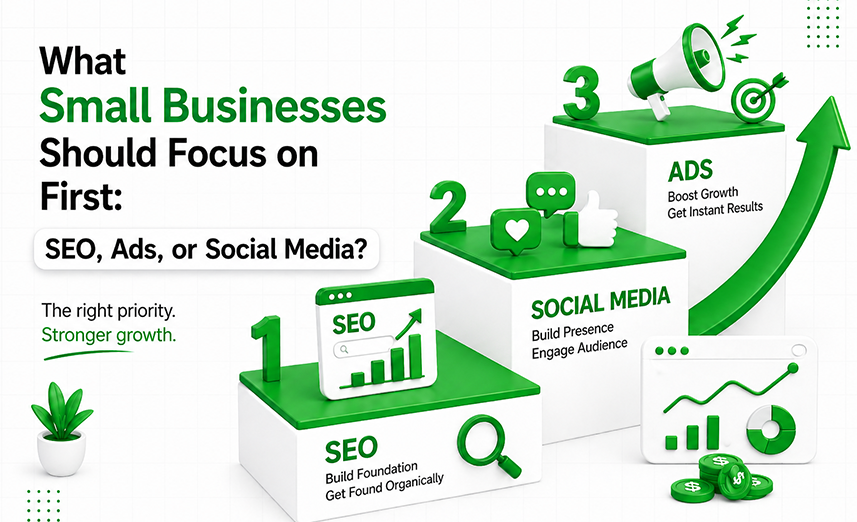
SEO, paid ads, and social media each play an important role, but they are not designed to achieve the same outcome. SEO is the long-term growth channel. It helps your business appear when people are actively searching for solutions, and that is exactly why it remains such a valuable investment over time. Paid ads, on the other hand, are built for speed. They can generate visibility, clicks, and leads quickly, making them especially useful when immediate results are needed. Social media plays a different role. It helps businesses stay visible, build familiarity, and create stronger audience connections through repeated exposure and engagement.
I do not see these channels as interchangeable, and I do not think small businesses should treat them that way. Each one serves a different purpose at a different stage of growth. SEO helps capture intent, paid ads help create quick momentum, and social media helps build recognition and trust. Once that difference is clear, the decision becomes much easier. The question is no longer which channel is better in general, but which one is most useful for the business right now.
When to Start with SEO
Start with SEO when your business needs steady visibility, lower long-term customer acquisition pressure, and stronger discoverability where buyers already search. This is where SEO vs. ads vs. social media becomes a timing decision, not a branding debate. I usually lean toward SEO first when intent already exists, budget is tighter, and the business can benefit from building assets that keep working after publication.
- Start here when people already search for your service before they ever speak to your team.
- Prioritize service pages and buying-intent content over vague posts that attract curiosity but not inquiries.
- Invest early when ad spend feels risky and you need compounding traffic instead of rented attention.
- Focus locally when nearby visibility strongly affects calls, visits, bookings, and trust signals.
- Build patiently because organic vs. paid marketing rewards assets that can improve long after launch.
This is also where a strong local SEO strategy becomes practical, not optional. Google says businesses with complete and accurate Business Profile information are more likely to appear in local search results, and BrightLocal found that 74% of consumers only care about reviews written in the last 3 months. In other words, visibility and trust now move together much more tightly than many businesses realize. If people already look for what you sell, I would almost always want to search in the first conversation.
 Warning: SEO is powerful, but it is not instant. Businesses that expect quick wins from SEO often quit too early, right before momentum starts building.
When to Start with Paid Ads
Paid ads should come first when the business needs lead flow quickly, wants to validate an offer, or cannot afford to wait for slower traction. This is where SEO vs. ads vs. social media stops being a strategic debate and becomes triage. If pipeline pressure is real, the launch window is short, or the market is crowded, ads can give you feedback much faster than waiting on rankings. That is the practical edge of SEO vs. PPC vs. social media: SEO builds, social warms, and PPC tests quickly. LocaliQ’s 2025 data makes that pretty clear.
The average search ad cost per click was $5.26, the average click-through rate was 6.66%, and the average conversion rate was 7.52%, indicating that a focused campaign can build momentum when the message and landing page are aligned. I still treat ads as a precision tool, not a lifestyle. A disciplined Google Ads strategy starts narrow, tests one offer at a time, and focuses on real lead-generation channels rather than admiring surface-level click volume. Paid traffic is not magical, but it is brutally honest, and sometimes that honesty is exactly what a business needs first.
 Quick Win: If you need leads fast, start with one focused campaign, one strong offer, and one clear landing page instead of spreading budget across too many experiments.
Best Time to Focus on Social Media
Focus on social media first when the brand needs familiarity, proof, and repeated exposure before buyers are ready to search, compare, or commit. This is one of the most misunderstood parts of SEO vs. ads vs. social media: attention is useful, but it is not the same as intent. Social usually works best when trust, visuals, personality, or storytelling shape the buying decision more than immediate search demand.
- Prioritize social first when buyers need repeated exposure before they feel comfortable enough to inquire.
- Lean into it when visual proof, founder presence, or brand personality strongly affects purchase decisions.
- Use posts to show outcomes, responsiveness, credibility, and everyday relevance, rather than vague inspiration.
- Treat comments, saves, and direct messages as trust signals, not just lightweight engagement metrics.
- Remember, the real social media marketing benefits show up when consistency improves recognition and recall.
DataReportal reports that connected adults spend 18 hours and 36 minutes per week across social and video feeds, which is a strong case for staying visible where people already spend attention. BrightLocal also found that 92% of consumers care about star ratings, and 31% will only use a business with 4.5 stars or more. That is why social proof, reputation, and familiarity matter so much. For some businesses, especially lifestyle-led or founder-led ones, this can become the best marketing strategy for a small business before search demand fully matures.
Deciding the Right Starting Point
The best starting point gets clearer the second you stop asking which channel is best in general and start asking which bottleneck hurts the business most right now. That is the right way to answer where to invest marketing budget. A company that needs leads this month should not plan like one that needs awareness first, and a brand with weak trust signals should not behave like one with strong demand and weak visibility. I usually start with the buyer journey and work backward.
- Match the first channel to the immediate goal: leads, awareness, validation, trust, or long-term visibility.
- Look at buyer behavior first because discovery habits should shape channel order more than opinions.
- Respect the timeline pressure, since urgent revenue needs call for different tactics than slower brand-building.
- Review internal capacity honestly before promising content, ads, and reporting that your team cannot sustain.
- Use data weekly because marketing budget allocation improves only when performance, not assumptions, drives decisions.
HubSpot reports that small businesses are 23% more likely than average to see ROI from blog posts, and blog posts were among the top five highest-ROI content formats in 2025, according to marketers. That is one reason I still take content seriously when shaping online marketing priorities and broader digital marketing planning. Good decisions usually come from identifying the biggest friction point first and funding the channel most likely to remove it.
Why an Integrated Strategy Works Best
The strongest systems usually come from letting each channel do the job it does best. Search captures demand, paid ads accelerate testing and lead flow, and social reinforces trust before and after the click. That is why digital marketing for small businesses improves when channels support each other rather than compete for attention. It is also where SEO, PPC, and social media start to make more sense operationally. HubSpot reports that website, blog, and SEO are the top ROI-generating channels at 27%, followed closely by paid social at 26%, which is a good reminder that channel roles matter more than channel loyalty.
I rarely recommend going all-in on one source forever. A better approach is to let search build durable assets, let ads stress-test the offer, and let social make the brand more credible and familiar. That is how isolated tactics become ROI marketing channels, stronger business growth channels, and clearer online marketing priorities over time.
| Channel | Best First Use | Main Strength | Main Weakness |
|---|---|---|---|
| SEO | Long-term demand capture | Compounding visibility and lower long-term acquisition pressure | Slower results |
| Paid Ads | Fast testing and immediate lead generation | Speed, control, and measurable feedback | Traffic stops when spend stops |
| Social Media | Awareness, proof, and familiarity | Repetition, trust-building, and brand visibility | Weaker direct intent on its own |
| Integrated Approach | Staged growth across goals | Short-term wins plus long-term stability | Requires coordination and clean tracking |
Quick Win: The smartest strategy is often a mix: use SEO for long-term visibility, ads for fast testing, and social media for trust and brand familiarity.Conclusion: There Is No One-Size-Fits-All Answer
There is no universal first move because small businesses do not start from the same place, sell the same way, or face the same urgency. That is why SEO vs. ads vs. social media should always be answered with context, not slogans. A local service brand with strong search demand may need SEO first. A new offer that needs traction now may need paid ads first. A visual or personality-led brand may need to be social-first.
For me, the real win is not choosing one channel forever. It is choosing the right one for now, then layering the others with purpose. That is often the best marketing strategy for a small business because it aligns with buyer behavior rather than channel hype. It also makes it feel less emotional and more strategic. If you want a practical plan that aligns SEO, paid campaigns, and social with your business goals, connect or request a quote with Ashwani Kumar Sharma to build a smarter, more measurable growth roadmap.
Frequently Asked Questions (FAQs)
Question: Which marketing channel delivers the fastest results for small businesses?
Answer: Paid advertising delivers the fastest results because it generates immediate visibility and traffic. Businesses can start receiving leads as soon as campaigns go live. Unlike SEO, which takes time to build rankings, ads provide instant placement in search results or social feeds. This makes them ideal for time-sensitive campaigns or new businesses. However, results depend on budget and optimization. Once spending stops, traffic also stops. While ads are effective for quick wins, they should be supported by long-term strategies like SEO to ensure sustainable growth and reduce dependency on continuous advertising spend.
Question: Is SEO worth investing in for small businesses with limited budgets?
Answer: Yes, SEO is highly valuable for small businesses with limited budgets because it builds long-term visibility without ongoing ad spend. While it requires time and consistent effort, it creates sustainable traffic and leads. SEO helps businesses appear in search results where users already have intent. Over time, this reduces reliance on paid campaigns. Investing in SEO early can create a strong foundation for growth. Small businesses should focus on targeted keywords, local SEO, and quality content. This approach ensures efficient use of resources and delivers long-term return on investment.
Question: How does social media contribute to business growth?
Answer: Social media contributes to business growth by increasing brand awareness, engagement, and customer relationships. It allows businesses to connect with their audience directly and build trust over time. While it may not always generate immediate sales, it influences buying decisions and supports other marketing channels. Consistent posting and interaction improve visibility and credibility. Social media is especially effective for storytelling and brand positioning. It also provides valuable insights into audience preferences. When integrated with SEO and ads, social media strengthens overall marketing performance and helps businesses grow sustainably.
Question: Should small businesses invest in all three channels at once?
Answer: Investing in all three channels can be effective, but it depends on resources and strategy. Small businesses with limited budgets should prioritize based on goals. Starting with one or two channels ensures focused execution. Once results are stable, expanding to other channels improves performance. Managing all three without a clear strategy can dilute efforts and reduce effectiveness. A phased approach works best. Combining channels strategically over time ensures better results. Businesses should focus on integration rather than trying to manage everything at once without proper planning.
Question: How do I decide the right marketing budget allocation?
Answer: Budget allocation depends on business goals, timeline, and competition. If immediate results are needed, a larger portion should go to paid ads. For long-term growth, investing in SEO is essential. Social media should support branding and engagement. A balanced approach works best. Businesses should start with testing and adjust budgets based on performance. Tracking ROI helps identify the most effective channels. Allocating budget based on data ensures better results. Regular evaluation allows businesses to optimize spending and maximize returns across different marketing channels.
Question: What is the biggest mistake small businesses make in digital marketing?
Answer: One of the biggest mistakes is choosing a channel without a clear strategy. Many businesses follow trends instead of aligning marketing with their goals. This leads to wasted budget and poor results. Another common mistake is expecting immediate results from SEO or ignoring long-term strategies. Inconsistent efforts also reduce effectiveness. Businesses often fail to track performance and optimize campaigns. Avoiding these mistakes requires a structured approach, clear objectives, and continuous monitoring. Strategic planning ensures better results and prevents unnecessary losses.
Question: How long does it take to see results from SEO, ads, and social media?
Answer: Paid ads deliver results almost immediately after launching campaigns. SEO typically takes three to six months to show noticeable improvements, depending on competition and effort. Social media results vary based on consistency and engagement, often taking time to build momentum. Each channel has different timelines. Businesses should set realistic expectations and avoid comparing results directly. Combining channels helps balance short-term and long-term outcomes. Understanding timelines ensures better planning and prevents frustration during the growth process.
Question: Can social media replace SEO or paid ads?
Answer: Social media cannot fully replace SEO or paid ads because each channel serves a different purpose. Social media focuses on engagement and brand awareness, while SEO targets search intent and long-term visibility. Paid ads provide immediate traffic and lead generation. Relying only on social media limits reach and conversion potential. An integrated approach delivers better results. Combining all channels ensures balanced growth. Businesses should use social media to support SEO and ads rather than replacing them completely.
Question: What type of businesses should prioritize SEO first?
Answer: Businesses that rely on search demand should prioritize SEO. This includes service-based companies, local businesses, and industries where customers actively search online. SEO is especially effective for businesses with long sales cycles and informational queries. It helps attract users with high intent. Companies aiming for sustainable growth benefit from SEO investment. Businesses with limited budgets can also use SEO as a cost-effective strategy. Prioritizing SEO ensures long-term visibility and reduces dependency on paid advertising.
Question: How can small businesses create an effective digital marketing strategy?
Answer: An effective strategy starts with clear goals and understanding the target audience. Businesses should identify where their customers spend time and how they search for products or services. Selecting the right channels based on these insights improves results. Combining SEO, ads, and social media ensures balanced growth. Regular tracking and optimization are essential. Testing different approaches helps refine strategy. Consistency and data-driven decisions improve performance over time. A structured plan ensures efficient use of resources and better outcomes.