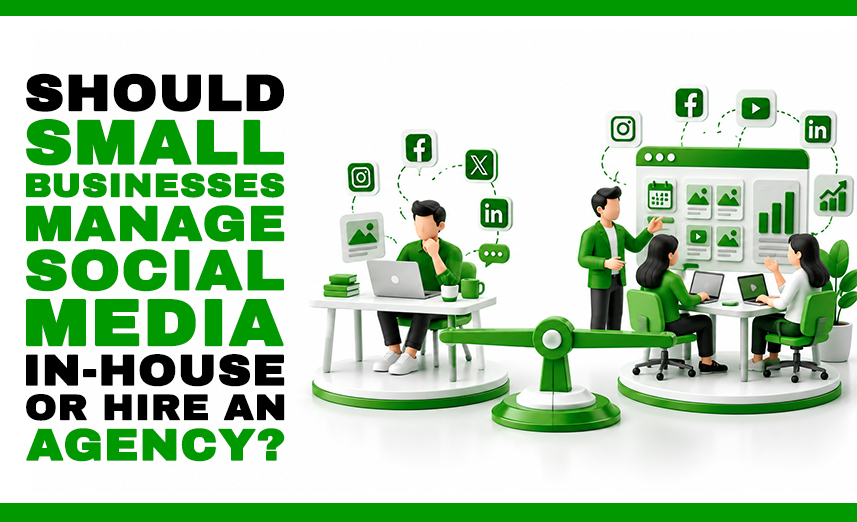
Running social media for a small business can take more time than most owners expect. What starts with a few Instagram posts soon turns into writing captions, editing videos, answering messages, planning campaigns, and checking results. Someone has to handle all of it. For a growing business, that raises a familiar question: is it better to hire an employee or bring in an agency? An internal employee can stay close to the business and its customers. An agency, meanwhile, may offer skills that would otherwise require several different hires. Both have their place.
In this blog, we’ll look at what social media management involves and compare the everyday benefits, costs, and challenges of managing it internally or through an agency. We’ll also talk about when each option makes sense, how a hybrid arrangement can work, and what small businesses should consider before spending money on either approach to support their long-term growth.
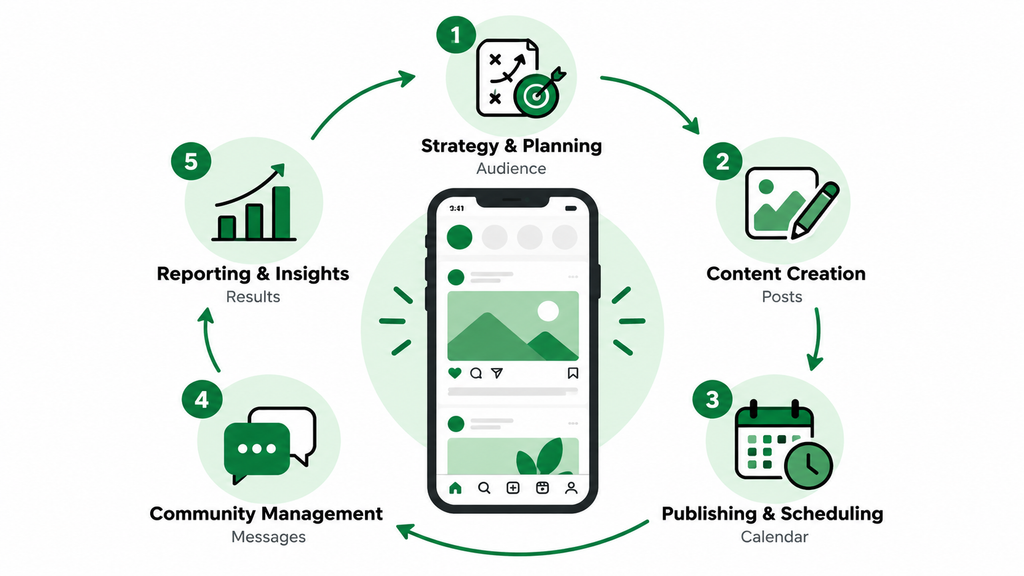
First, Understand What Social Media Management Actually Includes
It’s easy to underestimate how much work goes into running a business’s social media accounts. From the outside, it might look like someone designs a post, writes a caption, and uploads it. But that’s only a small part of the job. Behind every well-managed account, someone needs to understand the audience, decide what to share, create the content, respond to customers, and work out whether any of it is helping the business.
1. Strategy and Planning
Before creating content, a business needs to know what it wants social media to achieve. Without that direction, it’s possible to spend hours producing posts that receive attention but do little for the company.
A practical social media strategy usually covers:
- Audience definition: Understanding who the business wants to reach and what matters to those people.
- Platform selection: Choosing social channels that customers actually use.
- Campaign planning: Preparing promotions, launches, and seasonal activities.
- Content themes: Deciding which subjects deserve regular attention.
- Competitor research: Looking at how similar businesses communicate and where opportunities may exist.
- KPIs: Setting goals that can be measured, such as enquiries, engagement, or website visits.
For example, a local accounting firm may want to answer common tax questions and get in front of business owners on LinkedIn instead of sharing daily lifestyle tips on every social media platform. The strategy should reflect the customers and the business, not simply what’s trending.
2. Content Creation
Once the plan is clear, someone has to turn those ideas into content people will actually want to see. This could mean writing captions, designing graphics, filming videos, taking photos, creating carousels, or creating stories and reels.
Different formats require different skills. A useful educational carousel needs clear writing and design, while a product demonstration video may need filming, editing, and someone comfortable speaking on camera. A content creation team can divide these responsibilities. A smaller business may rely on one person to handle most of them. Neither approach is automatically wrong, but the workload needs to be realistic.
3. Publishing and Scheduling
Content also needs to be published consistently. That involves more than choosing a date on a calendar. Someone must check that captions are correct, images are properly sized, links work, and posts are scheduled for the right platforms.
Good social media content planning makes busy periods easier to manage. For instance, a retailer can prepare holiday promotions in advance rather than rushing to create everything during its busiest sales week. Still, a scheduled calendar shouldn’t become so rigid that the business can’t respond to something important happening today.
4. Community Management
Customers don’t always wait for business hours to ask questions online. They may comment on a post, send a direct message, leave a review, or complain about an experience. Someone needs to pay attention. Good community management means answering routine questions, acknowledging feedback, and knowing when an issue should be passed to another employee.
Imagine a restaurant that gets a message about a food allergy. A generic answer from someone who doesn’t know the menu isn’t enough. “Someone who has the right information has got to be asked the question. Social media is a two-way conversation, and businesses should treat it as such.
5. Measurement and Reporting
Posting regularly is useful, but businesses also need to know what they’re getting from the effort. Social media reporting might include reach, engagement, website visits, inquiries, and sales. Which numbers matter most depends on the purpose of the account.
For example, a local service provider might value five good leads over a post that gets hundreds of likes from people outside its service area. Reports should inform the business about what’s working, what’s not, and where we should change next.
What Does Managing Social Media In-House Mean?
In-house social media management means that the responsibility is given to a company’s employee. This may be a dedicated social media manager, a marketing executive, a content creator, or a larger internal team. In a very small business, the owner may handle the accounts personally until there’s enough work to justify hiring someone. The defining feature is that the work happens within the business rather than being managed primarily by an outside provider.
1. The Employee Works Closely With the Business
An internal employee gets to know the business through everyday experience. They answer customer questions, talk to coworkers, learn about products, and see how the company works.
Suppose it’s a clothing boutique. Someone who works there might know what sizes sell fast, what people ask about most, and what new products are coming in next week. That knowledge allows them to create posts that feel relevant, not generic.
2. Social Media Becomes Part of Everyday Operations
With in-house social media, content doesn’t always need to be planned weeks in advance. An employee might photograph a new product, record a short video during an event, or share a quick update about opening hours.
They are often already in the business, so they can respond to changes without having to be separately briefed. That said, don’t let spontaneous content take the place of proper planning. There are still people who need time to build campaigns, track their performance, and keep the message consistent.
3. One Employee May Still Need External Support
Hiring a social media manager does not mean that you have hired a designer, video editor, advertising specialist, and marketing strategist in one. Some employees have a lot of skills, but everyone has strengths and limitations.
A person who writes excellent content may need help producing professional videos or managing complicated advertising campaigns. Even businesses with an in-house marketing team sometimes use freelancers or agencies for work that requires specialist experience.
What Are the Main Benefits of an In-House Social Media Team?
The best argument for keeping social media in the business is proximity. The content creator is tied to the people, products, and decisions that make the brand. It makes it easier to communicate on a day-to-day basis, especially for businesses where things are always changing.
- Deeper Brand Knowledge: Being inside a company gives you more opportunity to get a feel for its culture. They hear the owner’s tone with customers, learn which products people like, and get a feel for the company’s values. Over time, that knowledge can make content sound more like the business itself. This is especially useful for brand voice management, where consistency depends on understanding more than a list of approved words.
- Faster Access to Internal Information: Think about if a product is going to be out of stock for a short time or if a special offer has to be changed. An internal employee can often talk directly to the relevant manager and update the content quickly. There’s no need for information to go through several people before it gets to an external team. That direct access is helpful when accuracy and timing matter.
- More Day-to-Day Control: Business owners may prefer having someone nearby who can discuss ideas, review drafts, and make changes during the working day. For example, the owner of a salon might want to promote an appointment slot that has unexpectedly become available. An internal employee can often coordinate that update quickly. However, constant interruptions can make it difficult to complete planned work. Even internal teams need clear priorities and reasonable deadlines.
- Easier Real-Time Content Creation: Some content is difficult to recreate after the moment has passed. A customer event, a new product delivery, or a behind-the-scenes activity may provide an opportunity for a useful post. An internal employee can capture these moments as they happen. This is particularly valuable for restaurants, gyms, retail stores, and businesses that regularly host events.
- Stronger Internal Collaboration: An employee in the company can also build relationships with the sales, customer service, and operations teams. Those relationships often lead to better content ideas. For example, if the sales team is constantly asked the same question about delivery times, the social media manager can create a post to answer it. The content is more helpful because it is based on real customer conversations.
What Are the Limitations of Managing Social Media In-House?
An internal employee can provide valuable knowledge and flexibility, but the arrangement also has costs and practical challenges. Small businesses sometimes don’t appreciate the range of skills involved or the amount of support an individual needs to do the job properly.
1. One Person May Need Too Many Skills
Social media work can be anything from writing, design, photography, video editing, advertising, analytics, and customer communication. It’s not easy to find one employee that is strong in all of these areas.
The best content creator might be a whiz at creating content but a bust in terms of paid advertising. The best analyst might be a whiz at data but hate to film a video. Too much responsibility placed on one person can compromise the quality of work.
2. Recruitment Takes Time
If you are hiring someone, there is advertising the job, reviewing applications, interviewing candidates, and helping the new employee settle in. Even after you’ve been hired, it takes time to learn about the company’s customers, products, and expectations. If a business needs specialist marketing support now, it may not be practical to wait for the right employee.
3. Training and Tools Add Cost
The employee’s salary is only part of the costs. Companies might need design software, scheduling software, camera equipment, analytics platforms, and training. Social media platforms are also constantly changing, so employees need time to learn new features and sharpen their skills. Without that support, even a capable employee can fall behind.
4. Capacity Can Become a Problem
One man can only do so much work in a day. It can be difficult to manage the workload, particularly when you have a product launch, scheduled posts, customer messages, and ad campaigns happening simultaneously.
Holidays and other unexpected absences can also cause problems. When your main social media staffer is out of the office, who will be handling important tasks? Businesses should consider this.
5. Creative Perspective Can Become Narrow
Sometimes, working on the same products and messages day in and day out makes it harder to see new opportunities. An insider can become accustomed to the familiar formats or repeat the ideas that have worked well in the past. Outside feedback now and then, customer research, and reviews of competitors can help bring fresh perspectives.
What Does Hiring a Social Media Agency Mean?
Hiring an agency means paying an external company to handle agreed social media responsibilities. Depending on the services needed, the business may work with strategists, writers, designers, video editors, paid advertising specialists, account managers, and analysts.
The business, instead of hiring a number of employees, has access to different abilities via a service arrangement. For example, a small home renovation company may need project photos converted to social posts, short videos, and lead generation ads.
A social media marketing agency may have separate people handling content, design, editing, and campaign performance. However, not all agencies provide the same services. Mostly, some create and schedule posts, while others provide full campaign planning, advertising, and analytics. Before signing an agreement, the business needs to understand what the agency will be managing.
What Are the Main Benefits of Hiring an Agency?
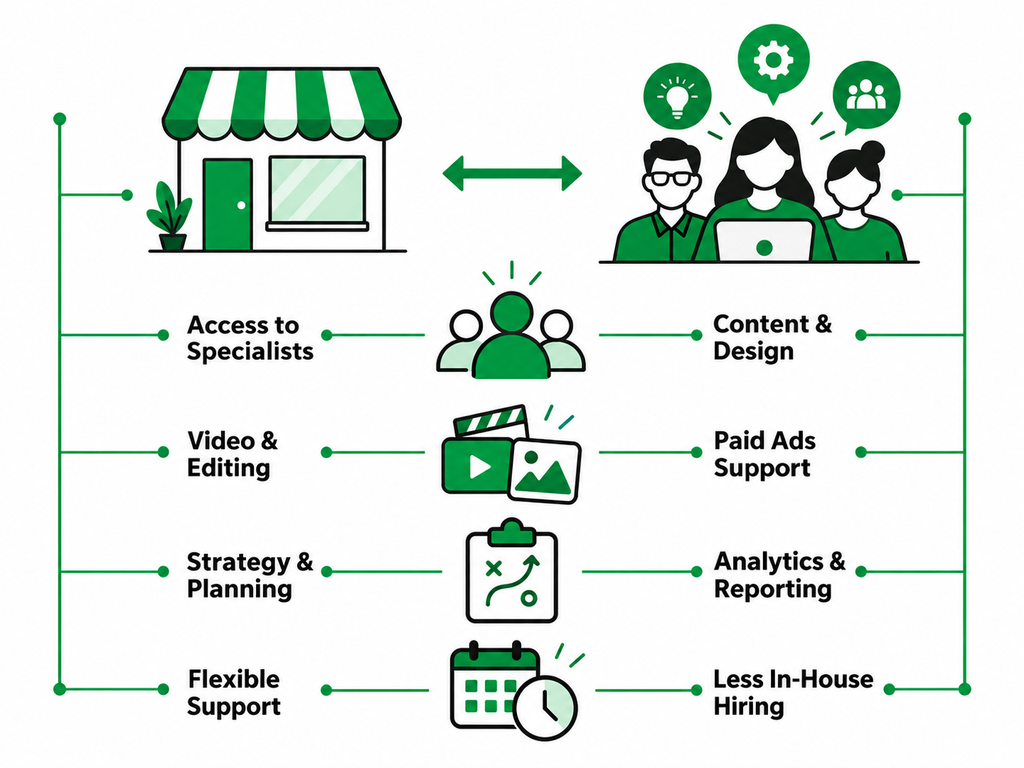
An agency provides skills and resources that would be difficult to sustain in-house, especially for a small business without an in-house marketing department. The biggest benefits are often access to specialists, already established processes, and additional production capacity.
1. Access to Multiple Skills
An agency might have separate people for strategy, writing, design, video, and advertising. That means that each task can be given to someone with the appropriate experience. For instance, a graphic designer can create campaign visuals while an advertising specialist manages targeting and budgets. This range of social media expertise can be valuable when a business needs more than basic content scheduling.
2. Broader Campaign Experience
Businesses that agencies work with often have different marketing challenges. They may have worked on local promotions, product launches, seasonal campaigns, brand awareness, and lead generation.
That exposure helps them identify common mistakes and recommend approaches to try. Of course, experience in another industry is no guaranty of results. The agency still has to get a handle on the specific business and its customers.
3. Easier Scalability
A business’s marketing needs can change throughout the year. In a slow month, regular organic posts may be enough. The same business might need more videos, graphics, advertising, and reporting before a big launch. The agency might be able to support it more without the need for the company to hire more employees. However, extra work may lead to extra costs, so the scope must be well defined.
4. Established Tools and Processes
Many agencies already have content calendars, scheduling platforms, approval systems, and reporting tools. These can help keep work organized and save the time it takes to create a process from scratch. For example, a department may develop a monthly calendar, obtain approvals, publish content, and review results at month-end. A predictable process can be especially useful for busy owners who don’t want to manage every small task themselves.
5. External Strategic Perspective
Sometimes, an outside team can spot things that people inside the company have stopped noticing. An agency might find that most posts are about the business, but seldom do they address the concerns of customers. It could mean more educational content, stronger calls to action, or a different presentation of services. That outside perspective is most useful when the agency also listens carefully to the people who know the business.
What Are the Limitations of Working With an Agency?
An agency can do a lot of heavy lifting but can’t do its job without business input. External teams need accurate information, timely feedback, and a clear understanding of what the company wants to achieve.
1. An Agency Does Not Know the Business Automatically
Even a well-established agency has to take time to get to know a new client. Needs information on products, services, customers, offers, brand values, and internal developments. For example, an agency that works with a dental clinic’s social media needs to have the right treatment information and approved language. It cannot take for granted that what is true at another clinic will be true there. A good on boarding process and regular communication allow the agency to familiarize itself with the business.
2. Approvals Can Slow Down Content
When every post has to be approved, delays can impact the publishing schedule. A business owner can be busy serving customers and forget to check on a campaign until after its scheduled date of publication. That can be frustrating for all involved. A firm approval deadline and one point person can help smooth the process along.
3. The Agency Is Not Physically Inside the Business
An external team may not know that an interesting event is happening or that a new product has arrived. Unless someone shares photographs, videos, and updates, those moments may never become content. Businesses that depend on frequent behind-the-scenes posts may still need someone internally to capture material.
4. Communication Quality Matters
Good results depend on more than creative ability. If the agency is given unclear instructions, or if critical information is received late, content may need to be revised multiple times. Regular meetings, shared calendars, and simple feedback can avoid many of these problems. Both sides need to know who’s responsible for what.
5. Different Agencies Offer Very Different Levels of Service
One agency might specialize in organic content, another in paid advertising or video production. Some do a full strategy and performance review. “Mostly, others do scheduling. The company should look at the service package itself rather than assume that all agencies provide the same level of support.
In-House vs. Agency: How Do the Costs Really Compare?
Cost is usually the deciding factor for small businesses. But comparing an employee’s salary with an agency’s monthly fee doesn’t tell the whole story. The actual cost depends on the amount of work required, the skills involved, and the additional resources required to support each option.
1. In-House Costs Can Include
Hiring an employee creates several expenses beyond their basic pay.
These may include:
- Salary and employee benefits
- Recruitment and on boarding
- Professional training
- Scheduling and reporting software
- Computer equipment
- Photography and video tools
- Design subscriptions
- Management and supervision time
- Additional freelancers or specialists
For example, a business may hire someone to manage Instagram and Facebook, then discover it also needs professional video editing and paid advertising support. Those additional content production costs can change the overall budget considerably.
2. Agency Costs Can Include
Agency fees vary according to the amount and type of work involved.
Depending on the agreement, charges may cover:
- Monthly management retainers
- Content planning and strategy
- Copywriting and creative production
- Graphic design and video editing
- Account management
- Performance reporting
- Paid advertising management
Some services like filming, photography, extra revisions, or additional campaigns can be invoiced separately. Often the agency’s management fee and advertising spend are charged separately. Businesses should ask for a clear breakdown before comparing proposals.
3. Compare Capability, Not Just Monthly Price
A lower monthly price doesn’t necessarily equate to better value. An employee may be cheaper than an agency but need more help with advertising or design. An agency may have a number of specialists available, but the monthly package may limit what can be done. Compare what each option realistically offers in terms of content quality, support for campaigns, reporting, responsiveness, and management time requirements. A good investment is one that satisfies the business needs without adding unnecessary costs or capability gaps
Which Option Gives You Better Brand Voice Control?
A consistent brand voice makes it easy for customers to identify a business and understand its personality. Some brands have a friendly, relaxed sound. Others advocate for a more formal or technical style. An internal employee can naturally learn that voice; an agency generally needs clear direction to copy it.
1. In-House Teams Have Natural Brand Exposure
Internal employees get exposed to how the business talks to customers on a regular basis. They learn common expressions and service explanations and the overall personality of the company. Say someone works at a family-owned café. They may instinctively know how to be informal and welcoming, without needing a long document to explain it. That familiarity can make everyday content feel genuine.
2. Agencies Need Strong Brand Guidelines
An external agency needs a reliable reference for how the business wants to communicate.
Useful guidelines include:
- Tone guidelines: How formal, friendly, or conversational the content should be.
- Approved terminology: Words and expressions the company prefers.
- Brand values: Ideas that should guide communication.
- Examples: Previous posts that represent the desired style.
- Restricted claims: Statements that shouldn’t appear in marketing materials.
These details help avoid repeated corrections and make it easier for different writers or designers to work consistently.
3. Consistency Depends on Process
An employee working inside the business can still produce inconsistent content if expectations aren’t clear. Likewise, an agency can maintain a recognizable voice when it receives good guidance and regular feedback. The important thing is to establish shared standards and review content against them. Where the team works matters less than whether everyone understands how the brand should communicate.
Which Option Is Better for Speed and Responsiveness?
Speed matters, but it depends on what needs to be done. An internal employee may respond more quickly to unexpected events, while an agency may be better equipped to produce several planned assets at once.
1. In-House Usually Has an Advantage for Immediate Updates
If something changes during the working day, an internal employee may be able to act immediately. This can be useful for events, customer questions, live situations, and behind-the-scenes content. For example, a retailer can quickly announce the return of a popular product. If the person is outside of the company, there is less need to send a detailed briefing.
2. Agencies Can Be Faster for Planned Production
On bigger projects, an agency might have multiple people working on different jobs at the same time. A writer can write captions, a designer can create graphics, and an editor can finish up videos. This helps the business to prepare their campaigns efficiently, especially if the content is planned in advance. Actual turnaround times are dependent on the workload of the agency and the terms of service negotiated.
3. Community Management Needs Clear Ownership
Someone has to be responsible for going through comments and messages. If both the business and agency think the other one will be responding, customers may be left waiting. A sensible setup might be to allow the agency to answer routine questions, with internal employees dealing with complaints, orders, or sensitive inquiries. It’s not that you need a team to handle all interactions; it’s more important to define who is responsible for what.
When Does Managing Social Media In-House Make More Sense?
Managing social media internally can work well when the business needs someone closely involved in daily activities.
It may be especially suitable when:
- Social media is an important part of everyday business operations.
- The company frequently shares real-time updates.
- Customer questions and messages require regular attention.
- There is enough work to justify a full-time employee.
- Content depends on detailed product or industry knowledge.
- The business already has designers, writers, or advertising specialists.
- Leadership wants close involvement in day-to-day marketing decisions.
Imagine a busy restaurant that posts updates to their menu, special events, and customer updates on a frequent basis. Having someone close by can make the job much easier. But the business has to be prepared to support that employee. No one person should be expected to do all marketing tasks without adequate resources, training, or help.
When Does Hiring an Agency Make More Sense?
An agency may be a practical choice when the business needs a broader range of marketing skills than it currently has.
This approach may suit companies that:
- Don’t have specialist marketing experience internally.
- Need to manage several social media platforms.
- Require writing, design, video editing, and campaign planning.
- Want to run paid campaigns alongside organic content.
- Have employees who are already busy with other responsibilities.
- Need more content without recruiting several people.
- Want stronger reporting and performance analysis.
For example, a small consulting business may need LinkedIn content, educational videos, and lead-generation advertising but have no reason to employ separate specialists for each task. In that situation, social media outsourcing may provide a practical way to access the required skills. Businesses considering whether to outsource social media management should still identify who will provide information and approve content internally.
Can a Hybrid Social Media Model Work Better?
Sometimes the most practical answer is to keep part of the work inside the business and bring in outside help for the rest. A hybrid arrangement allows employees to provide genuine brand knowledge while an agency handles tasks requiring additional expertise or production capacity. For many small businesses, hybrid social media management offers a useful middle ground.
1. Keep Brand Knowledge In-House
Someone in the business can continue to be responsible for passing on information that an external team would not otherwise know. This may involve product updates, photos, videos, feedback from consumers, and content approvals. For instance, employees working at a furniture store could take pictures of new arrivals and finished installations. They have the products already, so the agency doesn’t need to come and pick up this material every time.
2. Let the Agency Handle Strategy and Production
The agency manages content planning, design, editing, campaigns, paid advertising, and reporting. That frees up the internal employees to spend their time giving information rather than trying to learn every creative and technical skill themselves. A clear marketing team structure makes it easier to understand where each responsibility sits.
3. Split Community Management Carefully
Customer communication may need to be shared. The agency would be able to answer general questions and monitor general comments, whilst internal employees would deal with complaints or inquiries that involve customer-specific information.
For example, an agency may confirm general opening hours but pass a delivery complaint to the company’s customer service team. The important thing is that everyone knows when an issue needs to be escalated.
4. Build a Shared Content Workflow
A hybrid approach works best when information moves easily between both teams. The business could post updates each Friday, the agency could write content for weeks ahead, and an employee could review posts before they go live.
A shared calendar can provide a view of what deadlines are looming, what campaigns are in the pipeline, and what approvals are still pending. Without a clear process, the advantages of having two teams can evaporate quickly.
Practical Example: A local furniture company could take in-house pictures of new products and customer installations. An agency could use those materials to produce videos, to produce promotional posts, and to run paid campaigns. The agency takes care of specialist production; the business provides the real experiences.
What Questions Should Small Businesses Ask Before Choosing?
It is worth thinking about the real requirements of the business before taking on an individual or signing an agency agreement. These questions can help owners avoid paying for services they do not need or taking on too much responsibility for one person.
1. How Many Platforms Do We Actually Need to Manage?
Not every business needs an active account on all platforms. A professional consulting firm might find LinkedIn more useful, while a fashion retailer might focus on Instagram and Facebook.
Choose channels based on where customers spend time and how they discover products or services. Managing two relevant platforms properly is often more useful than posting inconsistently across five.
2. How Much Content Do We Need Each Month?
Think about the actual amount of content required. A business publishing three educational posts a week has different needs from one creating daily videos, stories, and advertisements. Estimate the number of posts, videos, graphics, and campaigns needed each month. That will help determine whether one employee has enough time or whether additional creative support makes sense.
3. Do We Need Paid Social Advertising Too?
Organic content and paid advertising are not exactly the same jobs. That person who writes engaging captions may not have experience in managing advertising budgets, audience targeting, or conversion tracking.
If social media advertising is central to growth, make sure the chosen employee or agency has the necessary skills. Otherwise, separate specialist support may be required.
4. How Quickly Do We Need to Respond to Our Audience?
Some businesses receive only a few messages each week. Others handle customer inquiries throughout the day. If quick responses are essential, the business needs someone available to monitor those conversations. An agency may offer this service, but response times and responsibilities should be agreed upon. The decision should reflect what customers reasonably expect.
5. What Skills Do We Already Have?
Look at the people already working in the business. Maybe one person is good at photography, another employee understands customer questions, and a marketing executive can build content calendars. Those skills might reduce the need to outsource everything. “Knowing what’s out there helps you to know the gaps that really need to be filled.”
6. What Business Result Should Social Media Produce?
This is the question that must guide the entire decision. Does the business want more inquiries, better customer relationships, higher brand awareness, more website visits, or direct sales? Different goals require different skills and investment levels. When you know what you’re trying to do, you can more easily figure out the kind of help you need and if that help is actually taking you anywhere.
How Should You Compare a Social Media Agency Before Hiring One?
Not every agency will be a good fit for every business. Before making a commitment, look beyond attractive designs and monthly prices. Try to understand how the agency works and what you’ll actually receive.
- Review Their Strategy Process: Ask what happens before the agency starts creating posts. Does it learn about your customers, review your current accounts, study competitors, and discuss business goals? Or does it immediately recommend a fixed posting package? An agency should understand what the business wants to achieve before deciding what content to produce.
- Ask Who Will Actually Work on the Account: Find out who will handle the day-to-day work. Will there be a dedicated account manager? Who writes captions, who does designs, who does advertising, and who does reports? It helps to know who is responsible for what to avoid confusion later. It also gives the business a better understanding of the expertise within the service.
- Review Relevant Work: Portfolio examples can show the creative capacity of an agency, but pretty posts don’t necessarily show business results. Search for examples with similar audiences, services, or campaign goals. For example, a B2B company may want to know if the agency has experience in creating professional content and generating leads for businesses. Ask why things were done the way they were. How was performance measured?
- Understand What the Monthly Scope Includes: The proposal should state what agency will produce. See how many posts, videos, platforms, revisions, meetings, and reports are included. Ask about extra charges for photography, filming, advertising management, or extra campaigns. A clear scope protects both sides from misunderstandings.
- Ask How Performance Will Be Measured: A suitable agency should explain which results it will track and why they matter. Depending on the business, this might include engagement, website visits, inquiries, advertising costs, or sales. Reports should also explain what the agency has learned and what it plans to improve. Numbers are useful, but business owners need to understand what those numbers mean.
Common Mistakes Businesses Make With Either Model
Whether a business chooses an employee or an agency, certain mistakes can make the arrangement less effective. Most of them come from unclear expectations, poor communication, or focusing on activity instead of results. Common problems include:
- Expecting one employee to do everything: Writing, design, advertising, and analytics require different skills.
- Choosing an agency only because it’s cheap: A low monthly fee may come with limited support or poor-quality work.
- Posting without a clear plan: Regular content has little value when it doesn’t serve a business purpose.
- Focusing only on followers: A larger audience doesn’t always lead to more customers.
- Ignoring comments and messages: Customers may lose interest when their questions go unanswered.
- Giving an agency too little information: Missing details can lead to generic or inaccurate posts.
- Taking too long to approve content: Delays can disrupt campaigns and cause missed opportunities.
- Using identical content everywhere: Different platforms may need different formats and messages.
- Not tracking inquiries or sales: Businesses may struggle to see whether social media is worth the investment.
- Changing strategy too frequently: Constant changes make it difficult to understand what’s working.
Even experienced teams can be plagued by these problems. The good employee needs backing; the good agency needs cooperation. Whatever the business decides, clear responsibilities and realistic expectations make a real difference.
How to Measure Your Social Media Setup Is Working
The purpose of measuring social media performance isn’t simply to collect impressive numbers. It’s to understand whether the time and money being invested are helping the business achieve something useful.
Depending on the goals, important measures may include:
- Engagement rate: How often people interact with the content.
- Reach: How many people see the posts.
- Video completion: Whether viewers watch videos to the end.
- Saves: How often people save content for future reference.
- Shares: Whether audiences find posts worth sharing.
- Website traffic: Visits generated through social media.
- Qualified enquiries: Leads that match the business’s target customers.
- Cost per lead: Advertising spend required to generate an inquiry.
- Paid campaign ROAS: Revenue attributed to advertising compared with the amount spent.
- Sales: Customers or purchases influenced by social media activity.
- Community response time: How quickly questions and messages receive answers.
- Content production consistency: Whether planned content is delivered reliably.
Inquiries and customer acquisition costs may be of greater interest to a local service company. Community branding might put a premium on meaningful engagement and response time. The important question is not just if enough posts were published. It’s whether social media is doing the job that the business needs it to do. Regularly reviewing results can indicate when the current setup needs better processes, more skills, or a different approach.
A Simple Decision Framework for Small Businesses
After considering the costs, benefits, and everyday responsibilities, the choice becomes easier when matched to the way the business actually operates.
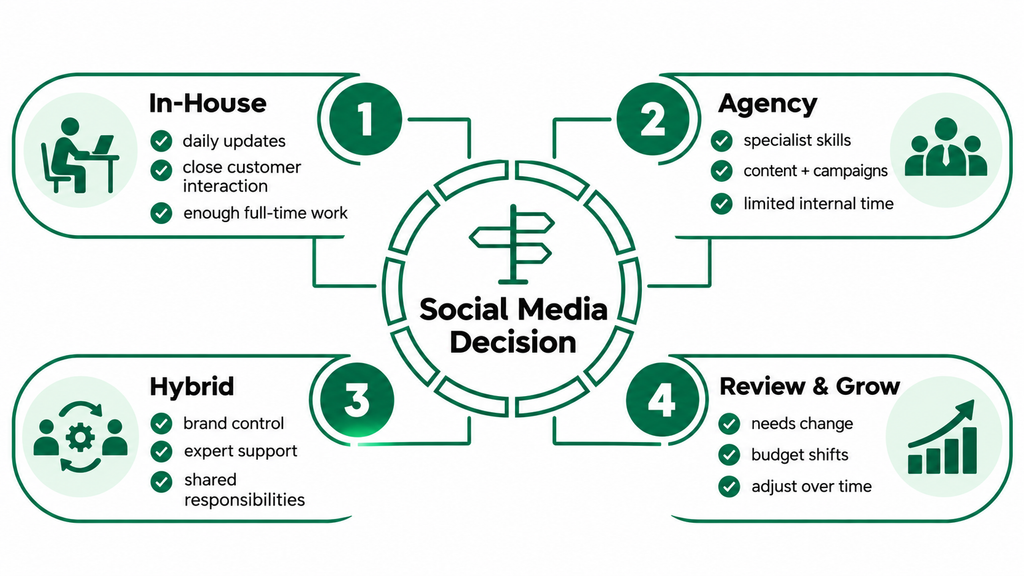
1. Choose In-House When
If your social media needs frequent activity in daily activities, immediate updates, or close customer interaction, use an internal employee. It can also be a good idea when there is enough consistent work to justify a full-time role and the business is able to provide the right tools and support. This tactic is often successful when content depends heavily on first-hand knowledge of a product or access to employees.
2. Choose an Agency When
If the business needs a number of specialist skills but isn’t quite ready to build a full internal department, then an agency may be the better option. It can also be beneficial when current employees don’t have the time to adequately manage content, campaigns, and reporting. Make sure the agency’s services are relevant to the business, and there’s someone internal who can disseminate information.
3. Choose a Hybrid Model When
The hybrid model might work well if the business wants to keep control of the brand information but needs professional help with strategy, production, or advertising. For example, an internal employee can handle updates and customer communication, and an agency can create content and run campaigns. This arrangement can provide useful flexibility without requiring a large internal team.
4. Review the Decision as the Business Grows
The best arrangement today may not be the best one two years from now. It could start with an agency, become a marketing coordinator, and then grow into a larger internal team. One company may start with just one employee and later bring in specialized help, like advertising or video production. Change the arrangement as business goals, budgets, and workload shift. This is about making social media manageable and effective, not doing it the way you are comfortable with.
Final Thoughts
There isn’t a universal answer to whether small businesses should handle social media in-house or hire an agency. Both can work, but they solve different problems. Internal employees provide everyday brand knowledge, more direct communication, and access to real-time activities. If marketing requirements change, an agency can offer a broader range of skills, professional creative support, and more flexibility. What matters most is how well each alternative fits the workload, budget, and goals of the business.
Before making a decision, consider more than the employee’s salary or the agency’s monthly fee. Think about the total cost, the expertise you have on hand, the content you need, and the results you want. If your business requires both internal participation and outside help, a hybrid arrangement may be worth exploring. Whatever you decide, be clear on responsibilities and review performance regularly. The key to effective social media marketing is not having the biggest team or posting the most. It’s about creating useful connections that support real business growth.
Not sure whether your business needs an internal employee, an agency, or both?
Managing social media effectively takes more than regular posting. Ashwani Kumar Sharma helps businesses build stronger social media strategies, create engaging content, and manage campaigns that connect with the right audience. Get professional guidance to make your social media efforts more focused, consistent, and aligned with your business goals.
Frequently Asked Questions
Question: Is it better to manage social media in-house or hire an agency?
Answer: It depends on what your business needs. An internal employee might be better suited to daily updates, customer interaction, and content that requires a close knowledge of the brand. If you need a range of specialist skills, an agency can help. Before deciding between these options, consider your workload, budget, available resources, and marketing goals.
Question: How much does it cost to hire a social media marketing agency?
Answer: Agency fees depend on the services provided. Running two platforms with basic posts is usually cheaper than making videos, running paid campaigns, and preparing detailed reports. See a clear breakdown of the monthly services and check whether advertising spend, filming, extra revisions, or specialist work costs more.
Question: Is hiring a social media agency cheaper than an in-house employee?
Answer: If you need a variety of marketing skills but can’t afford to hire more than one employee, an agency can be a better value. If daily involvement is key, an internal employee might be more practical. Consider all the costs—salary, benefits, software, training, agency fees, and any additional creative or advertising support you might require.
Question: What does a social media agency typically manage?
Answer: A social media agency can handle everything from planning and creating content to graphic design, video editing, scheduling, paid advertising, community management, and reporting. The exact services vary according to provider and package. Some agencies focus more on organic posts, while others offer a broader range of marketing services, such as strategy development, advertising campaigns, and performance tracking.
Question: Can a small business successfully manage social media in-house?
Answer: Yeah. If you have the time, skills, and resources to do the work on a consistent basis, a small business can handle social media in-house. It also helps to have a clear plan. The business can hire freelancers or specialists to assist the employee with video production, advertising, or analytics without outsourcing everything.