Introduction
Many businesses spend money on marketing every month but still feel disappointed with the results. Ads are running, social media posts are being published, website traffic may be increasing, yet inquiries remain low. This is where the real issue begins: Marketing not generating leads is usually not a budget problem alone. It is often a strategy, targeting, messaging, tracking, or conversion problem. A campaign may attract clicks, but not buyers. A website may attract visitors but not gain their trust. A company may invest in different media but fail to reach out to the buyers who are ready to buy. Thus, marketing cannot and should not be viewed only as a cost.
In this blog, we discuss why marketing is not generating leads, where marketing budgets often get wasted, how the modern buyer journey works, and what businesses can do to build a stronger lead generation process. The goal is simple: spend smarter, attract better prospects, and turn marketing into measurable growth.
Why Do Marketing Budgets Fail?
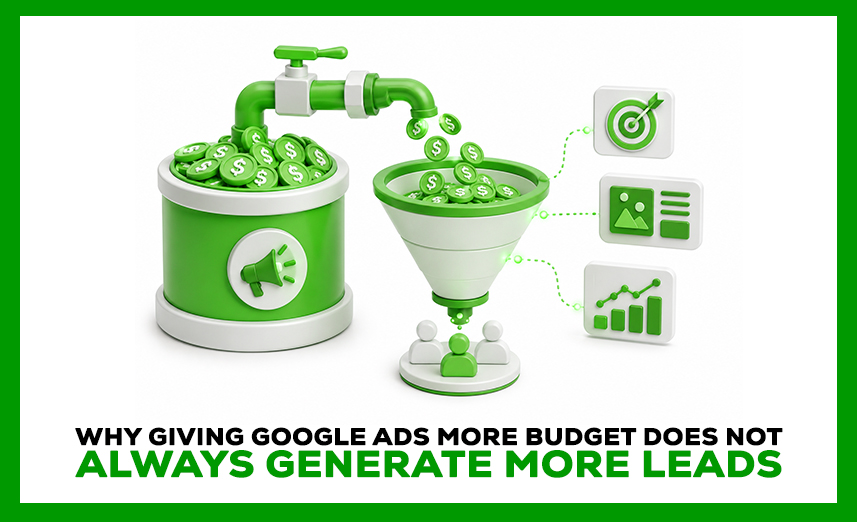
Many businesses believe that by increasing the budget, they can simply generate more leads. The reality is that while the budget provides a campaign with some room, it won’t solve problems related to improper targeting, poor offers, poor communication, slow website, and tracking issues. A business may run Google Ads for high-intent searches but send users to a generic homepage. Another business may spend heavily on Meta Ads but target a broad audience with no clear buyer intent. In both cases, the money is being spent, but the system is not built to convert.
This lack of conversion is one major reason why businesses don’t get leads even after investing in marketing. The campaign may create visibility, but visibility without relevance rarely produces results. As an illustration, a local service company could use the ad copy “affordable home repairs,” but link the visitors to a page that does not mention anything about their service, lacks customer reviews, does not have a clear location, and does not provide any call to action to the prospective customer.
A strong marketing budget needs the following:
- A clear business goal
- A defined target audience
- Relevant campaign messaging
- Strong landing pages
- Conversion tracking
- Regular performance reviews

Where marketing spending is wasted?
It is unfortunate that a lot of firms do not know how to use their marketing funds effectively because they tend to pay attention to what they are doing rather than the results that it will bring. One common mistake is measuring vanity metrics. Clicks, impressions, likes, and reach can look impressive, but they do not prove that a campaign is producing qualified leads. A campaign with fewer clicks but better inquiries may be more valuable than one with high traffic and no conversions.
Budgets also get wasted when businesses launch campaigns without proper tracking. If Google Analytics 4, ad conversion tags, call tracking, and CRM data are not connected properly, businesses cannot see what is actually working.
Waste usually happens when businesses:
- Choose channels without a clear strategy
- Chase traffic instead of lead quality
- Ignore search intent
- Use generic ads for different audiences
- Run campaigns without conversion tracking
- Stop campaigns before enough data is collected
- Fail to connect sales feedback with marketing reports
Good marketing campaign optimization starts by identifying what each channel is supposed to do. SEO may build long-term traffic. Paid search may capture urgent buyers. Social ads may build awareness and demand. Email may support lead nurturing. Each channel should have a clear role.
How Do Customers Actually Convert?
Most customers do not convert the first time they see a business. They may visit the website, compare options, read reviews, check pricing, leave, return later, and then decide. This is why a complete marketing funnel matters.
The buyer’s journey that a buyer undergoes is normally divided into three phases: awareness, consideration, and decision. Awareness phase: The individuals are becoming aware of a challenge. In the consideration phase, the individuals are comparing different options. They need to feel trusted, they need evidence, they need pricing, they need the reason behind it all. It is likely that an organization will be missing out on a lot by limiting itself to only targeting one phase of individuals. For instance, a B2B software company might be advertising only for demo requests. However, there could be a number of buyers who would require educational content, comparison pages, and even remarketing.
A strong conversion funnel supports people at every stage:
- Awareness content explains the problem.
- Comparison content helps buyers evaluate options.
- Service pages explain the offer clearly.
- Case studies and testimonials build trust.
- Forms, phone numbers, and CTAs make action easy.
- Remarketing brings interested visitors back.
This is why digital marketing lead generation needs more than one touch point. Customers need confidence before they share their details or speak with a sales team.

What Makes Lead Strategy Stronger?
A strong lead generation strategy starts with clarity. Businesses need to know who they want to attract, what problem they solve, why customers should trust them, and what action visitors should take next. The first thing to do is to define an ideal client. It should cover such aspects as location, type of business, budget, problems, purchasing intentions, and the decision-making process. Otherwise, marketing campaigns may end up targeting those clients who have no intention of becoming customers yet.
Next, the website must be built for website conversion. A visitor should quickly understand what the business offers, who it helps, why it is credible, and how to take action. If the page is confusing, slow, cluttered, or too generic, leads will drop.
Important parts of a stronger lead system include:
- Clear service messaging
- Strong value proposition
- Fast-loading pages
- Simple contact forms
- Trust signals like reviews and case studies
- Clear calls-to-action
- Mobile-friendly design
- Proper marketing analytics
- Sales follow-up process
For instance, if an advertising campaign for implants by a dental practice was being run, the user should not be directed to the services page. It would be best to create a landing page for implants that contains all the information about the procedure.
Strong conversion rate optimization does not always require a full redesign. Sometimes small changes, such as clearer headlines, better forms, stronger proof, and improved CTAs, can increase leads.
Which Channels Improve Lead Quality?
No one marketing approach can be best for any company. It all depends on how the target behaves the nature of the industry, money, competitors, and purchasing intention. Nonetheless, the most effective results can always be derived from utilizing more than one marketing approach. SEO is useful for long-term visibility and trust. It helps businesses appear when users search for services, comparisons, questions, and solutions. Content marketing supports this by answering customer concerns and building authority. Paid search helps capture high-intent users who are already looking for a solution. Social platforms help create awareness and demand, especially when the audience does not know the business yet. Email and remarketing help bring prospects back and keep the brand in their mind.
Useful channels for business lead generation include:
- SEO for long-term organic inquiries
- Google Ads for active buyer intent
- Meta Ads for awareness and demand
- Content marketing for education and trust
- Email marketing for follow-up
- Remarketing for returning visitors
- CRM automation for lead tracking
- Lead generation services for expert support
A business that wants to generate quality leads should not only ask, “Which channel is cheapest?” A better question is, “Which channel brings serious prospects who are more likely to become customers?”
How Should Results Be Measured?
So many companies are asking the question, “How many leads did we generate?” It is certainly a good question to ask, but there is more that needs to be known beyond that. Many leads can be generated from a marketing campaign, but if most of them are not qualified leads, it means that time and money has been wasted. Effective measurement is holistic in nature and considers all of these factors and how they connect. This is how businesses understand real marketing performance.
Important metrics include:
- Website traffic quality
- Conversion rate
- Cost per lead
- Cost per qualified lead
- Lead-to-customer conversion rate
- Customer acquisition cost
- Customer lifetime value
- Return on investment
- Revenue attribution
- Sales pipeline growth
Good reporting ties marketing with sales as well. If the marketing team is seeing just form fills but the sales team knows that the leads are poor quality, and then the campaign will not be able to be improved correctly. To improve marketing ROI, businesses should review what is producing real business value, not only has what looked good in reports. The goal is not more data. The goal is better decisions.
Conclusion
Too many businesses are failing because they are spending too little. They struggle because their marketing system is not dialed in properly. If your goal is consistent lead generation, ads, content, landing pages, tracking, and sales follow-up need to work together. Marketing becomes more predictable when companies understand the customer journey, fix weak conversion points, select the right channels, and measure the right numbers. It’s about spending better, not more, so you can get better quality leads and build better growth. If your business is investing in marketing but you’re still not getting enough leads, it may be time to review the entire strategy.
Get in touch with Ashwani Kumar Sharma and the experienced team at eSign Web Services for a detailed marketing analysis, practical campaign review, and smarter lead generation strategy. Discover where your current marketing efforts can improve, identify stronger growth opportunities, and build a focused plan designed to generate better-quality leads, improve performance, and support sustainable business growth.
Frequently Asked Questions
Question: Why am I getting website traffic but no leads?
Answer: If you have traffic without leads, it means that there is traffic to your page, but there isn’t enough incentive for visitors to get in touch. It could be a matter of lack of clarity on your part, poor site loading speed, or a mismatch between expectations and the actual offer. It could also be due to too-long forms, poorly written calls-to-action, lack of testimonials, and confusing layout design. In some cases, the traffic itself is just irrelevant. Analyze the sources of traffic, behavior on your page, and exit points.
Question: Why do marketing campaigns fail to generate qualified leads?
Answer: Marketing campaigns tend to be ineffective due to the lack of alignment between targeting, messaging, offer, and follow-up activities. The campaign can target a big audience; however, this does not necessarily mean that the right audience is targeted. Poorly designed ads, poor landing pages, and poorly executed calls-to-action will generate curiosity, but not interest. Poor tracking makes it even harder to recognize such a situation. It is important for companies to set a definition of an ideal customer, develop better messaging, and analyze feedback from the sales department.
Question: How much should a business spend on lead generation?
Answer: The amount of money required for lead generation varies from business to business. The correct amount would be determined by factors such as the industry type, location, and competition, average value of customers, sales cycle, and desired growth. A service company operating locally may start with a monthly budget, while a company operating in a competitive industry may require a higher budget. One should not use the budget of other companies because one would be working backward. The budgeting would consider the worth of new customers, cost per lead, and number of leads that the team can process.
Question: Which marketing channel generates the best leads?
Answer: It depends on your target audience and how they generally search for solutions to their problems. When people are actively searching for a service, then Google Ads can be a good option for them. SEO will be helpful in creating visibility and credibility in the market and getting constant organic traffic. Using social media ads can help you reach potential customers who are yet to start their search. Email marketing and remarketing help in keeping your company in the minds of the prospecting people. It takes more than one channel in most cases.
Question: How can I improve my website conversion rate?
Answer: Make your website understandable and user-friendly first of all. Customers have to know right away what you can do for them, what services you offer, and why you are trustworthy. This could be achieved through clear headlines, proper information about the services, testimonials of customers, case studies, and visible contact options. Make sure that your form is short and there are no distracting elements. In addition to that, make sure that your site loads fast and is mobile-friendly. It is better to test different headlines, CTAs, offers, and page layouts than to just assume something.
Question: What is lead quality versus lead quantity?
Answer: The lead volume can be defined as the number of contacts that the company gets through various marketing activities. The lead quality, on the other hand, depends on the degree of relevancy, seriousness, and potentiality of the contacts. For example, one marketing activity may get 100 leads, which would make the outcome a disappointment because all the people contacted had neither an interest nor a budget. On the other hand, another marketing activity may get only 20 leads but give some very good chances for sales. This is why having many leads does not always mean being successful.
Question: How long does digital marketing take to show results?
Answer: The time will depend upon the marketing channel chosen, the level of competition, the budget available, and the effectiveness of the marketing strategy employed. While paid advertisements have the capacity to provide you with immediate traffic data, it is important to note that sustained performance can be achieved only after proper testing and fine-tuning. SEO is generally a time-consuming process since ranking and authority take some time to develop. Similarly, email nurturing, remarketing, and landing page optimization might require a constant effort for a while before they deliver the required results. There should be early indications of success in the first few weeks.
Question: Should I choose SEO or paid ads?
Answer: Search engine optimization and online advertising work to achieve different purposes. Online ads offer fast visibility, targeted traffic control, and quick traffic generation as soon as the ad campaign starts. SEO will take some time, but it will be worth it, providing lasting visibility, credibility, and organic traffic without the need to pay for each visit. Everything will depend on the goals, budget, and timeframe that you have. Most of the time it turns out that combining the two works out much better than using one or the other alone.
Question: How do I know my marketing budget is wasted?
Answer: If you’re marketing campaign creates many clicks yet produces very few inquiries, or if the leads that have been generated are unable to become paying customers, this could be indicative of issues with your marketing budget. Marketing campaigns that emphasize only impressions, reach, and CTR could also conceal low performance levels. Incomplete attribution would be another warning sign. It will be difficult to discern what strategies are working when attribution of the marketing campaign success in terms of calls, form submissions, lead generation, and revenue creation becomes a mystery.
Question: Should I hire an agency for lead generation?
Answer: Using an agency can prove useful if there is not enough time, budget, or expertise within your organization for successful management of the lead generation process. An experienced agency should do more than just run advertisements and create content. It should be capable of getting to know your target audience, analyzing your website, optimizing landing pages, setting up analytics, and tying all marketing activities to sales. When choosing an agency, it is necessary to understand how success is going to be evaluated and what reporting is going to be provided. Communication, a realistic approach, and a focus on qualified leads are essential features to look for.