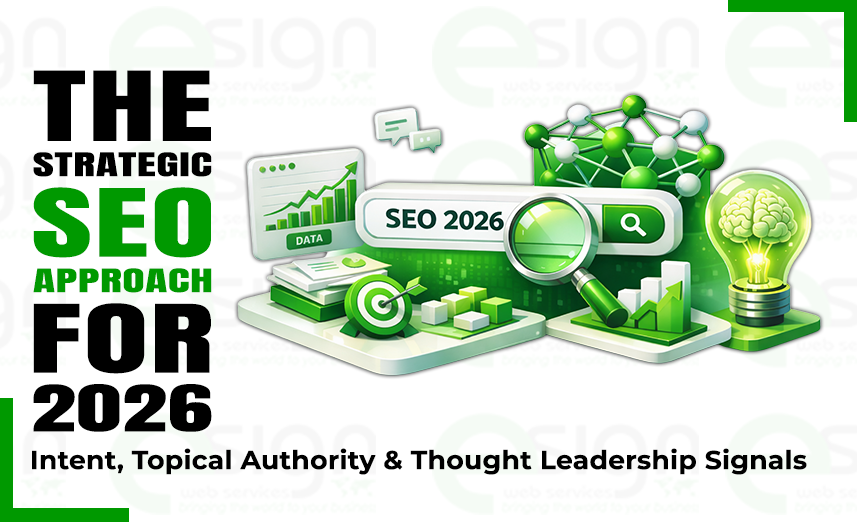
When I look at how SEO is shaping up for 2026, one thing stands out clearly: ranking alone no longer feels like the finish line. It feels like the entry requirement. In the early days, visibility was the reward. Today, visibility is granted only when trust is earned. That’s the fundamental shift behind the strategic SEO approach for 2026, and it’s the reason so many sites feel stuck despite “doing everything right.” Search systems have matured, users are sharper, and generic answers are increasingly filtered out by AI layers that compress sameness into a single summary.
What excites me about this phase is that SEO has finally aligned with how people actually think and decide. Instead of rewarding those who published first or optimized the hardest, search now leans toward those who explain best, cover the topic fully, and demonstrate real understanding. That’s where search intent SEO, topical authority SEO, and thought leadership SEO stop being buzzwords and start becoming survival skills. Intent keeps you relevant. Authority keeps you visible across variations. Leadership keeps you memorable.
The opportunity in 2026 isn’t to out-optimize competitors by a small margin. It’s to build a presence that search systems don’t want to replace. When your content reduces uncertainty, answers follow-up questions naturally, and reflects lived expertise, it compounds rather than resetting with every update. That’s the mindset shift that separates tactical SEO from a real SEO strategy 2026. In this blog, we explore how aligning intent, authority, and leadership transforms SEO from a tactic into a resilient, compounding strategy.
Did you know?: Many high-ranking pages in 2026 lose visibility not because they’re “bad,” but because they sound identical to dozens of other answers already summarized by AI-driven SERPs.
How Should SEO Work in 2026?
When most people discuss SEO strategy, the conversation quickly turns technical with tools, audits, dashboards, templates. I’ve seen that approach fail too often to rely on it. For me, the strategic SEO approach for 2026 starts much earlier, at the moment a person decides to search. Understanding that decision; not just the query; is where modern SEO either works or quietly breaks. Here’s how I break it down in practice.
The First Layer: Intent comes before everything else
At the core of my approach is intent. I don’t begin by asking whether a keyword is informational or transactional. I focus on the reason behind the search. This is where intent modeling matters. What I look for is:
- What outcome does the user expect after clicking on a result
- How urgent or exploratory the search feels
- What would make the user confident that they chose the right page
If the content solves the wrong problem, rankings may appear briefly, but trust and conversions won’t follow. This is why intent alignment is the foundation, not an optimization step.
The Second Layer: Authority is built through completeness, not volume
Once intent is clear, authority becomes the natural next layer. Topical authority SEO isn’t about publishing more content; it’s about covering a topic properly. I focus on:
- One strong pillar that defines the topic clearly
- Supporting pages that handle objections, comparisons, and execution
- Logical connections between pages using topic clusters
- Clear relationships reinforced through semantic SEO, not repetition
When content is structured this way, search systems don’t treat isolated pages as separate entities. They see a coherent body of knowledge.
The Third Layer: Leadership is proven, not claimed
The final layer is where most content falls apart. Thought leadership SEO is not about strong opinions or polished language. It’s about proof. This shows up through:
- Frameworks and models built from real experience
- Patterns observed across projects or time
- Honest constraints and trade-offs, not just success stories
- Signals that reinforce brand authority, signals, and author credibility
Even small elements of original research, benchmarks, or examples make content more trustworthy and harder to replace. Together, the three layers of a strategic SEO approach; intent, Authority, and Leadership, create a resilient, compounding system that meets user needs, builds depth, and earns lasting visibility and trust.
Why do these SEO work together?
Intent earns relevance. Authority earns breadth. Leadership earns trust. When these three are aligned, SEO stops behaving like a fragile tactic and becomes a system that holds up, even as algorithms and formats evolve.This alignment creates a kind of resilience that short-term optimizations cannot achieve. Content no longer competes on superficial signals alone; it competes on clarity, depth, and real usefulness. Users feel understood because their questions are anticipated and answered comprehensively. Search systems recognize the consistency and completeness of your content, rewarding it across queries and formats. Over time, this approach compounds, turning each well-crafted piece into a building block that strengthens the overall ecosystem, making your SEO not only more effective but inherently more trustworthy and sustainable.
How Search Systems Actually Evaluate Content in 2026
One of the biggest misconceptions I see is the belief that search systems “read” content the way humans do. They don’t. They evaluate whether a page consistently meets user needs. That’s why search intent SEO is now less about keywords and more about completion. Did the page answer the question quickly? Did it guide the reader logically? Did it reduce the need to go back to search? Pages that do this well tend to survive updates even when layouts change.
Authority shows up through structure and relationships. When a site covers a topic thoroughly and connects its pages logically, it behaves like a source instead of a publisher. That’s why topical authority SEO is closely tied to internal linking, consistent terminology, and depth across subtopics. A scattered site looks unsure. A connected site looks confident.
Leadership and trust are evaluated through signals that go beyond text. Who wrote this? Is the experience visible? Are claims supported? Is the content cited, shared, or referenced elsewhere? These signals feed into E-E-A-T signals and reinforce trust and authenticity marketing principles that now influence SEO outcomes directly. In simple terms, search rewards content that feels hard to fake. The more your content reflects real experience and structured thinking, the easier it is for search systems to trust it.
Strategic SEO vs Traditional SEO
Why the Old Playbook Feels Fragile
Traditional SEO taught me discipline. It forced structure, consistency, and respect for fundamentals—and that still matters. But relying on conventional SEO alone in 2026 feels increasingly risky. The reason is simple: traditional approaches are reactive by design. They focus on ranking individual pages, optimizing for isolated keywords, and adjusting tactics after every visible algorithm shift. That mindset worked when search systems were simpler. It’s far less reliable in an environment shaped by AI summaries, intent layering, and trust signals.
When I shifted to a strategic SEO approach for 2026, the biggest change wasn’t technical—it was philosophical. Instead of asking whether a single page could rank, I started asking whether the entire topic ecosystem could earn trust and stay relevant even as SERPs changed. That shift reframed how I measure success and how I decide what to publish.
Here’s the mindset change that made the biggest difference for me:
- Instead of asking “Can this page rank?”, I ask “Can this topic ecosystem earn trust?”
- Instead of tracking a single primary keyword, I track how widely we’re visible across related queries and surfaces.
- Instead of publishing more content, I focus on better-connected, better-supported content that compounds over time.
To make the difference clearer, this is how I compare the two approaches in practice:
| Traditional SEO | Strategic SEO (2026) |
|---|---|
| Focuses on individual pages | Focuses on complete topic ecosystems |
| Optimizes for specific keywords | Aligns content to intent and decision stages |
| Measures rankings as the main KPI | Measures coverage, trust, and lead quality |
| Reacts to algorithm updates | Designs for stability through updates |
| Publishes more to compete | Publishes proof-led, differentiated assets |
Traditional SEO reacts. Strategic SEO anticipates. When content is designed around intent, reinforced through authority, and differentiated through leadership, updates feel less disruptive. That’s why a modern SEO strategy 2026 prioritizes stability and credibility over short-term spikes. The goal isn’t to win a position for a moment—it’s to become the default answer people trust.
What I’ve learned: Traditional SEO teaches control. Strategic SEO teaches resilience. In 2026, resilience wins more often than precision.
How I Built a Strategic SEO System
My process always starts with clarity. Before writing anything, I carefully map my intent. I want to know what the reader expects to see, which questions will follow, and what would make them trust the answer. This prevents content bloat and keeps the focus tight. From there, I build a topic ecosystem instead of isolated posts, using topic clusters to guide readers logically from overview to execution.
Then I add differentiation. Every strong cluster includes at least one proof asset: a framework, a comparison, a teardown, or a small dataset. This is where thought leadership SEO becomes tangible and where original research SEO thinking pays off. Proof assets don’t just attract links; they create recall. Finally, I make credibility visible. Clear authorship, consistent topic focus, and transparent reasoning strengthen E-E-A-T signals without forcing them. When combined with solid structure and data-driven marketing discipline, SEO becomes less volatile and more predictable.
Quick checks I use before publishing:
- Does this clearly match the dominant SERP format?
- Does it answer fast, then go deeper?
- Is the internal path obvious?
- Is expertise visible without overselling?
What Quietly Kills SEO Strategy?
Most SEO failures don’t happen overnight. They happen quietly, through small misalignments that compound over time. One of the most common is intent drift. This is when a title promises one outcome, but the content delivers something else. Users click with a clear expectation, don’t find what they need, and leave. Over time, this erodes trust and weakens search intent SEO, even if the page looks well-optimized on the surface.
Another silent issue is what I call generic ecosystems. Pages exist, content is published regularly, but nothing truly stands out. Without structure, depth, or differentiation, these pages fail to build topical authority SEO. They may rank briefly, but they’re easily replaced. Search systems are increasingly good at identifying content that adds no new value.
The third breaker is authority theatre. This happens when brands publish frequently to look active, without a clear system behind the content. Volume replaces clarity, and structure gets ignored. Without strong signals of brand authority and visible author credibility, consistency alone doesn’t create trust.
Warning: If you plan to be “slightly better optimized” than competitors, AI-driven SERPs will flatten that advantage. Without proof, positioning, and clarity, content becomes interchangeable; and forgettable.
SEO Signals That Matter 2026
Rankings still have a role in SEO, but in 2026, they’re only part of the picture. A single ranking doesn’t tell you whether users trust your content or return to it. That’s why my measurement approach has evolved alongside my SEO strategy 2026. I focus less on isolated positions and more on signals that indicate long-term strength.
One of the clearest indicators is coverage growth. When you build topical authority SEO properly, your site starts ranking for related queries you never explicitly targeted. That’s a sign search systems see your content as complete, not just optimized. Another key signal is multi-surface visibility—appearing in featured snippets, People Also Ask, or AI-generated summaries. Visibility across surfaces matters more than a single blue link.
I also track branded lift. When thought leadership SEO works, people return intentionally. They search for your name, reference your ideas, or share your content internally. That behavior reflects trust, not just curiosity. Finally, I look at lead quality. Fewer, better-aligned visitors consistently outperform large volumes of disengaged traffic. In 2026, meaningful SEO performance is measured by confidence and continuity, not spikes.
In Essence
In 2026, SEO feels less like a race and more like a system-building exercise. Chasing short-term movement, rankings, traffic spikes, or trends, creates constant instability. What holds up is clarity. When intent is precise, authority is structured, and leadership is proven, content doesn’t reset with every update. It compounds. That’s the real value behind a strategic SEO approach for 2026.
What I’ve learned is that search systems increasingly reward confidence. Not loud confidence, but quiet confidence built through completeness, relevance, and consistency. When content genuinely helps users think, decide, or act, it sends signals that algorithms struggle to ignore. That’s where E-E-A-T signals and trust-driven performance naturally align.
SEO has finally moved closer to how people actually evaluate information. They don’t just ask, “Is this visible?” They ask, “Does this feel reliable?” When your content answers that question clearly, predictability replaces volatility. You spend less time reacting and more time refining.
That’s why I no longer see SEO as a set of tactics. I see it as an investment in understanding, structure, and credibility. Build those deliberately, and SEO stops feeling fragile. It starts behaving like an asset that grows stronger with time.
Ready to Take Your SEO to the Next Level?
SEO isn’t just about rankings; it’s about building a sustainable, trusted presence. If you’re ready to shift from quick fixes to long-term strategy, let’s craft a plan that grows with you. Let’s make your SEO work for you, now and in the future. Ready to get started? Let’s connect!
Frequently Asked Question
Question: What is the strategic SEO approach for 2026?
Answer: The strategic SEO approach for 2026 is about building a content system that aligns with user intent, demonstrates topical authority, and provides thought leadership. This means mapping content to real user needs, covering a topic fully across connected pages, and offering proof-based insights. It focuses on trust and relevance, not just rankings, and ensures that SEO adapts as algorithms and user expectations evolve.
Question: How does search intent affect SEO?
Answer: Search intent is the foundation of SEO. It focuses on understanding the true reason behind a search query, whether users are seeking information, comparing options, or looking to purchase. Aligning your content with search intent SEO ensures that you deliver what users expect, which boosts trust and engagement, leading to better rankings and long-term performance.
Question: What is topical authority SEO?
Answer: Topical authority SEO is about creating a comprehensive content ecosystem that fully covers a subject from multiple angles. It involves pillar pages supported by related content—each reinforcing the other. This structure helps search systems understand your site as an authority on the topic. Topic clusters and semantic SEO ensure that your site isn’t just about individual pages, but about delivering consistent, in-depth knowledge.
Question: What makes thought leadership SEO different from regular SEO?
Answer: Thought leadership SEO isn’t just about ranking—it’s about originality and proof. Instead of repeating generic content, it includes unique frameworks, case studies, research, and insights that demonstrate expertise. It builds author credibility and brand authority, making your content not only rank higher but also be cited, referenced, and trusted over time. This is how you become a go-to resource in your niche.
Question: How do E-E-A-T signals impact SEO?
Answer: E-E-A-T (Expertise, Authoritativeness, Trustworthiness) signals are crucial for SEO in 2026. They reflect the quality of content and credibility of authorship. Search systems use these signals to determine whether a page is trustworthy enough to rank high. You can build E-E-A-T signals by demonstrating real-world expertise, offering transparent reasoning, and showing consistent quality through your content. Strong author credibility is key to earning E-E-A-T trust in competitive spaces.
Question: What are brand authority signals?
Answer: Brand authority signals are indicators that show your brand is a trusted, credible resource in its industry. This includes mentions, citations, backlinks, and content consistency across platforms. Building authority means offering value-driven content that resonates with your audience, building user trust, and being referenced by other respected sources. Topical authority SEO and thought leadership contribute significantly to these signals.
Question: How can I improve my author credibility?
Answer: Author credibility is earned by consistently demonstrating expertise in your field. You can improve this by authenticating your author bio, publishing high-quality content, and showcasing first-hand experience. Linking to verified sources, contributing to relevant forums or publications, and maintaining authorship consistency across your website can boost your credibility. A clear, consistent voice backed by real insights helps solidify your authority.
Question: Why is intent modeling important for SEO?
Answer: Intent modeling is essential because it goes beyond simple keywords. It’s about understanding the reason behind each search and matching it with content that delivers real value. By mapping user needs to your content, you ensure that your website isn’t just ranking, but actually solving problems and guiding users through their journey. This deepens engagement and results in higher trust and conversions.
Question: What role do topic clusters play in SEO?
Answer: Topic clusters help organize your content logically and make it more discoverable by search systems. A pillar page serves as the main content hub, while supporting pages link back to it. This structure enables search engines to understand semantic connections between pages, boosting topical authority. It’s a strategy that increases both the breadth and depth of your content coverage, ultimately improving rankings and visibility.
Question: How does semantic SEO affect rankings?
Answer: Semantic SEO focuses on understanding the meaning behind words, not just exact keyword matches. By considering context, user intent, and relevance, it ensures that your content is aligned with what users truly want. Search systems reward content that uses related terms, phrases, and natural language, ensuring it meets real-world expectations. This boosts content’s ability to rank across related topics, not just isolated keywords.