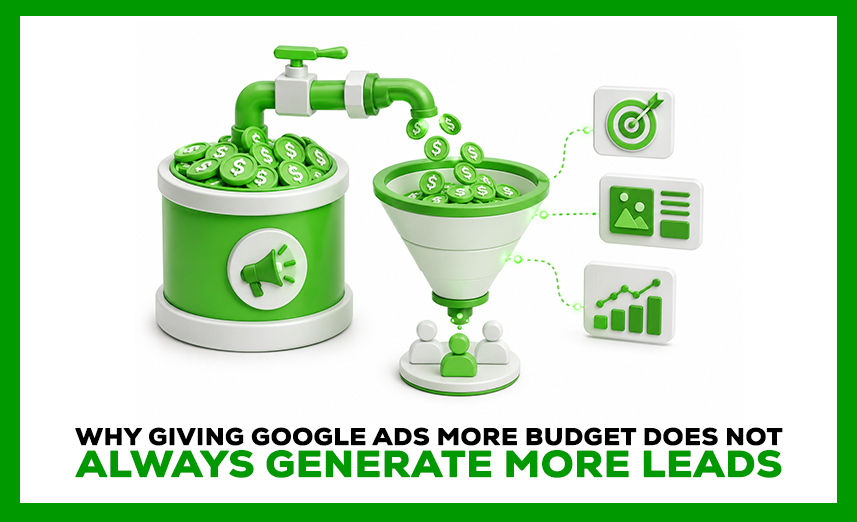
Google Ads can be a powerful way to generate leads, but increasing the budget does not always produce the growth businesses expect. A campaign that performs well at one spending level may behave differently when more money is added. Search demand, competition, targeting, conversion rates, lead quality, landing-page performance, and even the sales process can all affect the outcome.
Before increasing a Google Ads Budget, businesses need to understand what is actually limiting lead generation. More spend can help when a campaign is genuinely restricted by budget, but it can also increase wasted clicks when deeper performance issues remain unresolved. In this blog, we will look at the main reasons why a higher Google Ads budget may not generate more leads and what businesses should review before scaling their campaigns.
Why the “More Budget = More Leads” Assumption Is Flawed
It is easy to see why businesses expect more advertising spend to produce more leads. If a campaign is already bringing in inquiries, putting more money behind it feels like the obvious next move. The problem is that Google Ads does not sell leads at a fixed price. It gives advertisers access to changing auctions, users, searches, and opportunities. A higher Google Ads budget can help, but only when enough valuable demand is still available.
1. Google Ads Is an Auction, Not a Lead-Purchasing System:
Every time someone carries out an eligible search, advertisers may compete for the chance to show an ad. The result: more than just the budget shapes the outcome. The outcome factors beyond just the budget influence the outcome. by factors beyond just the budget. Bids, ad relevance, expected performance, landing-page experience, competition, and other auction signals all influence the appearance of an ad. Raising the budget simply gives a campaign more room to participate. It does not create a guaranteed supply of enquiries waiting to be purchased.
2. Budget Buys Opportunities, Not Guaranteed Customers:
Suppose a business spends $100 a day and usually receives five inquiries. Moving the daily budget to $200 does not automatically turn five leads into ten. The campaign may gain more clicks, but those visitors still need to be the right people, land on a convincing page, and feel ready to take action. More spending creates additional opportunities. Whether those opportunities become customers depends on everything that happens before and after the click.
3. Advertising Demand Is Not Unlimited:
A local roofing company, specialist law firm, or niche B2B provider only has a certain number of relevant searches available in its target market. Once a campaign is already reaching much of that demand, there may simply be fewer high-quality opportunities left to capture. At that point, an extra budget may push the campaign towards broader searches, new audiences, different locations, or more expensive auctions instead of producing the same type of lead at the same cost.
More budget can support growth, but it cannot promise it. The campaign still depends on demand, competition, targeting, conversion rate, landing-page quality, and the type of people clicking the ads. It is more useful to think of budget as fuel. If the campaign is already working well, extra fuel can take it further. Adding more fuel won’t solve the engine’s issues if it has any.
Is Your Campaign Budget-Limited or Performance-Limited?
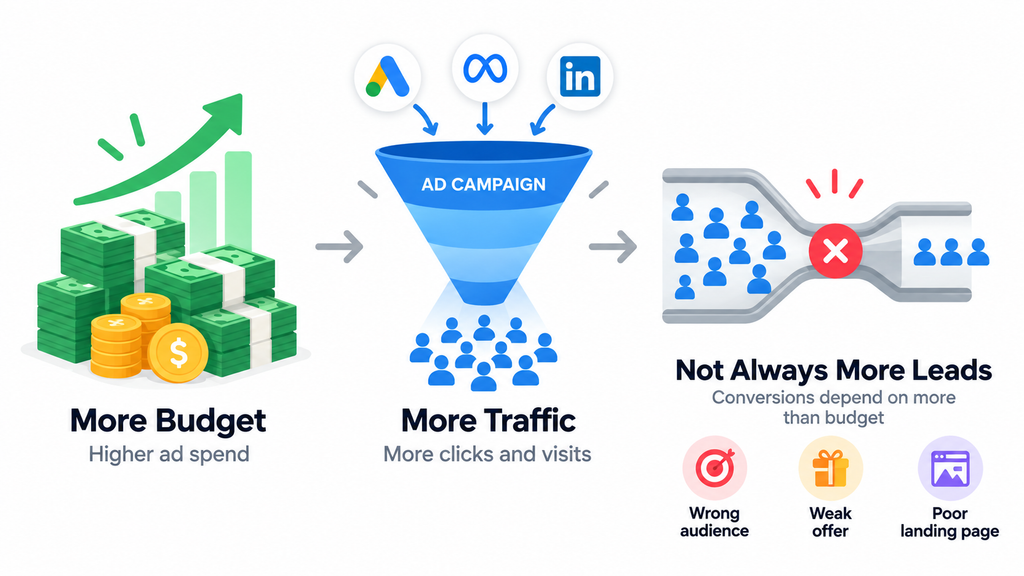
Before changing spend, it helps to work out what is actually holding the campaign back. Some campaigns are genuinely budget-limited. They already generate excellent leads at sustainable costs but cannot participate in enough valuable searches because the available spend runs out. Others are performance-limited. They have access to traffic, but weak targeting, poor conversion rates, inaccurate tracking, weak offers, or low-quality enquiries stop that traffic from producing strong results.
- What Budget-Limited Actually Means: A budget-limited campaign is usually already doing several things well. It may have a healthy conversion rate, useful search terms, consistent qualified leads, and a cost of acquisition the business can afford. The issue is simply that the campaign cannot capture all the relevant demand available. When that happens, increasing the budget may give a proven campaign more opportunities without requiring a major change in strategy.
- What Performance-Limited Means: A performance-limited campaign looks entirely unique. It may already be getting plenty of clicks, but too few of them turn into genuine inquiries. Perhaps the searches are too broad, the landing page is weak, the offer is not convincing, or the leads are poor quality. In these cases, businesses often complain about Google Ads not generating leads even though the account is spending consistently. Increasing the budget only allows the existing weaknesses to consume more money.
- Use Impression Share to Understand Constraints in Your Campaign: Impression share can help show how much eligible demand a campaign is currently capturing. Search lost impression share due to budget can indicate that ads are missing opportunities because the budget is limited, while lost impression share due to rank points to competitiveness or Ad Rank issues. These numbers are useful because they give advertisers a clearer idea of whether the real constraint is money, campaign strength, or a combination of the two.
Knowing whether a campaign is budget-limited or performance-limited makes scaling decisions far easier. If beneficial searches are being missed because a profitable campaign genuinely runs out of money, a budget increase may make sense. If the campaign has enough traffic but struggles to turn it into worthwhile leads, optimization should come first. This simple distinction can prevent a business from throwing more money at a problem that spending alone cannot solve.
Increasing Google Ads spend does not always result in more leads. The following reasons explain why a higher budget may still fail to deliver the expected growth:
Reason #1: There May Not Be Enough Search Demand
Sometimes the problem is not the campaign, website, or content. There may simply be a limited number of people actively searching for that service. When demand is small, even strong visibility cannot create unlimited traffic or leads.
- Search Volume Creates a Natural Ceiling: If only a limited number of people search for the service each month, traffic and lead growth will naturally have a limit.
- Geographic Targeting Limits Available Demand: Businesses serving a small city, radius, or local area have fewer potential searchers than companies targeting a much wider market.
- Niche Industries Have Smaller Search Pools: Specialized services often receive fewer searches because the audience is smaller, even when those searches are highly relevant.
- High-Intent Searches Are Usually Limited: People who are ready to contact, book, or buy make up only a small portion of overall search activity.
- Expanding Beyond Core Demand Can Reduce Lead Quality: Broadening targeting may increase traffic, but it can also attract less relevant visitors who are less likely to become customers.
Reason #2: Additional Budget Can Buy More Expensive Clicks
Increasing the budget does not always mean getting more traffic at the same cost. As spend grows, the campaign may need to compete in more expensive auctions to find extra clicks and leads.
- Google Ads Operates through Auctions: Every ad click comes from an auction where advertisers compete based on bids, relevance, quality, and the likelihood of getting results.
- Competition Influences CPC: When more advertisers go after the same searches or audiences, click costs can rise even when your campaign settings stay exactly the same.
- Incremental Traffic May Cost More: The easiest and cheapest opportunities are often captured first, while finding additional traffic may require paying more for each click.
- More Clicks Can Arrive Without Proportional Conversion Growth: Extra spend may bring more visitors, but conversions can grow more slowly if that additional traffic is less relevant or less ready to act.
Reason #3: Your Targeting May Be the Real Problem
More budget cannot fix poor targeting. If your ads are reaching the wrong searches, locations, or audiences, extra spend can simply bring in more low-value traffic.
- Keywords Are Too Broad: Broad keywords can attract searches that are only loosely connected to your service and unlikely to turn into useful enquiries or sales.
- Search Intent Is Poorly Matched: A keyword may look relevant while still attracting people who are researching, comparing, or learning rather than ready to contact a business.
- Geographic Targeting Is Too Wide: Showing ads outside realistic service areas can waste budget on people who are unlikely or unable to become actual customers.
- Negative Keywords Are Incomplete: Missing negative keywords can allow irrelevant searches to trigger your ads, increasing clicks without improving the number of qualified leads.
- Search Terms Are Not Reviewed Regularly: Search term reports show what people actually typed, helping you spot irrelevant traffic and improve targeting before more budget is wasted.
Reason #4: Your Landing Page Cannot Convert the Additional Traffic
More traffic will not help much if the landing page struggles to turn visitors into leads. Increasing spend can simply expose the same conversion problems to more people.
- Weak Value Proposition: Visitors should quickly understand what you offer, why it matters, and why choosing your business makes sense compared with other available options.
- Poor Message Match: If the landing page does not match what the ad promised, visitors may leave because the experience feels confusing or disconnected.
- Slow Page Speed: A slow page can lose potential customers before they even see the offer, contact details, form, or other important information.
- Poor Mobile UX: Small text, awkward forms, confusing navigation, or badly placed buttons can reduce conversions when a large share of traffic comes from mobile devices.
- Missing Trust Signals: Reviews, testimonials, credentials, guarantees, and clear company information can help people feel more confident before they submit an enquiry.
- Conversion Rate Becomes the Scaling Bottleneck: If the page converts poorly, more traffic may raise costs faster than leads because the real conversion issue has not been fixed.
Reason #5: The Offer Isn’t Competitive Enough
Sometimes the campaign is doing its job and the landing page is usable, but the offer itself is not strong enough to convince people to choose the business.
- Competitors Have Stronger Offers: Customers may choose another provider when competitors offer clearer benefits, stronger guarantees, faster service, better packages, or more attractive incentives.
- Customers Cannot See Enough Value: Even fair pricing can feel expensive when the page does not clearly explain what customers receive and why the offer is worthwhile.
- No Meaningful Differentiation: If several businesses look almost identical, customers have little reason to choose one unless there is a clear and relevant advantage.
Reason #6: Conversion Tracking Is Giving Google the Wrong Signals
Automated campaigns rely heavily on conversion data. If that data is wrong or incomplete, Google may optimize toward actions that do not represent real business results.
- Incorrect Conversion Actions: Campaigns may optimize toward actions that look useful inside the platform but have little connection to actual leads, sales, or revenue.
- Micro-Conversions Counted as Leads: Page views, button clicks, or small actions should not be treated like qualified leads when they do not represent genuine enquiries.
- Duplicate Conversions: Recording the same lead more than once can make performance look stronger and give automated bidding a misleading view of campaign success.
- Missing Conversion Tracking: When valuable actions are not recorded, Google gets an incomplete picture of which searches, ads, audiences, and campaigns are actually working.
- Phone Calls Not Properly Tracked: Businesses that depend on calls may underestimate results or optimize poorly if valuable phone enquiries are not being captured accurately.
Reason #7: Google Is Optimizing for Lead Quantity Instead of Lead Quality
A campaign can produce more leads without producing more customers. The real goal should be valuable enquiries, not simply a higher number of form submissions.
- Not Every Lead Has Equal Business Value: Some enquiries are ready to buy, while others may be poorly matched, outside the service area, or unlikely to become customers.
- Spam and Low-Intent Enquiries: Cheap conversions can sometimes include spam, job seekers, research enquiries, or people with very little intention of purchasing the service.
- Lead-to-Sale Rate Matters: Performance should consider how many leads become paying customers instead of judging success only by form submissions, calls, or conversion totals.
- Offline Conversion Data: Sending sales outcomes back into Google Ads can help automation understand which leads eventually became qualified opportunities or paying customers.
Reason #8: Automated Bidding Needs the Right Conditions to Scale
Smart bidding can help campaigns grow, but it still needs reliable data, realistic targets, and enough flexibility to compete in the right auctions.
- Smart Bidding Needs Reliable Conversion Data: Automated bidding depends on historical and current conversion signals, so inaccurate or inconsistent tracking can lead to poor bidding decisions.
- Target CPA Can Restrict or Expand Traffic: An unrealistic CPA target can limit auction participation, while a more flexible target may allow the campaign to reach additional opportunities.
- Target ROAS Changes Auction Participation: Higher ROAS requirements can make bidding more selective, reducing traffic when Google predicts certain auctions may not meet profitability goals.
- Budget and Bid Strategy Must Work Together: Increasing budget alone may have little effect when bid targets or campaign settings prevent Google from entering enough suitable auctions.
Reason #9: Increasing Budget Too Quickly Can Change Campaign Behavior
A campaign that works well at one budget level may behave differently when spend rises quickly. More budget can change where and how Google looks for traffic.
- Historical Performance May Not Scale Linearly: Doubling the budget does not automatically double leads because the campaign may already be capturing many of its most efficient opportunities.
- Automation May Explore Additional Opportunities: More budget gives Google room to enter auctions it previously skipped, which can introduce traffic with different costs and conversion potential.
- Traffic Mix Can Change: As campaigns expand, more clicks may come from different searches, audiences, devices, times, or locations than those driving earlier performance.
- CPA Can Increase during Expansion: Extra conversions may become more expensive as the campaign moves beyond the strongest and easiest opportunities already available.
Reason #10: Your Sales Process May Be the Bottleneck
Google Ads does not control what happens after a lead comes in. A strong campaign can still produce weak business results if the sales process does not convert those enquiries.
- Slow Lead Response: Potential customers may contact several businesses at once, so a delayed reply can give competitors the chance to start the conversation first.
- Missed Calls: Unanswered calls can quickly become lost leads, especially for urgent services where people may simply contact the next available business.
- No Lead Nurturing: People who are not ready today may still convert later if the business continues to provide useful and relevant communication.
- CRM Problems: Missing notes, duplicate records, poor lead assignment, or inconsistent updates can make opportunities harder to manage and performance harder to measure.
- Marketing Leads vs Closed Customers: Campaign success should ultimately connect ad-generated leads with qualified opportunities, closed customers, and revenue rather than stopping at conversion counts.
When Increasing Google Ads Budget Actually Makes Sense
Increasing the budget makes more sense when the campaign already has solid foundations and there is clear evidence that extra spend can support profitable growth.
- Campaigns Are Consistently Profitable: Scaling is easier to justify when campaigns regularly bring in customers at a cost that still leaves room for healthy profit.
- Conversion Tracking Is Accurate: Reliable tracking gives advertisers and Google a clearer picture of which clicks and campaigns are actually producing valuable results.
- Lead Quality Is Strong: Extra budget is more useful when current enquiries closely match the target customer and regularly move forward through the sales process.
- Search Lost Impression Share Shows Additional Opportunity: Lost impression share from budget can point to relevant demand the campaign is currently unable to capture fully.
- Sales Teams Can Handle More Leads: Additional advertising only helps when the sales team has enough capacity to respond quickly and manage extra enquiries properly.
- Customer Acquisition Cost Remains Sustainable: More spend makes sense when the expected cost of winning additional customers remains reasonable compared with their value and profit.
When You Should Optimize Before Increasing Budget
If the campaign already has clear efficiency or tracking problems, adding more budget can simply make those problems more expensive. Fix the weak areas first.
- High Spend but Low Conversion Rate: If plenty of people click but few convert, review targeting, landing pages, offers, and user experience before spending more.
- Poor Search Term Quality: Irrelevant or loosely related searches suggest targeting needs work. More budget could simply increase spending on the same low-value traffic.
- Expensive Unqualified Leads: High lead volume means little when enquiries rarely match customer needs. Lead quality should improve before the campaign receives more money.
- Broken or Incomplete Tracking: Scaling with unreliable tracking makes it harder to know what works and can cause automated bidding to chase the wrong outcomes.
- Poor Mobile Experience: Mobile usability issues can waste a large share of paid traffic, especially when forms, navigation, or calls-to-action are difficult to use.
- Low Lead-to-Sale Rate: When many leads fail to become customers, the issue may be lead quality, follow-up, qualification, pricing, or the sales process.
A Better Framework for Scaling Google Ads
Scaling Google Ads works better when each increase is based on real performance data rather than budget alone. The goal is to grow while keeping lead quality, acquisition costs, and profitability under control.
Step 1 – Validate Conversion Tracking: Make sure forms, calls, bookings, purchases, and other important actions are being recorded accurately before using that data to guide decisions.
Step 2 – Measure Lead Quality: Look beyond total conversions and check whether leads are relevant, qualified, and likely to become paying customers.
Step 3 – Analyze Search Demand: Review how much genuine demand exists for your main services, locations, and high-intent searches before expecting budget increases to create unlimited growth.
Step 4 – Review Search Terms and Targeting: Check the actual searches triggering ads and remove irrelevant traffic before putting more money behind the campaign.
Step 5 – Evaluate Impression Share and Lost Opportunities: Look for strong campaigns or keywords losing valuable visibility because of budget or Ad Rank before deciding where additional spend belongs.
Step 6 – Improve Landing Page Conversion Rate: Strengthen messaging, page speed, trust signals, forms, mobile usability, and calls-to-action so more existing visitors become leads.
Step 7 – Calculate Sustainable Customer Acquisition Cost: Work out how much the business can afford to spend on acquiring a customer without damaging profitability.
Step 8 – Increase Budget Strategically: Raise spending where the data shows additional profitable demand instead of increasing every campaign by the same amount.
Step 9 – Monitor Incremental Performance: Watch what happens to CPC, CPL, lead quality, conversion rate, and customer acquisition cost as additional budget begins spending.
Step 10 – Scale until Marginal Returns Stop Making Business Sense: Continue growing while each additional level of spend still produces customers at a cost the business can comfortably support.
Avoid Common Budget Scaling Mistakes
Scaling works best when the campaign is already stable. Before increasing spend, make sure tracking is reliable, targeting is clean, landing pages perform well, and lead quality is strong enough to support growth.
- Do Not Double the Budget Just to Get More Leads: More spend does not automatically produce the same quality of traffic or the same conversion efficiency.
- Fix Tracking Problems Before Scaling: If conversions are being recorded incorrectly, budget increases can push Google toward the wrong actions and create misleading results.
- Review Search Terms Before Increasing Spend: Poor search terms can waste additional budget quickly, especially when targeting is already bringing in low-value or irrelevant traffic.
- Improve Weak Landing Pages First: Sending more visitors to a page that converts poorly usually increases wasted spend rather than solving the underlying problem.
- Understand Lead Quality Before Scaling: More enquiries are not helpful if they rarely match the target customer or turn into real sales.
- Avoid Changing Budget and Bidding Together: Making several major changes at once makes it harder to understand what actually caused performance to improve or decline.
- Do Not Judge Results Too Quickly: A few days of data may not show the full effect of a budget change, especially when automated bidding is adjusting.
- Treat Platform Recommendations Carefully: Google’s suggestions can be useful, but each recommendation should still fit the campaign goals, margins, lead quality, and wider business situation.
- Scale Based on Business Economics: Confirm tracking, understand demand, improve conversion paths, and set realistic acquisition limits before raising spend further.
- Know When to Pause: If additional customers become too expensive or profitability starts falling, review performance and fix the weak areas before scaling again.
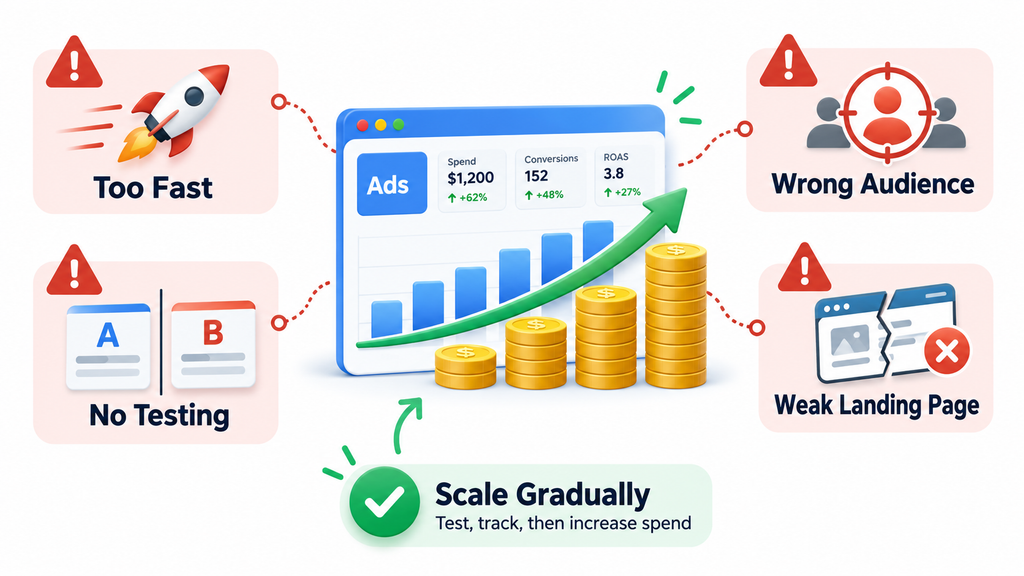
The safest approach is controlled growth. Increase spend gradually, watch how costs and lead quality change, and continue only while the extra volume remains profitable and manageable for the business.
Conclusion
Increasing a Google Ads budget can bring in more leads, but it works best when the budget is genuinely the reason a strong campaign cannot grow further. If the real issue is weak targeting, limited demand, poor landing pages, an unconvincing offer, inaccurate tracking, unsuitable bidding, low-quality enquiries, or a weak sales process, spending more will not remove the problem. It may simply make that problem more expensive. The first step should always be diagnosis.
Work out whether the campaign is budget-limited or performance-limited. Review search demand, impression share, search terms, conversion quality, landing-page performance, bidding, qualified-lead rates, acquisition costs, and sales outcomes. From there, calculate how much additional customer acquisition the business can support profitably. When those foundations are weak, improving them first will usually make every future advertising dollar work harder.
Ready to Get More From Your Google Ads Spend?
Ashwani Kumar Sharma and the experienced team at eSign Web Services can review your Google Ads campaigns, identify performance gaps, improve targeting and conversion tracking, and build a smarter budget strategy around your business goals. Get in touch today for practical Google Ads guidance focused on stronger lead quality, sustainable acquisition costs, and measurable ROI.
Frequently Asked Questions
Question: Will increasing my Google Ads budget generate more leads?
Answer: It can, but only when valuable demand is still available and the current budget is restricting a healthy campaign. If targeting, tracking, landing pages, or lead quality are weak, those issues should usually be addressed first.
Question: Why did my cost per lead increase after raising my Google Ads budget?
Answer: The campaign may start entering more expensive auctions or reaching broader traffic as it grows. A higher CPL is not automatically bad if the additional leads remain valuable and the overall customer acquisition cost stays profitable.
Question: How do I know if my Google Ads campaign is limited by budget?
Answer: Review lost impression share due to budget along with conversion rate, lead quality, search terms, and profitability. A true budget limitation usually means a strong campaign is missing valuable opportunities simply because available spend is running out.
Question: How much should a business spend on Google Ads per month?
Answer: There is no fixed amount for every business. Budget should reflect market demand, customer value, competition, conversion performance, acquisition targets, sales capacity, and how much the company can afford to spend profitably on new customers.
Question: Should I increase my Google Ads budget if my campaign is performing well?
Answer: Possibly. If tracking is accurate, leads are valuable, acquisition costs remain sustainable, profitable demand is still available, and the sales team can handle additional inquiries, a controlled budget increase may be worth testing.