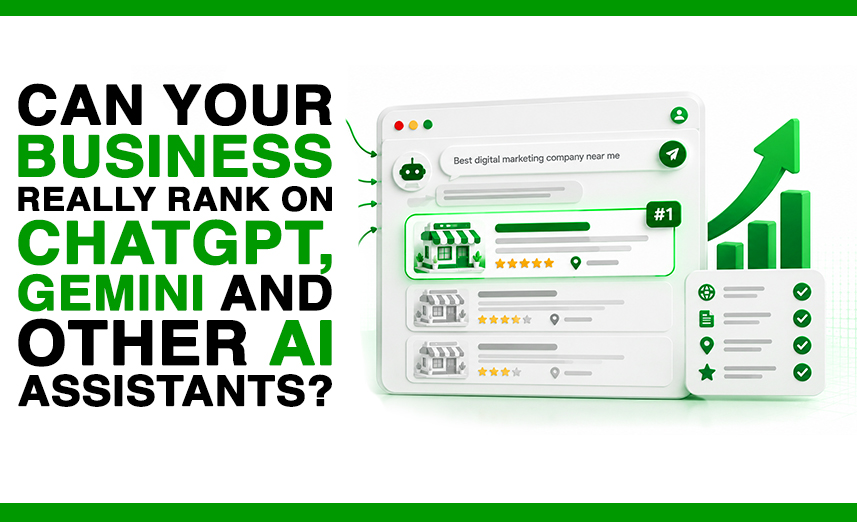
When a potential customer asks an AI assistant to recommend a business like yours, does your company appear? It is a reasonable question, especially if you have already invested in your website and SEO. Businesses can appear in these answers, but a brand mention, a website citation, and a provider recommendation mean different things. None establishes a permanent position. The useful question is whether your business appears accurately for customers whose needs match what you offer, and whether those appearances lead to meaningful interest.
In this blog, I will explain how ChatGPT, Gemini, and other assistants discover businesses, what you can improve, and how to measure progress. We will cover website access, service information, customer questions, useful content, and credible evidence. You will also learn how to recognise misleading ranking promises and build a review process that connects visibility with relevant enquiries rather than relying on a few favourable screenshots.
What Does “Ranking” on an AI Assistant Actually Mean?
Businesses can appear in AI answers. However, describing every appearance as a ranking creates expectations that the evidence may not support. AI search ranking is better understood by examining what the answer says, which sources it includes, and whether your business fits the customer’s request.
Mentions, Citations, and Recommendations Are Different
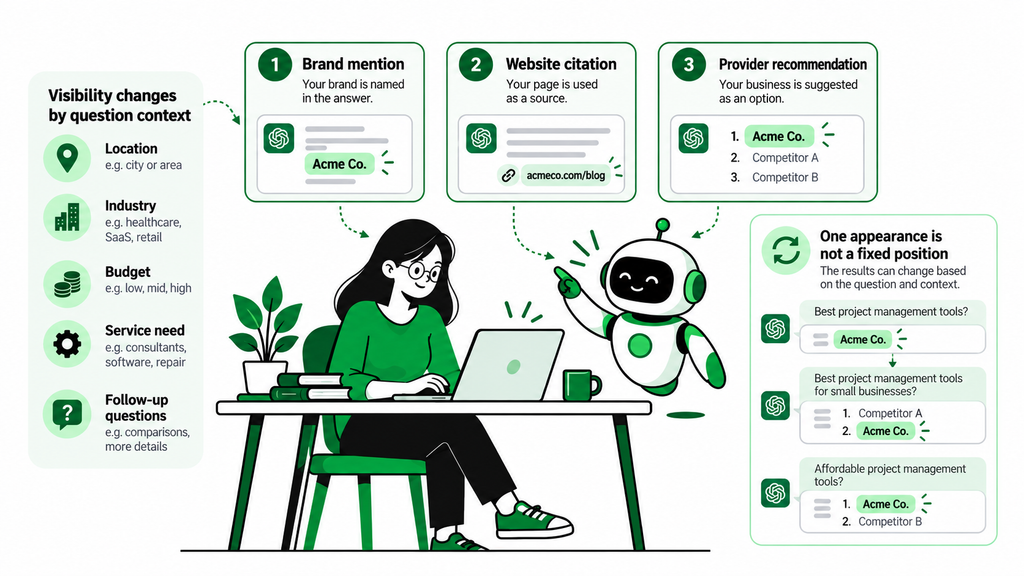
Imagine a hypothetical accountancy firm called Riverside Accounts. An assistant might mention its name while describing local firms, cite its tax guide when answering a bookkeeping question, or suggest it to someone looking for retail accounting support. Each appearance has a different meaning.
Brand mentions show that the business appears in the response. Website citations connect the answer to a particular source. AI-generated recommendations suggest that the business may suit the user’s requirements. A citation to Riverside’s guide does not necessarily mean the assistant recommends hiring the firm.
| Appearance Type | What It Demonstrates | What It Does Not Prove |
| Brand mention | The business is named in that response. | Endorsement, a website visit, or customer suitability. |
| Website citation | A page is linked as a source or supporting resource. | Recommendation of the business as a provider. |
| Provider recommendation | The business is presented as an option for that request. | A permanent position or verified suitability for every customer. |
Visibility Depends on the Question and Context
An answer to “recommend an accountant” may look very different from one asking for an accountant who handles retail payroll in a particular city. Budget, location, industry, urgency, and service requirements all change what a useful recommendation should contain.
Follow-up questions can narrow the options further. A firm mentioned initially might disappear when the user asks for weekend appointments or experience with overseas transactions. Evaluate visibility against the requirements your business actually meets, rather than treating every omission as a problem.
One Appearance Does Not Establish a Stable Position
One favourable response shows what happened in one test. It does not establish how often customers will receive the same answer.
Repeat relevant questions over time and record the circumstances. Keep fresh-chat tests separate from conversations containing previous brand information. This helps distinguish an appearance under ordinary discovery conditions from one influenced by the context you supplied.
How Do Different AI Platforms Discover Businesses?
There is no single discovery process covering every assistant. AI chatbot visibility depends partly on the product, the features being used, and the information available for that response. Understanding these distinctions helps you choose sensible checks without assuming one platform’s guidance applies everywhere.
Previously Learned Information and Live Retrieval Are Different
A model can generate an answer using information learned during training. A search-enabled experience can also retrieve external information when responding. These processes have different implications for freshness and website access.
For OpenAI’s crawlers, OAI-SearchBot supports search discovery, while GPTBot relates to potential model training. Their permissions are independent; a website can allow the search crawler while declining the training crawler. Neither permission guarantees a recommendation. Allowing training is therefore not a substitute for making current business information discoverable.
ChatGPT Search, Gemini Apps, and Google AI Search Need Separate Checks
ChatGPT Search can retrieve web information and provide source links. Gemini Apps may display sources or related links, but not every response includes them. Google AI Overviews and Google AI Mode are experiences within Google Search, rather than interchangeable names for the Gemini app.
When assessing whether you can rank on Gemini, specify which experience you mean. A business appearing in a Google Search AI answer has not necessarily appeared in Gemini Apps. I would assess these separately and record the sources visible in each.
Other Assistants and External Sources Broaden the Picture
Perplexity searches the web to develop cited answers. Microsoft Copilot should also be checked as its own experience, with attention to the product and mode used. Microsoft’s publisher reporting covers supported Copilot, Bing, and partner AI surfaces, rather than every AI assistant.
Inspect the visible sources rather than assuming the answer came directly from your website. A business profile, review platform, industry article, or directory may provide information about your company. The source matters when investigating an inaccurate description or missing service.
Which Customer Questions Should Your Business Focus On?
Testing should reflect the decisions customers face. Asking assistants about your company repeatedly can confirm branded recognition, but it reveals much less about whether people discover you while looking for help.
Start With Real Buying Questions
Collect questions from sales calls, enquiry forms, support conversations, and consultations. Look for questions that help people identify a problem, compare approaches, or choose a provider.
A managed IT business might hear, “Do we need ongoing support or occasional repairs?” and “Who can support an office with several locations?” These questions reveal different information needs. Group them by the decision involved, then select a manageable set representing your most important services.
Include the Details That Determine Suitability
Compare “recommend an accountant” with “recommend an accountant for a small retail business in my city.” The second question gives clearer criteria for assessing whether a provider fits.
Include location, industry, service scope, and budget where customers genuinely use them. Avoid constructing unusually specific questions solely to make your company appear. Conversational search optimization should begin with real customer language and useful answers, rather than prompts designed to produce a flattering result.
Separate Branded Visibility from Customer Discovery
Branded tests ask about a named business, such as whether it offers a particular service. Discovery tests ask for suitable options without naming a provider. Both are useful, but they answer different questions.
Small, local, and specialist businesses should focus on needs they can credibly serve. A specialist may be relevant to a narrow technical request even when it has little reason to appear in a broad national comparison. Build your question set around genuine suitability.
What Website Foundations Should You Fix First?
A useful website must be accessible and understandable before its information can help anyone evaluate the business. Technical work creates an opportunity for discovery. Clear service information gives that discovery practical value.
Check Access and Technical Barriers
Review crawler permissions, accidental indexing restrictions, server errors, and security settings that may block legitimate requests. Check important service pages individually rather than assuming the whole website works because the homepage loads.
For ChatGPT search discovery, review OAI-SearchBot access. For Google’s AI search features, check the current Search eligibility requirements and relevant settings. These are platform-specific checks, not a universal switch for AI visibility. Meeting technical requirements does not guarantee that a page will be selected.
Make Your Business Identity and Services Clear
Your website should make it easy to establish the business name, services, audience, locations, and contact details. Where qualifications matter, explain who holds them and what they cover.
“Complete solutions for modern businesses” tells readers very little. “Payroll and bookkeeping support for independent retailers in Bristol” provides a service, audience, and location. Include limitations too, such as minimum project size or areas you do not serve. This information helps prevent unsuitable expectations.
Maintain Useful SEO Structure
Use descriptive page titles, relevant headings, and internal links that help visitors find related services and explanations. Keep important information available as readable text. Where appropriate, use Schema.org structured data that accurately reflects the visible page.
Google Search Console can help investigate Google discovery and indexing issues. However, Google rankings should not be treated as a direct measure of visibility across assistants. Google also states that its AI search features do not require special AI schema or new machine-readable files.
Use this checklist to prioritise the foundations:
- Access: Important pages load correctly and intended crawlers are not accidentally blocked.
- Business details: Names, contact information, qualifications, and service areas are accurate.
- Service pages: Visitors can understand the offer, suitability, and next step.
- Internal links: Related explanations and evidence are easy to find.
- Information consistency: Website details agree with relevant public profiles.
Fixing these issues improves the information available to customers and discovery systems. It also creates a clearer starting point for testing, without promising that technical changes alone will produce recommendations.
What Content and Evidence Make Your Business Easier to Evaluate?
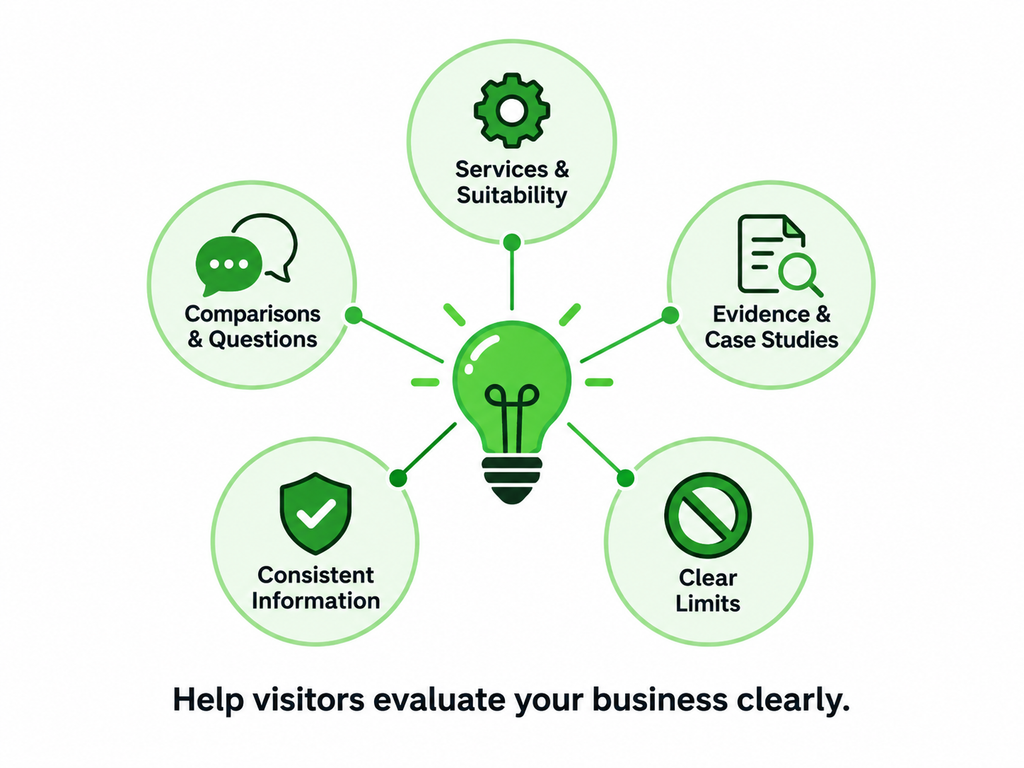
Strong content helps someone decide whether your business can solve their problem. It should explain the offer, answer important questions, and provide evidence readers can assess. Publishing more pages is less useful when the essential information remains vague.
Explain Services, Suitability, and Limitations
A service page should describe what is included, who the service suits, how delivery works, and what the customer must provide. Explain relevant timing, pricing conditions, or eligibility requirements when these affect the decision.
For example, an office cleaning company could state which property types it serves, whether cleaning happens outside working hours, and whether specialist tasks require a separate quotation. A prospect can then assess suitability without guessing what “comprehensive cleaning” includes.
Limitations are useful information. If you provide scheduled maintenance but no emergency callouts, say so. If a package excludes replacement parts, explain that before the enquiry. Honest boundaries can reduce unsuitable leads and help customers compare options fairly.
Answer Comparisons and Follow-Up Questions
Customers rarely make a decision after reading one broad description. They want to understand costs, alternatives, requirements, and trade-offs.
Begin with a direct answer, then explain the conditions that change it. A software provider comparing subscription and one-time pricing could explain recurring costs, update arrangements, support coverage, and migration requirements. The useful answer is the one that makes the decision clearer, even when neither option suits everyone.
Consider the questions that follow the initial comparison: What happens if requirements change? What information is needed for a quote? How difficult is switching providers? Can the customer start with a smaller service? These explanations belong on relevant pages, rather than being scattered across repetitive articles.
Support Claims with Genuine Evidence
Source credibility comes from information readers can inspect, not simply confident wording. Use documented processes, relevant credentials, demonstrations, case studies, and original observations where they support the claim. A useful case study explains the starting problem, the work completed, the timeframe, and the outcome. It also states important limitations. A result from one project should not become a promise that every customer will achieve the same outcome.
For example, a website project might improve enquiry completion after simplifying a form. Explain how the outcome was measured and whether other changes happened during the same period. That context makes the evidence more useful than an impressive figure presented without explanation. Google’s guidance for generative AI search emphasises useful, original content and experience rather than recycled summaries. This supports investing in material your business can genuinely contribute. It does not establish a guaranteed recommendation formula for every assistant.
Keep Website and External Information Consistent
Review relevant business listings, independent coverage, public reviews, and professional profiles. Check that names, services, locations, and qualifications remain current. Maintain your Google Business Profile where applicable, alongside the details on your website.
Independent sources can give readers another perspective. A review describing the service received or an industry profile explaining specialist expertise provides more context than a generic promotional claim. However, neither guarantees inclusion in an AI answer.
If your business moves or changes its offer, update the sources you control and request corrections from others where appropriate. An old directory listing should not continue presenting a discontinued service. I would strengthen these explanations and supporting evidence before commissioning more articles.
How Can You Measure AI Visibility Meaningfully?
A useful measurement process tracks relevant appearances and checks whether they lead anywhere valuable. AI brand visibility should be assessed through a defined sample, with enough context to explain what the results represent.
Build a Repeatable Question Set
Choose representative questions covering your main services and customer decisions. Record the exact wording, platform, mode, date, and relevant location or conversation context.
Repeat the same questions under comparable conditions, while keeping follow-up tests separate. Save the response and visible sources so you can review changes later. Avoid continually changing your question set to include prompts where the business happens to perform well.
Track Appearance and Accuracy Separately
Record mentions, citations, and recommendations as separate outcomes. Then check whether the answer describes your services, location, and qualifications correctly. A recommendation containing the wrong service area should not count as an unqualified success. Keep an accuracy note explaining the problem and any visible source involved. The hypothetical entries below illustrate a simple tracking format.
| Question | Platform | Appearance Type | Cited Page | Accuracy | Date |
| Accountant for a local retailer? | ChatGPT Search | Recommendation and citation | Retail services page | Correct service and location | Test date |
| What does bookkeeping include? | Perplexity | Citation only | Bookkeeping guide | Explanation accurate | Test date |
| Does Riverside serve my city? | Gemini Apps | Brand mention | No visible source | Incorrect service area | Test date |
This record is more informative than a single score because it shows the difference between visibility, source use, and business suitability.
Review Competitors and Their Visible Sources
Inspect the information appearing alongside competitors. Are they represented through detailed service pages, useful comparisons, reviews, or independent profiles? Look for decision information your own website lacks.
Treat these observations as leads for investigation. If a competitor is cited through a case study, that does not prove the case study alone caused inclusion. Microsoft’s AI Performance reporting provides additional citation insights for supported surfaces, but its citation data should not be read as a universal ranking position.
Connect Visibility with Business Outcomes
Attribution remains incomplete. Someone may read an answer, remember the business, and return through another channel. Ask new customers how they found you and allow for assisted discovery. Visibility scores describe the tested sample; qualified enquiries help establish whether that visibility matters commercially.
Which AI Visibility Mistakes Should Businesses Avoid?
The main risks are misleading promises, weak information, and selective measurement. Businesses can spend considerable effort on apparent progress while leaving the details customers need unresolved.
Believing Guaranteed Rankings or Universal Shortcuts
Be cautious about promises of permanent positions or guaranteed recommendations. A provider can commit to research, technical checks, content work, and measurement. It cannot control every assistant’s answer.
Generative engine optimisation and answer engine optimisation describe areas of work, not guaranteed outcomes. Ask which platform a recommendation concerns and what evidence supports it. Google explicitly says special AI files and formatting tricks are unnecessary for its Search AI features; that guidance should not be stretched into claims about every product.
Publishing Repetitive Content or Manufacturing Credibility
More articles cannot compensate for unclear services or unsupported promises. Several pages repeating the same advice may leave the customer’s actual decision questions unanswered.
Never invent reviews, credentials, statistics, or case studies. AI-assisted drafting should receive factual and editorial review before publication. A smaller collection of accurate, useful pages gives visitors more reason to trust the business than a large collection of generic claims.
Judging Progress from Isolated Responses
Selective screenshots can hide how often a business fails to appear or appears inaccurately. Branded prompts alone also provide limited evidence of discovery.
Use consistent testing, record unsuccessful results, and document changes. If appearances improve after a website update, report that observation without claiming the update caused every improvement. Changes in platforms, available sources, and question context can also influence responses.
A Practical Plan for Improving Your AI Visibility
A practical approach to ChatGPT SEO starts with relevant questions and accurate information. Use the following steps to organise improvements across the platforms your customers may use.
Establish Your Baseline
Select your priority customer questions and platforms. Record current mentions, citations, recommendations, and accuracy problems. Include both branded and discovery questions, keeping their results separate so you know what each test establishes.
Prioritise the Most Important Gaps
Address access problems and incorrect business information first. Then improve service explanations and missing decision content. Give priority to pages supporting important customer choices before expanding into additional topics.
Improve, Retest, and Maintain
Update priority pages and relevant profiles, then repeat your observations under comparable conditions. Review referral traffic and qualified enquiries alongside appearances. Maintain the information as services change, and describe progress without assuming one edit explains every difference.
Conclusion
Your business can appear in answers from ChatGPT, Gemini, and other AI assistants. However, visibility is more useful when it is relevant, accurate, and supported by information customers can evaluate. A mention is different from a citation, and neither automatically establishes a provider recommendation. The goal should be to make your business easier to discover and assess for questions that match the services you genuinely offer.
I would begin with accessible pages, clear business details, and useful explanations of suitability, costs, processes, and limitations. Support important claims with genuine evidence, keep relevant public information current, and test each platform separately. Then connect those observations with identifiable referrals and qualified enquiries. No business can secure a permanent position in every generated answer, but it can improve the information available about itself. That gives customers a stronger basis for choosing and gives your team a clearer way to judge progress over time.
Want to understand where your business appears in AI search, what customers are being told, and which visibility gaps need attention?
Understand where your business appears, what customers are told, and which gaps deserve attention. Partner with Ashwani Kumar Sharma and his team at eSign Web Services to review discoverability, strengthen service content, and build a practical measurement plan. Contact our team to discuss improving relevant AI visibility while keeping accuracy, customer suitability, and business outcomes in focus.
Frequently Asked Questions
Question: Can my business appear in ChatGPT without ranking first on Google?
Answer: Yes. Appearing in ChatGPT is not the same as holding the first Google result. Visibility depends on the question, available information, and the experience being used. Keep your website accessible and business details clear, then assess actual mentions, citations, and recommendations rather than assuming Google position determines every assistant’s response.
Question: What does it actually mean to rank on Gemini?
Answer: Usually, it means a business appears in a Gemini response, but that could be a mention, citation, or recommendation. Specify whether you mean Gemini Apps or a Google Search AI experience. Record the question and context, then assess relevance and accuracy instead of interpreting one appearance as a permanent position.
Question: Why does an AI assistant mention my business without linking to my website?
Answer: The response may draw on information available through another source or generate an answer without displaying supporting links. A mention therefore does not prove that your website was retrieved. Check visible sources where available, verify the description, and record the appearance separately from citations and measurable visits to your website.
Question: Can small or newly established businesses appear in AI recommendations?
Answer: Yes, they can appear, although inclusion is not guaranteed. Focus on accurate business details, specific services, relevant locations, and evidence customers can evaluate. Test questions matching your actual expertise. Limited public information may make assessment harder, so strengthen useful explanations and legitimate profiles rather than attempting to manufacture authority artificially.
Question: Does allowing GPTBot improve visibility in ChatGPT Search?
Answer: Allowing GPTBot is not a requirement for ChatGPT Search visibility. GPTBot concerns potential model training, while OAI-SearchBot supports search discovery. Their permissions are independent. Review the relevant search crawler access and website availability, but remember that technical access creates an opportunity for discovery rather than guaranteeing mentions, citations, or recommendations.