Local SEO can seem pretty straightforward at first. A business creates a Google Business Profile, adds an address, publishes a few service pages, and expects nearby customers to start finding it. In reality, there is a lot more happening in the background. Local visibility depends on several things working together, including accurate business information, helpful website content, customer reviews, mobile usability, local authority, and the experience people have when they visit the site. Even a small issue can gradually reduce visibility if the same problem shows up across several pages or platforms.
In this blog, we will look at seven common local SEO mistakes small businesses often make without realizing it, why those mistakes matter, and how to correct them before they start affecting calls, inquiries, and traffic. We will also cover Google Business Profile optimization, NAP consistency, local targeting, reviews, location pages, local links, website signals, performance tracking, and practical audit steps that can help strengthen a business’s local presence over time.
Why Small Local SEO Mistakes Can Have a Bigger Impact Than Expected
A strong local SEO strategy is rarely built around one ranking factor. Local visibility comes from several things working together, such as accurate contact information, useful pages, reviews, website performance, authority, and a clear local presence. One small issue may not cause an immediate problem, but when several small issues build up, they can slowly make the business less clear and less trustworthy to both search engines and customers.
- Local Search Depends on Multiple Signals: Search engines look at different pieces of information when deciding which businesses may be relevant to a local search. A complete Google Business Profile, accurate website details, useful local content, customer feedback, links, and location relevance can all play a part. Because of this, improving just one area while ignoring the rest usually only gets you so far. A business may have plenty of good reviews, for example, but still struggle if its website shows outdated contact information or makes it unclear which areas the company actually serves.
- Problems Often Build Up Over Time: Most local SEO problems do not appear all at once. They usually build quietly. A business may move to a new address but forget to update a few directories. Later, the phone number changes, opening hours are adjusted, and several older pages still show information that is no longer correct. As these differences begin to stack up, local search optimization becomes harder to manage. Regular maintenance matters because business details, service areas, customer habits, and even competitors can change over time.
- Local SEO Is Connected to Real Customer Actions: Local SEO is not only about appearing higher in search results. The real value comes from helping nearby customers take useful action, whether that means calling, asking for directions, booking an appointment, submitting an inquiry, or visiting a physical location. Even when rankings look fine, a simple problem can still cost the business a lead. A wrong opening time, broken call button, or old address may be enough to make someone choose another company instead.
Mistake 1 – Leaving Your Google Business Profile Incomplete or Outdated
For many local businesses, Google Business Profile optimization is one of the most important parts of staying visible in local search. Yet many profiles are created once and barely touched again.
Business details change over time. Services expand, opening hours shift, phone numbers are replaced, and photos become dated. Keeping the profile current gives potential customers a clearer picture of the business and reduces the chance of old information creating unnecessary confusion.
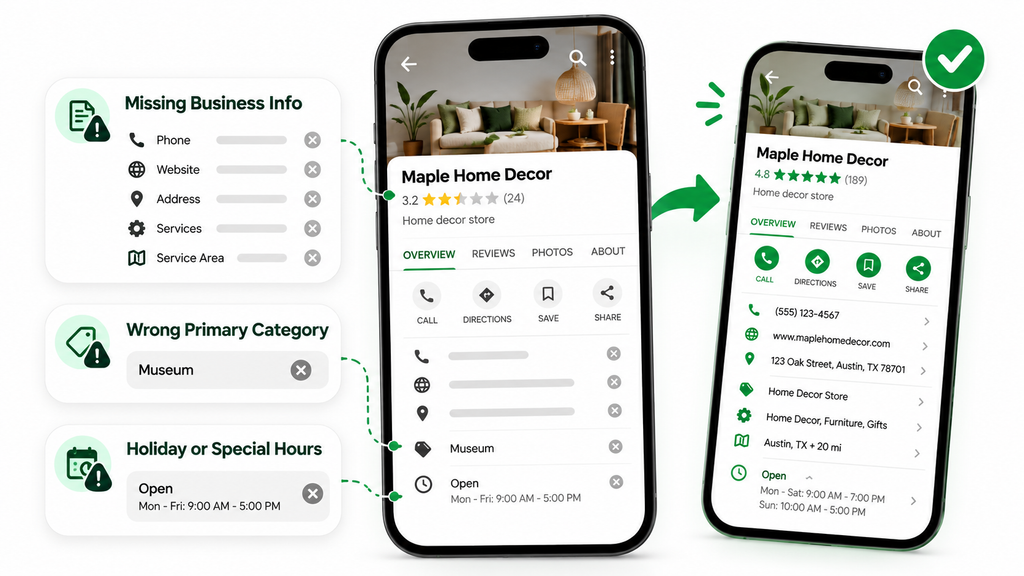
Missing Important Business Information
An incomplete profile can leave people with questions that should be easy to answer. Details such as phone number, website, address, opening hours, services, service areas, and business description should be accurate and complete wherever they apply. For service-based businesses, clearly showing where the company operates can be especially useful. Good service area optimization helps customers understand which areas are covered without making it look as though the business has offices in places where it does not.
Choosing the Wrong Primary Category
The primary category should closely reflect what the business mainly does. Choosing something too broad, inaccurate, or only loosely related can make it harder for search engines to understand the company properly. Secondary categories can add useful context, but adding every category that sounds remotely relevant is not a better approach. A smaller group of accurate categories usually makes more sense than a long list that does not properly match the business.
Forgetting Holiday or Special Hours
Regular business hours do not always apply during holidays, events, seasonal periods, or temporary closures. If special hours are not updated, customers may call or arrive when no one is available. That may seem like a small inconvenience, but it can affect trust. If the information online appears unreliable, another business with clearer details may feel like the safer option.
Mistake 2 – Using Inconsistent Business Information across the Web
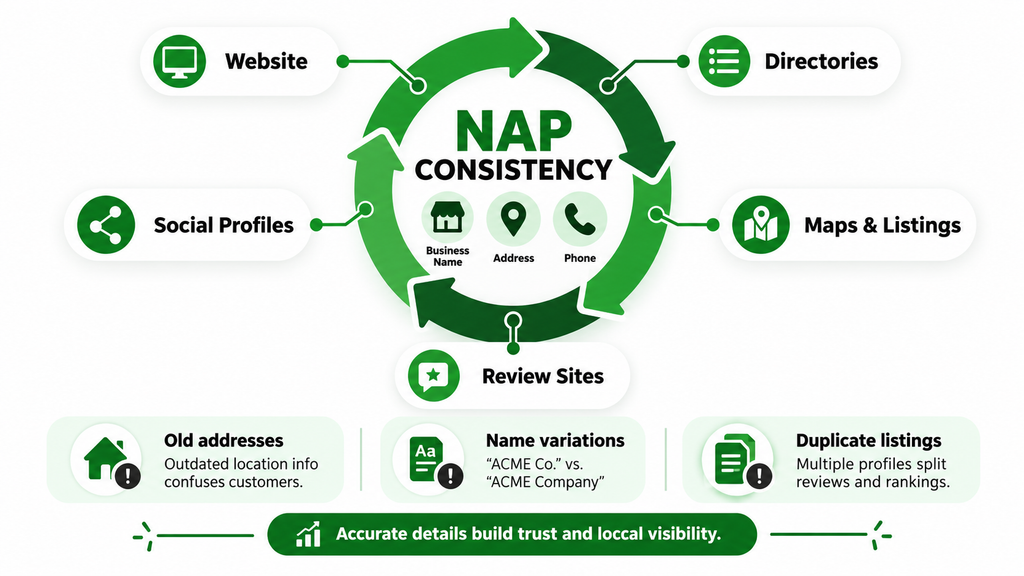
Consistency in a company’s business name, address, and phone number is commonly known as NAP consistency. These details can appear on the website, maps, social platforms, industry directories, local listings, review sites, and other third-party sources.
When different places show different information, customers may not know which version is correct. Keeping important local citations accurate gives the business a cleaner and more dependable online presence.
Old Addresses Remain in Directories
Moving to a new location does not automatically remove the old address from every directory. Older listings can stay live for years unless someone updates or removes them. It helps to search the company name along with previous addresses from time to time. The most visible and important listings should be corrected first, especially the ones customers are likely to use for directions or contact information.
Business Names Are Written Differently
Small formatting differences are not always serious, but unnecessary variations can make the business look inconsistent. One listing may use the formal company name, another may add extra service terms, and an older one may still show a previous brand name. In most cases, the business should use its real-world name consistently rather than changing it from one listing to another just to fit in extra services or locations.
Duplicate Listings Remain Active
Duplicate listings can split reviews, show conflicting details, and make it unclear which profile customers should trust. They may appear after a move, ownership change, accidental submission, or repeated directory registration. Reviewing business directory listings occasionally can help uncover duplicates that need to be corrected, merged, or removed where possible.
Mistake 3 – Targeting Keywords without Local Search Intent
Broad service terms may have a lot of search demand, but they can also be highly competitive and too general. Local customers are often looking for a specific service in a particular city, neighborhood, or nearby area.
Good local keyword targeting is about understanding how location changes what someone actually wants. It is not about adding a city name to every paragraph. The content should genuinely help people looking for that service in that place.
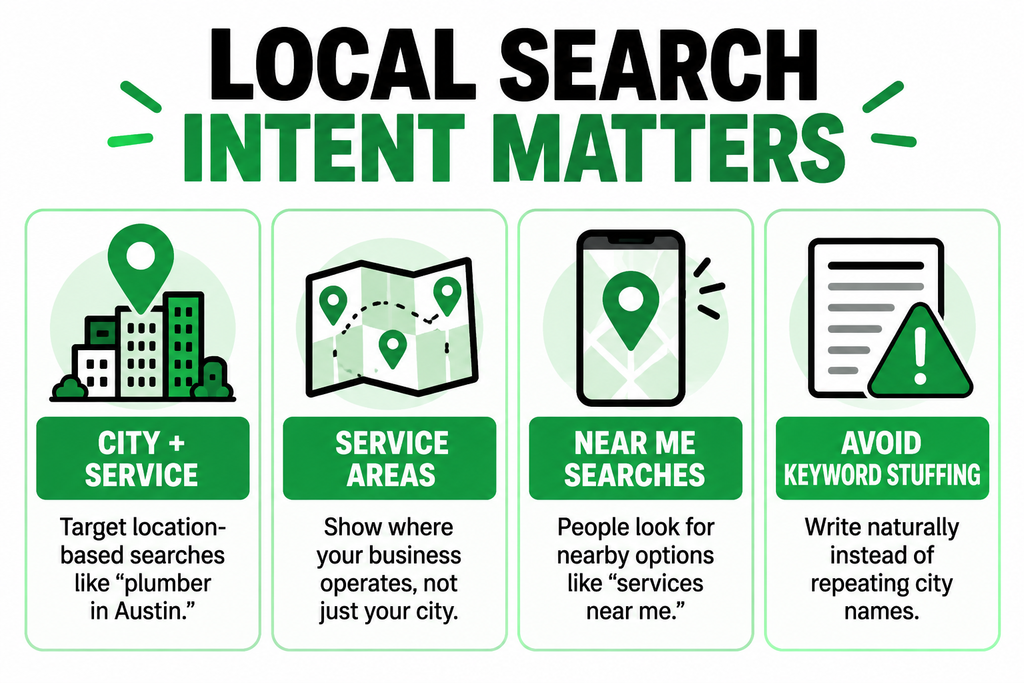
Ignoring City and Service-Area Searches
Customers often combine the service they need with a city, suburb, neighborhood, or region. If a business works in specific areas, those connections should be clear on the relevant pages. For example, a plumbing company serving several parts of a city could explain where emergency services are available instead of relying on one generic page that says nothing about coverage.
Stuffing City Names into Every Page
Repeating a city name over and over does not automatically make a page more useful. In fact, it can make the writing sound forced and difficult to read. Location references should appear where they add something meaningful. A page can talk about service areas, regional conditions, response times, nearby communities, or local details without repeating the same place name in every heading and paragraph.
Ignoring “Near Me” Search Behavior
People often use “near me” when they want something convenient and close by. Businesses do not need to repeat that phrase throughout the website to show up for those searches. Accurate location details, clear service areas, helpful pages, consistent business information, and a strong local presence can support local search visibility in a much more natural way.
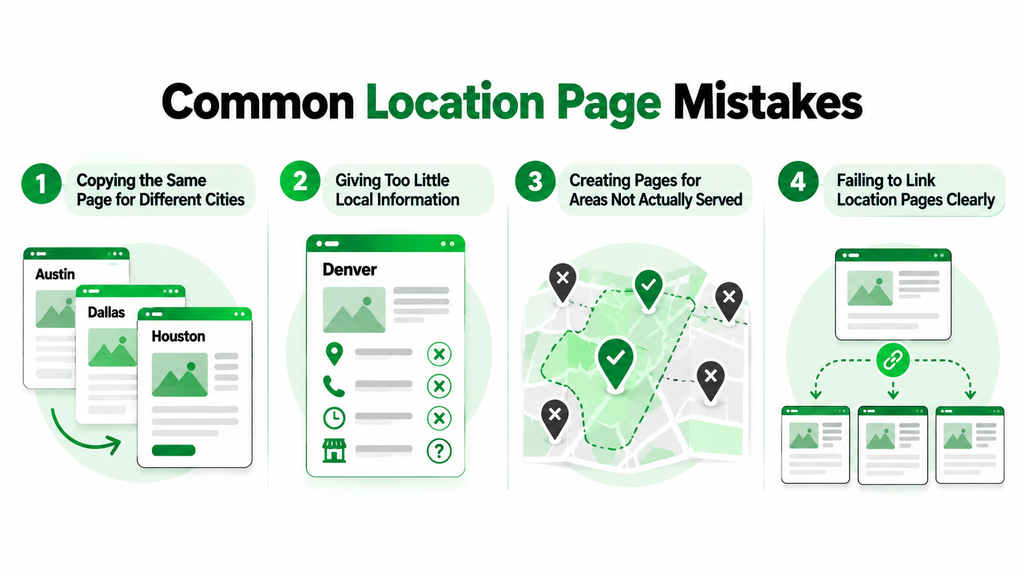
Mistake 4 – Creating Weak or Duplicate Location Pages
Businesses that serve several cities or service areas often create location pages to explain where their services are available. These pages can be useful when each one gives visitors something specific and relevant about that area. Problems begin when a website creates dozens of almost identical pages and only changes the city name.
Copying the Same Page and Changing Only the City Name
A duplicated template may increase the number of pages on the site, but it does not give visitors much new information. Search engines also gain very little from several pages that say essentially the same thing. A stronger location page should reflect real differences where possible. That may include service availability, local examples, directions, team members, travel coverage, nearby landmarks, customer needs, or completed projects.
Giving Visitors Too Little Local Information
A useful location page should help someone understand what the business offers in that area and what they need to do next. Depending on the business, useful information may include:
- Services available in that location
- Correct business or service address
- Relevant phone and contact details
- Current opening or operating hours
- Directions for customers who can visit
- Well-known nearby landmarks
- Team members serving the area
- Reviews from local customers
Not every page needs every item. A service business without a physical storefront, for example, should not add a made-up address just to make the page seem more complete.
Creating Pages for Locations the Business Does Not Actually Serve
Creating pages for places the business does not realistically serve can create a poor experience and weaken trust. Location coverage should match real operations. If customers in a certain area are unlikely to receive the service, there is little point in creating a page purely to target that location.
Failing to Link Location Pages Clearly
Even a useful page can underperform if visitors cannot find it. Location pages should be connected naturally through navigation, service pages, contact sections, location hubs, or relevant internal links. Clear linking also makes it easier for people to move between services and the areas where those services are actually available.
Practical Example: If an HVAC company works in three cities, each location page could cover the services offered there, common property types, local contact arrangements, customer feedback, and service coverage instead of repeating the same general content three times.
Mistake 5 – Treating Customer Reviews as Optional
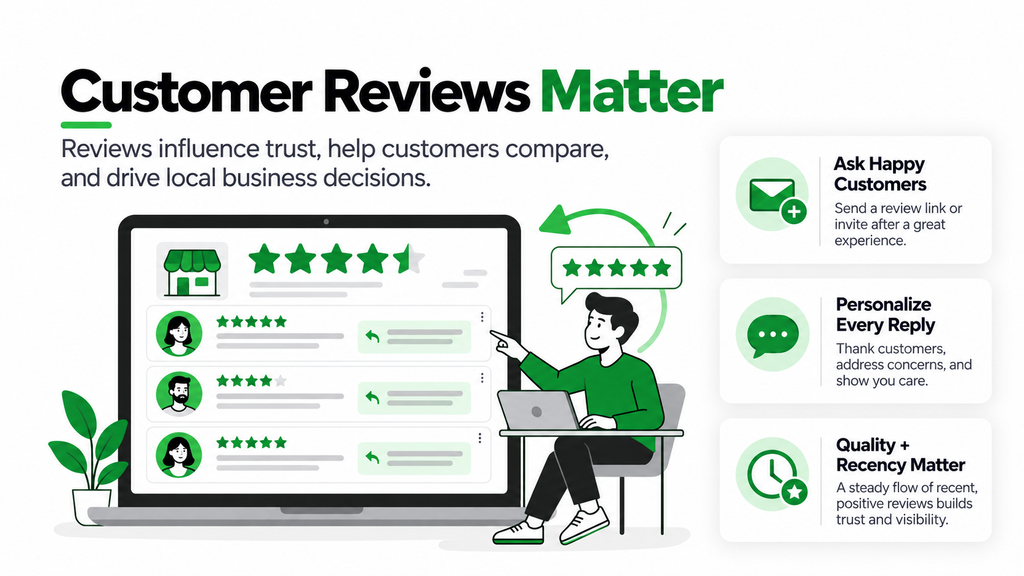
Online customer reviews can play a major role in how people judge a local business. They often influence trust, comparison, and the decision to call, book, visit, or keep looking. Reviews are not simply a reputation number. They are part of the wider local experience and should be handled as an ongoing conversation with customers.
Not Asking Satisfied Customers for Reviews
Happy customers do not always think to leave a review, even after a good experience. Businesses can make the process easier by asking for feedback after a completed service, appointment, purchase, or successful interaction. The request does not need to feel pushy. A short follow-up email or message with a direct review link is often enough.
Responding With Generic Copy-Paste Messages
Using exactly the same reply under every review can make the business feel automated. Even a small amount of personalization can show that someone actually read the feedback. The response does not need to be long. Mentioning the service or a specific part of the customer’s experience can make the reply feel far more genuine.
Focusing Only on Review Quantity
A high review count can help, but numbers alone do not tell the whole story. Recent feedback, authenticity, detail, and steady activity also matter to people comparing local businesses. A company with regular, recent reviews may look more active than one with hundreds of older reviews and very little current feedback.
Mistake 6 – Ignoring Local Website Signals
A business profile can help people discover a company, but local SEO for small businesses should not depend on one platform alone. The website gives a business much more control over how it explains its services, locations, experience, contact options, and value.
Weak website signals can make it harder for visitors to move from finding the business to actually contacting it.
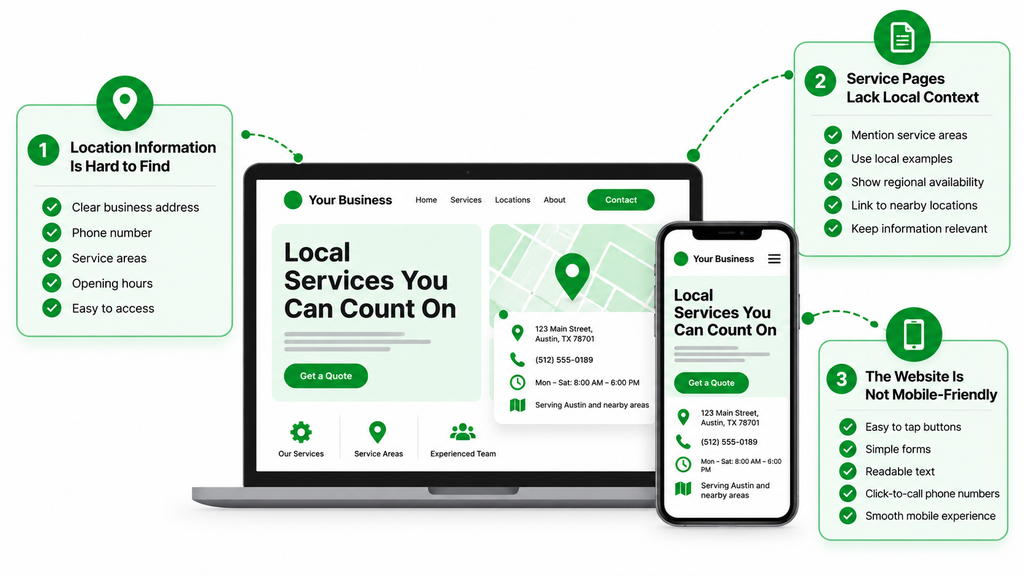
Location Information Is Hard to Find
People should not have to dig through several pages to work out where a business is based or which areas it serves. Important location details can appear on the contact page, footer, service pages, dedicated location pages, or other logical areas. The best setup depends on whether customers visit the business or the business travels to them.
Service Pages Lack Local Context
A service page may explain the service well but still fail to say where it is available. Adding useful geographic context helps people decide whether the company is relevant to them. That context could include service areas, local examples, regional conditions, availability, or links to nearby location pages instead of simply repeating the same city name throughout the copy.
The Website Is Not Mobile-Friendly
Many local searches happen on phones, especially when someone needs information quickly. A poor mobile experience can turn into a real business problem. Buttons should be easy to tap, forms should work properly, text should be easy to read, and phone numbers should be simple to call directly from the page.
Mistake 7 – Forgetting About Local Authority and Links
Strong local search rankings are not built only through keywords, profiles, and listings. Mentions and links from relevant websites can also strengthen the authority around a business. Good local backlinks often come from real business relationships, community involvement, partnerships, helpful resources, and local coverage rather than random link-building activity.
No Relationships with Relevant Local Websites
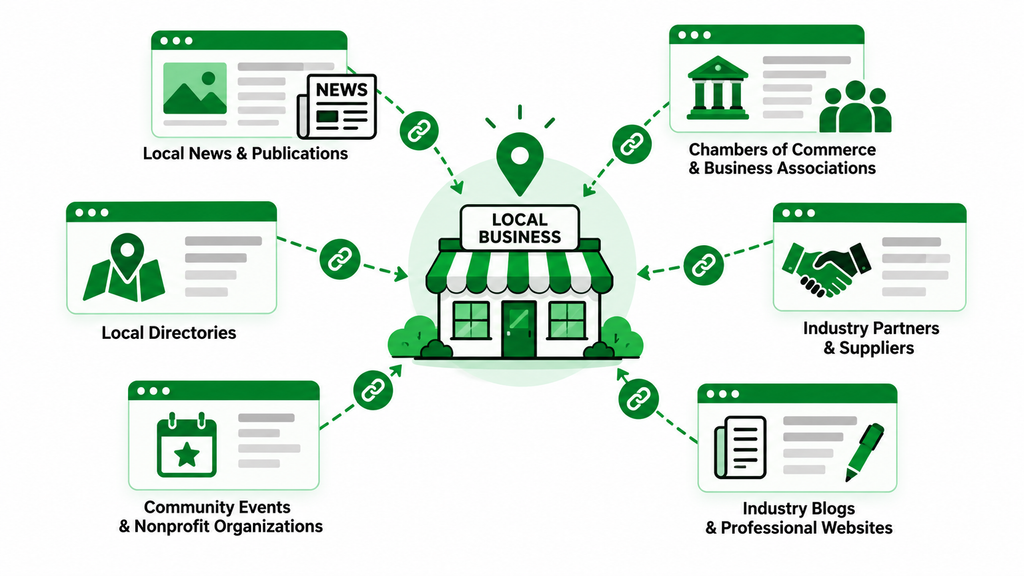
Businesses can look for genuine ways to connect with useful organizations in their area or industry. Possible sources include:
- Local business associations
- Chambers of commerce and networking groups
- Community organizations and nonprofit initiatives
- Local publications covering businesses or events
- Industry partners, suppliers, and professional groups
These relationships should make sense even without SEO. A valuable link is often the result of real involvement, not something created purely for rankings.
Relying on Low-Quality Directory Links
Submitting a business to hundreds of weak directories does not automatically build authority. Some directories are useful because customers genuinely use them or because they are relevant to a particular location or industry.
Quality and relevance matter more than collecting as many listings as possible.
Missing Local PR Opportunities
Local publications often cover community events, business developments, partnerships, milestones, expert commentary, and useful local stories. When a business has something genuinely worth sharing, reaching out to the right publications can build awareness and sometimes lead to valuable online mentions at the same time.
Ignoring Industry-Relevant Links
Local relevance matters, but industry relevance matters too. Professional associations, suppliers, manufacturers, specialist publications, partners, and educational resources may all provide legitimate opportunities for mentions. A natural mix of local and industry references usually makes more sense than depending heavily on one type of link.
Other Local SEO Problems Businesses Often Miss
The seven mistakes above are common, but smaller technical and operational issues can quietly cause trouble too. They are easy to overlook because each one may seem too minor to worry about on its own.
Watch for problems such as
- Incorrect business hours: Customers may call or arrive when nobody is available.
- Broken website links: Visitors may end up on dead pages instead of useful information.
- Old business descriptions: Outdated copy may no longer reflect current services.
- Untracked phone calls: Valuable enquiries may never appear in reporting.
- Missing schema markup: Important information may not be clearly structured for search engines.
- Poor title tags: Pages may not explain their subject clearly enough.
- Duplicate citations: Conflicting listings can make business information harder to manage.
- Incorrect service areas: Customers may misunderstand where the business actually operates.
- Unclaimed directory listings: Wrong details may stay online because nobody is managing them.
- Weak internal linking: Useful service and location pages can become harder to discover.
- Outdated images: Old visuals may no longer represent the business accurately.
- No conversion tracking: Traffic can grow without showing whether it creates real enquiries.
When several of these smaller problems happen at the same time, performance becomes harder to diagnose. A business may struggle to work out whether weaker results come from inaccurate details, technical issues, poor usability, or missing measurement.
How to Audit Your Local SEO before Making Bigger Changes
Before redesigning a website, publishing dozens of new pages, or changing the entire strategy, it helps to understand what is already working and what is not. A local SEO audit gives businesses a practical way to find existing weaknesses and decide what deserves attention first. The process does not need to begin with expensive software. Many useful checks can be done simply by looking at what customers and search engines already see.
1. Review Your Google Business Profile
Check the business name, category, address or service area, phone number, website link, opening hours, description, services, photos, attributes, and anything else that applies. Look for missing details or information that no longer matches how the business operates today. Reviews and customer questions can also highlight information people may be struggling to find elsewhere.
2. Search Your Business Name Online
Search for the exact business name and a few natural variations. Look through the results for old addresses, incorrect phone numbers, duplicate profiles, outdated pages, or listings that nobody appears to manage. This simple check can reveal what a potential customer may see before they ever reach the official website.
3. Review Important Local Landing Pages
Go through the main service, location, and contact pages. Ask whether each one has a clear purpose, accurate information, useful local context, and an obvious next step. Do not judge a page only by word count. A shorter page can still be useful if it answers the right questions, while a longer page can still feel weak if it repeats general information without actually helping the reader.
4. Compare Website and Directory Information
Create one reference document containing the correct business name, address, phone number, website, hours, and other important details. Then compare it with major external listings. Start with the platforms and directories customers are most likely to use. There is little value in fixing an obscure listing first while a major platform is still showing incorrect information.
5. Review Local Search Performance
Local performance should be measured through both visibility and real customer actions. Useful areas to review include:
- Phone calls from local visitors
- Website visits from relevant locations
- Direction requests
- Local rankings and visibility
- Leads, bookings, sales, or other local conversions
These actions help show whether stronger map pack visibility or website exposure is actually leading to something meaningful for the business.
How Small Businesses Can Build a Stronger Local SEO Foundation
Fixing problems is only part of improving small business local SEO. Businesses also need simple processes that keep information accurate and useful after the initial cleanup is done. A stronger foundation comes from several areas supporting one another rather than treating every activity as a separate SEO task.
- Optimize for Real Local Search Intent: Think about what the person searching is actually trying to do. Someone looking for emergency repair may need a phone number and immediate availability, while someone comparing professional services may want reviews, experience, pricing information, and location details. The content should help with those decisions instead of being written only around search phrases.
- Create Useful Location-Specific Pages: Location pages are worth creating when there is enough real information to make them useful. They should explain services, availability, local relevance, contact options, and anything else that helps visitors understand the business in that area. Avoid producing large groups of nearly identical pages just to cover more city names.
- Strengthen Local and Industry Authority: Take part in relevant local and professional communities. Partnerships, memberships, useful contributions, sponsorships, community involvement, and legitimate media coverage can all help build awareness and authority naturally. The goal should be to build worthwhile relationships rather than collect unrelated links.
- Measure Real Customer Actions: Visibility numbers are useful, but businesses still need to understand what people actually do after finding them. Calls, inquiries, bookings, directions, sales, and other conversions help connect SEO work with business results. Tracking local search traffic alongside those actions gives a much more complete view of performance.
All of these areas work better together. Better visibility means little if the website is frustrating to use, while a strong website may still generate limited local business if the location information is inaccurate. Good local SEO brings accuracy, relevance, authority, usability, and measurement together.
What Should You Measure to Know Whether Local SEO Is Improving?
Local SEO should not be judged by one number alone. Businesses need to look at both how visible they are and whether that visibility is leading to useful customer activity.
Important measurements can include:
- Google Business Profile views
- Phone calls
- Website clicks
- Direction requests
- Local keyword visibility
- Map pack presence
- Organic local traffic
- Form submissions
- Bookings or appointments
- Store visits where they can be measured
- Review growth and recent feedback
- Conversion rate from local visitors
Google Maps rankings and organic positions can help show whether visibility is moving in the right direction, but rankings alone do not tell the whole story. A business could improve for several searches and still see little change in enquiries.
A better measure is whether increased visibility leads to real customer actions. If calls, bookings, direction requests, form submissions, and relevant visits are also improving, the business has much stronger evidence that its local SEO work is creating value.
Final Thoughts
Local SEO problems are easy to miss because many of them seem small when looked at on their own. An outdated phone number, weak location page, unanswered review, missing internal link, or incorrect opening hour may not feel urgent at first. Over time, however, several small issues can make a business harder to find, understand, and trust. Strong local visibility comes from accurate information, useful content, consistent signals, local authority, and an experience that makes it easy for customers to take the next step.
Small businesses do not need to fix everything at once. A practical place to start is with the information customers rely on most, then move through profiles, website pages, citations, reviews, technical performance, and conversion tracking. Regular checks can stop minor problems from becoming bigger ones. Instead of chasing every new tactic, businesses are usually better served by building a reliable local foundation that helps nearby customers find the right information and act on it with confidence.
Is your business losing local visibility because of small SEO issues you have not noticed yet?
If you want to strengthen your local search presence and attract more relevant customer enquiries, Ashwani Kumar Sharma and eSign Web Services can help. From reviewing business profiles and website pages to improving local listings, content quality, and search performance, the goal is simple: identify what is holding your business back and build a stronger foundation for local visibility. Reach out today to develop a practical local SEO strategy that improves discoverability, builds customer trust, and turns better search visibility into measurable business growth.
Frequently Asked Questions
Question: What are the most common local SEO mistakes?
Answer: Common mistakes include incomplete business profiles, inconsistent names, addresses, or phone numbers, weak location pages, poor local targeting, ignored reviews, slow mobile websites, and low-quality directory listings. Businesses may also overlook outdated hours, duplicate listings, weak internal links, tracking gaps, and other smaller issues that gradually reduce local visibility.
Question: How important is Google Business Profile for local SEO?
Question: A Google Business Profile gives customers quick access to useful details such as services, opening hours, phone numbers, directions, photos, and reviews. Keeping it accurate helps create a stronger local presence. However, it works best alongside a useful website, consistent listings, good reviews, and other supporting local signals.
Question: Does inconsistent business information hurt local SEO?
Answer: Inconsistent information can create confusion when different websites show different addresses, phone numbers, business names, or opening hours. Customers may struggle to work out which details are correct. Businesses should maintain one accurate version of their main information and update important directories, profiles, and website pages whenever something changes.
Question: Do small businesses need location pages?
Answer: Location pages can be useful when a business operates from or genuinely serves several areas. Each page should offer meaningful local information rather than simply copying the same content and changing the city name. Useful details may include services, contact options, opening information, directions, reviews, team members, and location-specific service details.
Question: How do reviews affect local SEO?
Answer: Reviews help potential customers judge reputation, service quality, and recent customer experiences before getting in touch. A steady flow of genuine feedback can strengthen trust and give the business useful insight. Companies should encourage honest reviews, respond professionally to feedback, and avoid focusing only on the total number of reviews.