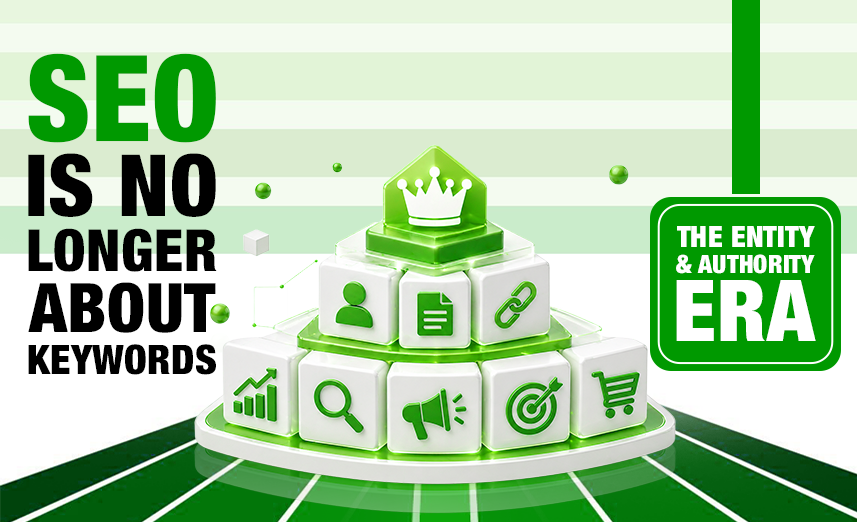
SEO has entered a more intelligent era, and that shift is changing the rules of visibility. Rankings are no longer driven by keywords alone. Search engines are now far better at understanding meaning, context, relationships between topics, and the credibility of the source behind the content. That changes what strong optimization looks like. For small businesses, startups, agencies, and marketing teams, success now depends less on repeating the right phrase and more on building content that is clear, connected, and trustworthy. The pages that perform well today are not simply optimized for search terms; they are designed to help search engines fully understand the subject. They define the topic clearly, connect it to related ideas, and demonstrate enough expertise to deserve attention.
That is why entity-based SEO has become such an important shift in modern search strategy. Instead of treating each keyword like a separate target, businesses now need content ecosystems that show who they are, what they offer, and how their expertise fits into the larger conversation. With AI-generated answers, semantic search, and zero-click behavior reshaping how users interact with search results, the message is becoming clearer by the day: visibility is no longer built on keyword placement alone. Keywords still matter, but authority, structure, and context now play a much bigger role in determining who gets seen.
From Keywords to Entities: The Evolution of SEO
SEO did not transform overnight. It evolved through clear stages, and each stage reshaped how search engines evaluate relevance, understand intent, and decide which pages deserve visibility, trust, and stronger rankings in an increasingly context-driven and authority-focused search environment.
Step 1: Search began with keyword matching
In the early SEO era, search engines relied heavily on exact-match phrases, so pages often ranked well simply by repeating the target keyword more often than competitors.
Step 2: Search engines started understanding intent
Search gradually improved at identifying what users actually wanted, which meant relevance depended less on exact wording and more on whether the page answered the query properly.
Step 3: Semantic search changed the game
Search engines began connecting related words, phrases, and subtopics, allowing them to understand broader meaning and reducing their reliance on rigid, repetitive keyword placement.
Step 4: Entities became more important than isolated words
Modern search systems started recognizing real-world concepts like brands, products, services, people, and places, helping them understand relationships far beyond simple keyword usage.
Step 5: Context and authority now shape visibility
Today, pages rank better when they show topic depth, clear relevance, strong trust signals, and enough authority to prove they deserve long-term search visibility.
That is the real evolution of SEO. Search has moved from matching words to understanding meaning, and that is exactly why modern optimization now depends more on clarity, context, and authority than on keyword repetition alone.
What Is Entity-Based SEO?
At its best, entity-based SEO makes a page impossible to misunderstand. It helps search systems identify what the page is about, who it serves, how it connects to related topics, and why it deserves visibility in both classic and AI-driven search results.
- Clear topic definitions reduce ambiguity and help search engines interpret content with stronger confidence.
- Structured headings, schema, and authorship cues provide machines with clearer signals about page meaning.
- Consistent terminology across pages strengthens entity signals to Google and reinforces semantic relationships sitewide.
- A smart entity SEO strategy keeps your offer, audience, and authority aligned across every key page.
- Better structure often improves click performance, visibility, and richer result eligibility in search.
In simple terms, this is about saying one thing clearly and supporting it everywhere else. That is why semantic SEO strategy matters so much: it turns scattered messaging into a recognizable system, and that system gives search engines a stronger reason to trust your topic, your site, and your authority over time.
SEO Evolution: From Keywords to Entities
| SEO Stage | Primary Focus | How Search Engines Evaluated Content | Modern Impact |
|---|---|---|---|
| Keyword Matching Era | Exact-match keywords | Counted keyword usage and page optimization signals | Limited understanding of context |
| Search Intent Era | User intent | Evaluated whether content answered the query effectively | Improved relevance beyond exact phrases |
| Semantic Search Era | Topic relationships | Connected related words, phrases, and concepts | Reduced dependence on keyword repetition |
| Entity-Based Search Era | Entities and relationships | Identified brands, products, people, services, and places | Improved contextual understanding |
| Authority & AI Era | Expertise, trust, and context | Evaluates topical authority, E-E-A-T, and entity signals | Drives visibility in AI-powered search results |
Why Is Authority Replacing Keyword Focus?
Authority does not come from publishing more pages. It comes from publishing the right pages with enough depth, connection, and intent that your site starts feeling like a reliable source instead of a content lottery ticket.
- One strong page can rank, but multiple connected pages build stronger trust and deeper topic coverage.
- Topical authority SEO grows when a site covers the main questions and important follow-up questions well.
- A clear content clusters strategy helps users and search engines navigate expertise more naturally.
- Topical clusters in SEO work because they build structure, reduce overlap, and improve semantic support.
- Authority grows stronger when relevance spreads across a domain rather than sitting on a single page.
That is why I see topic coverage as a business asset, not a blogging tactic. The goal is not to publish endlessly; it is to create an ecosystem where every page sharpens the others. That is exactly where entity-based SEO and topical authority SEO start compounding in a way isolated content never can.
Role of E-E-A-T in the Entity Era
A page can define a topic well and still feel weak if the source behind it looks uncertain. That is where trust becomes the deciding factor, because search engines increasingly care about who is speaking and why they should be believed.
- Real experience adds weight that polished, generic writing usually cannot convincingly fake.
- Visible author names, credentials, and profiles strengthen credibility for readers and search systems.
- E-E-A-T SEO matters because expertise without proof often feels like marketing, not authority.
- Reviews, references, transparency, and dates all strengthen user confidence and perceptions of trust.
- Strong authority signals SEO make content easier to trust, cite, surface, and remember.
This is why credibility should never sit in the footer like an afterthought. It should live inside the content itself. When expertise is visible, evidence is clear, and authorship is obvious, entity-based SEO becomes much stronger because the topic is not only understandable, but also believable, and that changes everything.
How AI Is Accelerating Entity-Based SEO
AI search did not create the move toward entities, but it absolutely made the shift louder, faster, and harder to ignore. In a world of summaries and answer boxes, clarity now decides whether your content gets used at all.
- AI systems rely on structured meaning, not vague writing, to generate accurate contextual answers.
- SEO in the AI era demands pages that define topics clearly and back them up with evidence.
- AI search optimization works better when the content is easy to extract, summarize, and trust.
- AI Overviews reaching over 1 billion users prove that answer-first search is already mainstream.
- Ahrefs found that AI Overview presence was associated with a 34.5% lower CTR on top-ranking pages.
That is why a modern entity SEO strategy is no longer optional for brands that want durable visibility. If search behaves more like a responder than a directory, then content must become easier to understand before the click even happens, and entity-based SEO is one of the clearest ways to make that possible.
Common Mistakes in Modern SEO Strategy
The biggest SEO mistake today is not using keywords. It is treating keywords like the final answer. That mindset creates awkward pages, weak topic coverage, and content that feels optimized for algorithms from another decade.
- Repeating phrases without adding value limits clarity, authority, and long-term relevance.
- Weak entity definitions make pages harder to understand, trust, and connect semantically.
- Fragmented content prevents the authority from building across related pages and supporting topics.
- SEO beyond keywords fails when structure, proof, and context are ignored.
- Stronger context-based SEO starts with content built as a connected system.
That is the real fix: stop publishing pages like separate islands and start building them like part of one bigger authority map. In a search environment shaped by zero-click behavior, AI summaries, and trust-driven visibility, better topical authority SEO and stronger entity-based SEO come from strategy, not volume.
Wrapping It Up
SEO is no longer won by repeating the right phrase more often than everyone else. It is won by making your content easier to understand, trust, and connect across a broader topic ecosystem. Keywords still matter, but they now work best as signals within a stronger framework built on context, entity clarity, topical depth, and authority. Businesses that continue treating SEO as a keyword-only exercise will struggle to keep pace with modern search behavior. The brands that adapt will be the ones creating content that feels useful, credible, and well-structured from start to finish. As search engines and AI systems become better at interpreting meaning, the advantage will belong to businesses that make expertise clear and value hard to miss.
Ready to Build SEO That Lasts?
If you want an SEO strategy built on clarity, authority, and long-term performance, Ashwani Kumar Sharma and eSign Web Services can help. From stronger content structures to entity-focused optimization and smarter topical planning, the goal is simple: build visibility that keeps compounding. Reach out today to create an SEO foundation that earns trust, improves discoverability, and turns better strategy into measurable business growth across search, AI overviews, and your market.
Frequently Asked Questions (FAQS)
Question: What is entity-based SEO?
Answer: Entity-based SEO focuses on optimizing content around real-world concepts such as people, brands, products, and topics rather than relying only on keywords. Search engines use entities to understand relationships and context more effectively. This approach helps algorithms deliver accurate results by connecting related information. Clearly defining entities within content improves visibility across multiple queries. It also supports inclusion in AI-generated answers and knowledge graphs. Entity-based SEO aligns with modern search behavior, where meaning matters more than keyword matching. Businesses adopting this approach build stronger authority, improve relevance, and achieve sustainable search performance in evolving digital environments.
Question: How is entity-based SEO different from traditional keyword SEO?
Answer: Traditional SEO focuses on matching keywords with search queries, while entity-based SEO emphasizes understanding concepts and relationships. Keyword SEO relies on exact phrases and density, whereas entity SEO prioritizes context, meaning, and relevance. Search engines now interpret topics through entities, making content more flexible and comprehensive. This shift reduces dependency on exact keywords and improves accuracy in results. Entity-based SEO also supports AI-driven search systems that generate answers rather than listing links. By focusing on entities, businesses can create content that ranks across multiple related queries instead of targeting individual keywords separately.
Question: Why are keywords no longer enough for SEO success?
Answer: Keywords are no longer enough because search engines have evolved to understand intent and context rather than exact matches. Relying solely on keywords limits content relevance and restricts visibility. Modern algorithms evaluate meaning, relationships, and user satisfaction. Content that focuses only on keywords may fail to address broader user needs. Entity-based strategies provide deeper coverage and improve authority. Keywords still support discovery, but they must be integrated within a larger context. Businesses that move beyond keyword-only approaches can achieve better rankings, stronger engagement, and improved inclusion in AI-driven search experiences.
Question: What is topical authority and why does it matter?
Answer: Topical authority refers to the level of expertise a website demonstrates within a specific subject area. It is built by consistently publishing high-quality, comprehensive content covering all relevant aspects of a topic. Search engines favor websites that show depth and consistency. Strong topical authority improves rankings across multiple related queries, not just individual keywords. It also enhances trust and credibility. Building authority requires content clusters, internal linking, and continuous updates. Websites with strong topical authority are more likely to be featured in AI-generated results and maintain long-term visibility.
Question: How do entities help search engines understand content better?
Answer: Entities help search engines identify and connect real-world concepts within content. Instead of analyzing words in isolation, search engines recognize entities such as brands, people, and topics. This allows them to interpret relationships and context more accurately. Clear entity definition improves indexing and relevance. It also helps search engines match content with user intent more effectively. By using consistent terminology and structured information, businesses can strengthen entity signals. This improves visibility across multiple queries and enhances inclusion in AI-generated answers where contextual understanding is essential.
Question: What role does E-E-A-T play in entity-based SEO?
Answer: E-E-A-T stands for Experience, Expertise, Authoritativeness, and Trustworthiness. It plays a critical role in entity-based SEO by validating content credibility. Search engines evaluate whether content is created by knowledgeable sources and whether it provides reliable information. Strong E-E-A-T signals improve rankings and increase trust. This includes author credentials, real-world experience, and transparent information. In entity-based SEO, E-E-A-T strengthens authority signals and improves content relevance. Businesses that demonstrate expertise and trust are more likely to achieve consistent visibility and perform well in AI-driven search environments.
Question:How do content clusters support entity-based SEO?
Answer: Content clusters organize related topics around a central theme, improving semantic relationships. Each cluster includes a main pillar page supported by detailed subtopics. This structure helps search engines understand topic depth and connections. Internal linking strengthens navigation and authority. Content clusters improve relevance across multiple queries and enhance topical authority. They also provide better user experience by guiding readers through related information. In entity-based SEO, clusters reinforce entity relationships and improve contextual understanding. This approach increases visibility and supports long-term performance across search results.
Question: Can entity-based SEO improve rankings in AI-generated search results?
Answer: Yes, entity-based SEO improves visibility in AI-generated search results by enhancing contextual clarity. AI systems rely on entity relationships to generate accurate responses. Content with clear entity signals is easier to interpret and extract. This increases the likelihood of being included in summaries and answers. Structured data further supports AI understanding. Entity-based SEO also improves authority and trust signals, which influence selection. As AI-driven search becomes more dominant, optimizing for entities ensures content remains relevant and visible. Businesses adopting this approach gain competitive advantage in modern search environments.
Question: What are common mistakes in entity-based SEO implementation?
Answer: Common mistakes include focusing only on keywords, ignoring entity relationships, and creating fragmented content. Lack of consistency in terminology weakens entity signals. Many businesses fail to build content clusters, limiting authority. Overlooking structured data reduces clarity for search engines. Another mistake is neglecting E-E-A-T signals, which impacts credibility. Some strategies focus on quantity rather than depth, reducing effectiveness. Successful implementation requires structured planning, consistent messaging, and comprehensive topic coverage. Avoiding these mistakes ensures stronger relevance, better rankings, and improved performance in AI-driven search environments.
Question: How can businesses start implementing entity-based SEO strategy?
Answer: Businesses can start by identifying core topics and defining key entities relevant to their industry. Creating content clusters around these topics builds authority. Using consistent terminology improves entity recognition. Implementing structured data helps search engines interpret content. Internal linking strengthens relationships between pages. Demonstrating expertise through detailed insights enhances credibility. Regular content updates ensure relevance. Monitoring performance helps refine strategy. Combining these steps creates a strong foundation for entity-based SEO. This approach improves visibility, supports AI-driven search inclusion, and delivers long-term growth in evolving digital landscapes.